
By Lehlohonolo Lehana.
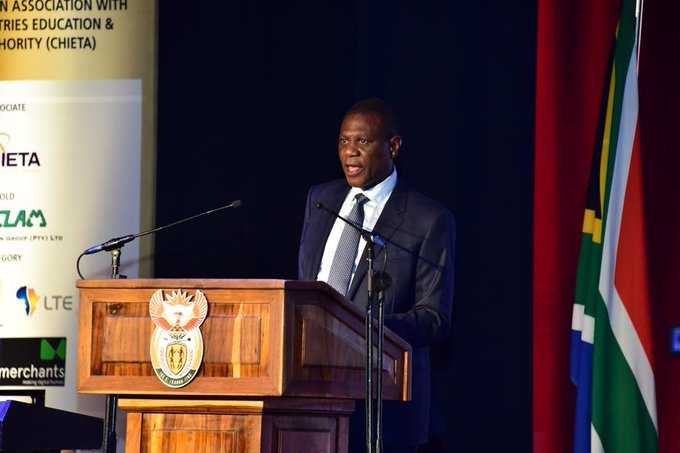
Deputy President Paul Mashatile has called on social partners to work with government to deal with the country’s pressing issues, especially unemployment.
Mashatile took to the podium at the National Economic Development Labour Council’s (NEDLAC) 28th Annual Summit in Johannesburg on Friday to reflect on the COVID-19 pandemic, which he said intensified economic setbacks, resulting in high unemployment and loss of jobs.
He also spoke about the current condition of the labour market, which he believes is indicative of the legacy of apartheid.
“We have inherited a labour force characterised by racial and gender inequities, skills shortages and high unemployment rates, particularly among Africans,” he told the delegates.
He welcomed the decline in the unemployment rate to 32.6% in the second quarter of this year, this is down from 32.9% in the first quarter.
“The best that can be said here is that the trend is heading in the right direction, albeit at a slow pace. Serious concerns such as job losses in manufacturing remain.
“In this regard, organised business, labour, government and the community sector at NEDLAC have turned to each other to seek ways of turning our economy around, reversing unemployment and building inclusive growth.”
Through collective efforts, one purpose and shared values, he said, they hold the power to determine the trajectory of South Africa.
Mashatile cited President Cyril Ramaphosa who has called for a social compact between the government and the social partners in his 2022 State of the Nation Address.
He noted that NEDLAC has historically sought to collaborate about the big policy choices that face the country.
“However, in South Africa, where unemployment is so high and those who work support many of those who do not, this type of trade-off may be difficult to attain. The most pressing challenge appears to be one about ideological positions among social partners with respect to the path to growth, which have not shifted despite the enormous crisis the country faces.
“We must summon enough bravery to discuss this matter openly in order to prevent the ticking time bomb of poverty, inequality and joblessness from going off. This is not impossible to achieve.”
He also urged social compacts to avoid being mere “talk shops”.
“NEDLAC has a responsibility to demonstrate to the nation that there can be win-win situations and that we can proceed with the best potential or least worst outcomes.”
The summit also highlighted Nedlac’s constraints as a policy-formulating body to ensure legislative reform.
Employment and Labour Minister Thembelani Thulas Nxesi said some legislative reforms discussed included improving the functioning of the Labour Court, which has experienced severe backlogs and overworked judges.
“The issue of backlogs at the labour court has compromised workers with few overworked judges. Cases have gone three to four years because there are no judges,” said Nxesi.
Nedlac executive director Lisa Seftel says the partners mostly agree on what needed to be done in the short term, but they do not agree on the long-term programme to turn the economy around.
“Bill implementation is taking too long. The bigger problem is that the government is not tabling the bills,” said Seftel.
Only a third of bills since 2015/16 that have passed through Nedlac have become law.
Watch Live in the video below:
Video Courtesy of GCIS.