
By Lehlohonolo Lehana.
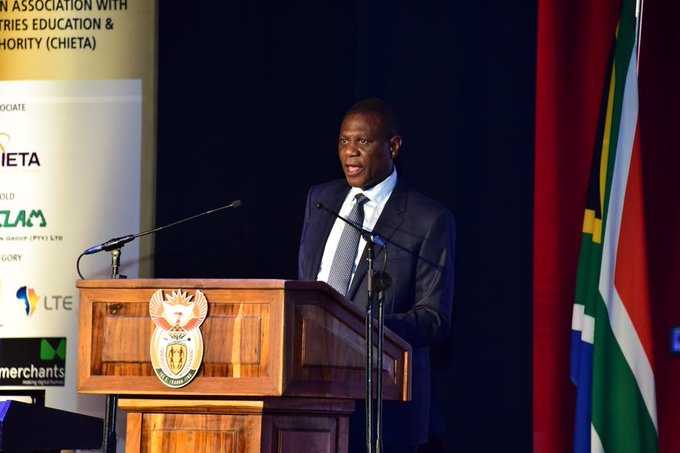
Deputy President Paul Mashatile says the issue of land claims is sensitive and needs to be treated with the utmost urgency it deserves.
Mashatile was on Friday responding to questions in the National Assembly on progress achieved by government in resolving land claims, as part of the land reform programme.
Speaking to Members of Parliament (MPs), he said as of June this year, there were 5 407 outstanding old order claims instead of the 6 600, as indicated by a Parliamentarian, who had posed a question to the Deputy President.
“There has been some movement now that is taking place,” he assured MPs.
The Deputy President said government has since adopted several interventions to support the acceleration of land reform programmes.
This, according to Mashatile, includes the Expropriation Bill that is currently being considered by the National Council of Provinces.
“The Land Court Amendment Bill, which includes provisions for communal land transfer, registration, title and appointment of a land rights enquirer, has been sent to the President for assent.”
The bill, Mashatile explained, aims to regulate the administration and use of communal land by communities within the framework of the applicable laws, including spatial planning and land use management.
The Deputy President noted the revision of the Property Valuation Act to provide for the precise scope of the Office of the Valuer-General and methodology to determine just and equitable compensation.
In addition, the State is identifying land needs within cities and towns to inform the land reform programme, prioritising land needs for human settlements, and industrial, economic and urban agricultural development.
This move, the Deputy President, aims to change spatial patterns and enhance socio-economic advancement.
He told MPs that the Inter-Ministerial Committee on Land Reform and Agriculture will continue to review the best plausible options to improve the overall financing of the Backlog Reduction Strategy, as introduced by the Commission.
The Deputy President believes that this will help to accelerate the settlement of old order claims so that government can resolve this matter within a reasonably shorter period.
SA reiterates support for continental initiatives
Mashatile has emphasised that South Africa is committed to supporting all regional and continental initiatives to silence the guns on the continent, in support of Agenda 2063.
“We will continue to support the Intergovernmental Authority on Development (IGAD) and African Union-led initiatives aimed at ensuring peace and prosperity in South Sudan and the Horn of Africa,” Mashatile said.
He said the visit to South Sudan enabled him to familiarise himself with the South Sudan peace process and its challenges.
The Deputy President held extensive and fruitful discussions with President Salva Kiir Mayardit and met with the First Vice President of the Republic of South Sudan and leader of Sudan People’s Liberation Movement-In Opposition, Dr Riek Machar; Vice President Taban Deng Gai; Vice President Dr. James Wani and Vice President Hussein Abdelbagi, among other stakeholders.
During these discussions, Mashatile highlighted that the key issue Sudanese actors and others raised was the need to fully implement the Transitional Security Arrangements contained in Chapter 2 of the Revitalised Agreement on the Resolution of Conflict in the Republic of South Sudan.
“The South Sudanese have requested assistance from South Africa in this area, and the Departments of Defence and Police will be consulted regarding assistance in implementing Chapter 2, including a holistic Disarmament, Demobilisation and Reintegration process.
“South Africa is committed to supporting South Sudan to conclude the implementation of the revitalised transitional phase to hold peaceful national elections by December 2024,” the Deputy President said.
Mashatile told MPs that another outstanding issue is the promulgation of electoral and political party legislation to enable the reconstitution of electoral institutions such as the National Elections Commission (NEC) of South Sudan.
To prepare for the organisation of national elections by December 2024, he said, the NEC will require capacity building and training for its officials. In addition, it was noted that substantial electoral funding will be required, particularly if national, provincial and local elections will take place simultaneously.
South Sudan is due to undertake a permanent constitution-making process under Chapter 6 of the R-ARCSS.
The Deputy President noted that this process attaches with substantial legal work and is necessarily time-consuming.
He said a broader nationwide consultative process must still be undertaken to build on the modest work already commenced.
South Sudan further requires assistance with Transitional Justice matters and Judicial Reconstitution and Reforms under Chapter 5 of R-ARCSS, which focuses on Transitional Justice, Accountability, Reconciliation and Healing.
Service delivery issues in local government
Mashatile has assured Members of Parliament (MPs) that the State is attending to issues facing local government.
The Deputy President on Friday said the challenges are multi-dimensional and primarily rooted in governance, institutional capacity, poor financial management and political instability.
“To this end, we have conducted oversight visits to six provinces to ensure that we resolve the challenges of poor governance and lack of service delivery in these areas,” he said.
Mashatile said outreach programmes were conducted in North West, Gauteng, Free State, KwaZulu-Natal, Mpumalanga and the Northern Cape.
“This was to ensure that we resolve challenges of poor governance and lack of service delivery in these areas,” he explained, adding that they also identified areas of improvement for coordinating service delivery related to infrastructure backlogs and essential services.
The Department of Cooperative Governance and Traditional Affairs (COGTA) has identified 66 out of 257 municipalities as those that need support.
The State, Mashatile said, is also working through the District Development Model (DDM) to improve intergovernmental relations on policy planning, budgeting and execution.
“Together with the Department of COGTA, we established what we call the Result Management Office (RMO), which will be used to strengthen this work.”
The RMO will focus on ensuring that municipalities improve service delivery with support and capacity from the war room.
It will also act as an engine for integrated service delivery that links to the community, coordinates profiles and integrates service delivery.
Watch Live in the video below:
Video Courtesy of Presidency.