
By Lehlohonolo Lehana.
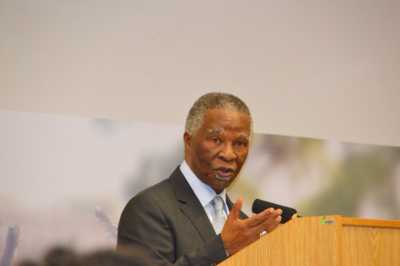
Former president Thabo Mbeki slammed the lack of service delivery, saying there was a major disconnect between ordinary citizens and those in authority.
The Chancellor of Unisa and Patron of the Thabo Mbeki Foundation, was speaking during the South African Association of Public Administration and Management’s (SAAPAM) annual conference in Ekurhuleni.
The conference was held under the theme, ‘Repositioning African Governments in the Changing Global Order and Disorder.’
Mbeki, who delivered his address virtually, urged delegates to use the conference as an opportunity to reflect on the state of the country and ask the right questions.
Mbeki emphasised that South Africa is in steep decline, a case which should also bother conference attendees.
“I therefore hope that this conference will pose and answer this question honestly. What contribution, if any, have the public administration and management made to the steep decline?
“And what contribution can and should the public administration and management make to pull our country out of the steep decline and place it on the opposite trajectory?”
“The mission statement of the South African Association of Public Administration and Management (SAAPAM) is to encourage and promote good governance and effective service delivery through the advancement of professionalism, scholarship, and practice in public administration and management.
“Obviously, the question arises, does the fact that our country is in steep decline mean that SAAPAM has failed in its task to encourage and promote effective governance?” he asked.
Mbeki also painted a dire picture of South Africa’s future, warning the situation could get worse if there is not a functioning government.
“Here we have this receding power of the state, its loss of authority and credibility, its inability to translate plans into action, and the growing disconnect between the ruling elite and those they govern, and this is where South Africa’s greatest opportunity for the future is to be found, in its innovative and resilient private sector and civil society, which are solving problems in the growing absence of the state and doing so successfully.
“In years to come, South Africa will become a case study of how private initiative succeeds where states fail,” said Mbeki.
He warned that South Africa’s public administrations and management are already collapsing, leaving the responsibility of solving problems to civil society and the private sector
“In political science, this is characterised as a counter-revolution, and a counter-revolution is not innocent, but in our case, a direct threat to our democratic state and the welfare and wellbeing of millions of our people.”
Mbeki said the negative observation about the democratic state is, in essence, a negative comment about the place and role of South Africa’s public administration and management.
“It calls for the right response from public administration and management themselves. I would like to imagine that most of us present and participating at this conference have read the 2007 seminal book by Naomi Klein entitled ‘The Shock Doctrine: The Rise of Disaster Capitalism’.
“I am mentioning this book because it dramatically analyses and exposes what is identified as our country’s destination.”
The SAAPAM conference aims to contribute towards the development of good governance and effective service delivery.
“As the state becomes less and less capable, it is being increasingly bypassed by private actors. This process has been underway for a considerable amount of time already. Those who can afford it rely on private healthcare and schooling of a quality far higher than that provided by the state. In the absence of reliable electricity from the state-owned utility, those who can afford it install solar power on their roof tops, “Mbeki said.