
By Kevin Rademeyer.
Sunday at Roland-Garros delivered something extraordinary. Two modern titans stood across the net, vying for the coveted Coupe des Mousquetaires in a battle that might just go down as the greatest Grand Slam final of them all.
The era of the Big Three may be behind us, but on this electric Parisian evening, tennis found a new summit, one scaled by two young men with hearts as fierce as their forehands.
“Where were you when…?” Already the question rings through commentary boxes, message boards, and locker rooms. It’s the kind of moment that doesn’t just make history—it bends time around it. Because what unfolded on the final Sunday of Roland-Garros 2025 wasn’t merely a match; it was a five-hour, 29-minute marathon of heart, grit, and genius. A duel that pushed two of the sport’s brightest stars past the edge of exhaustion and into the annals of legend.
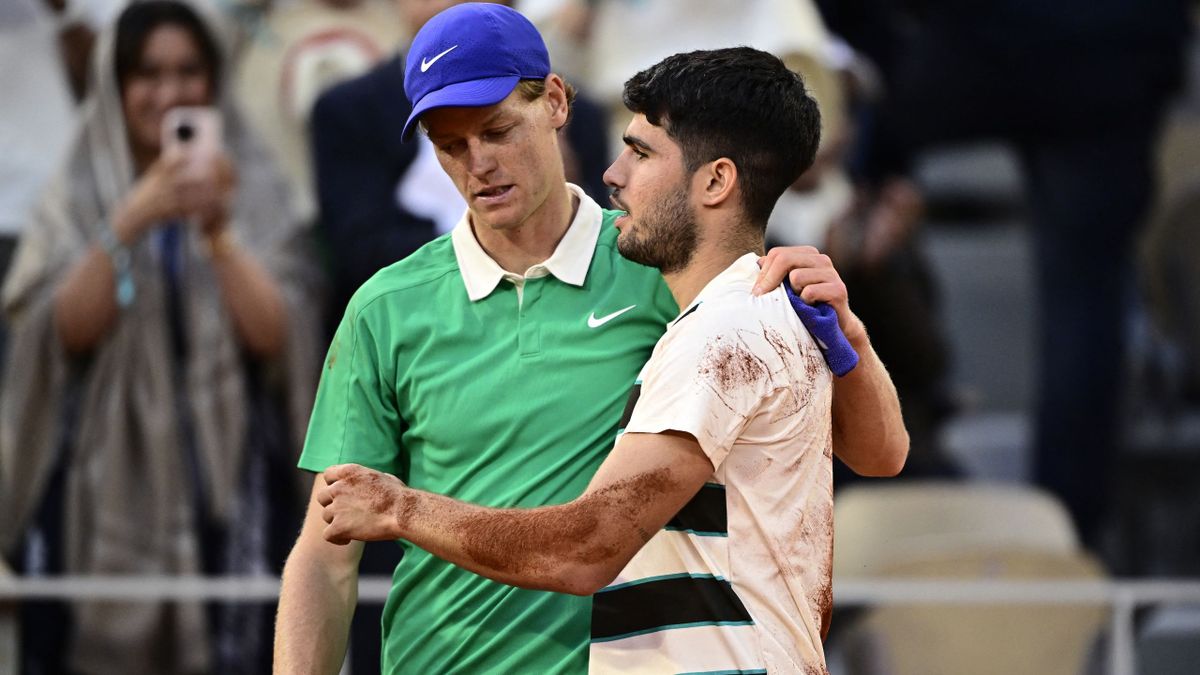
Carlos Alcaraz’s titanic comeback win over Jannik Sinner, 4-6, 6-7(4), 6-4, 7-6(3), 7-6(10-2),, after facing three successive championship points in the fourth set, wasn’t merely the longest French Open final in history. It was the embodiment of everything tennis can be, cruel, beautiful, nerve-shredding, and ultimately, euphoric.
High in the Philippe-Chatrier commentary box, one veteran announcer, overcome with emotion, broke with custom and declared: “There is no game like Tennis, I love it” , For once, there was no need for restraint. The words were as honest as the sweat-drenched shirts of the warriors below.
This was the first Grand Slam final between Sinner and Alcaraz, but their 12th meeting overall. A rivalry already rich in plot lines has now crowned a chapter that will be studied for generations. It had everything: contrasting styles, championship points saved, and the kind of mental resilience that borders on spiritual.
Sinner had been supreme all fortnight, dispatching Novak Djokovic in the semis and arriving in the final with a staggering 47-2 record since August, both losses, notably, to Alcaraz. When the Italian built a two-set lead and earned triple match point at 5-3 in the fourth, the match seemed his. But in that moment, when defeat looked inevitable, Alcaraz breathed deep, served with bravery, and found shots that defied physics.
He didn’t just survive, he took flight. The Spaniard’s comeback from two sets down, a first in his career, was forged in the furnace of belief. By the time he sealed the championship with a dominant 10-2 tiebreak, the 22-year-old had joined tennis royalty.
He is now the third-youngest man to win five Grand Slam titles, trailing only Björn Borg and Rafael Nadal. He is also the eighth man in the Open Era to defend a Roland-Garros crown.
There were scenes of heartbreak too. Sinner, ever gracious, was consoled by none other than 1999 champion Andre Agassi. For the world No. 1, this was a loss of inches and millimetres, a brutal reminder that even the smallest lapse against Alcaraz can be fatal.
The emotions behind the scenes were almost as intense. Tournament Director Amélie Mauresmo stood “speechless” amidst the tears and embraces, later saying she’d toast the fortnight with a deserved glass of red.
It all began with a touching tribute to Rafael Nadal, the ‘King of Clay,’ whose plaque now adorns Court Philippe-Chatrier. It ended with Alcaraz honouring the same legacy, not by mimicry but through his own, fearless brand of shot-making and willpower.