
By Lehlohonolo Lehana.
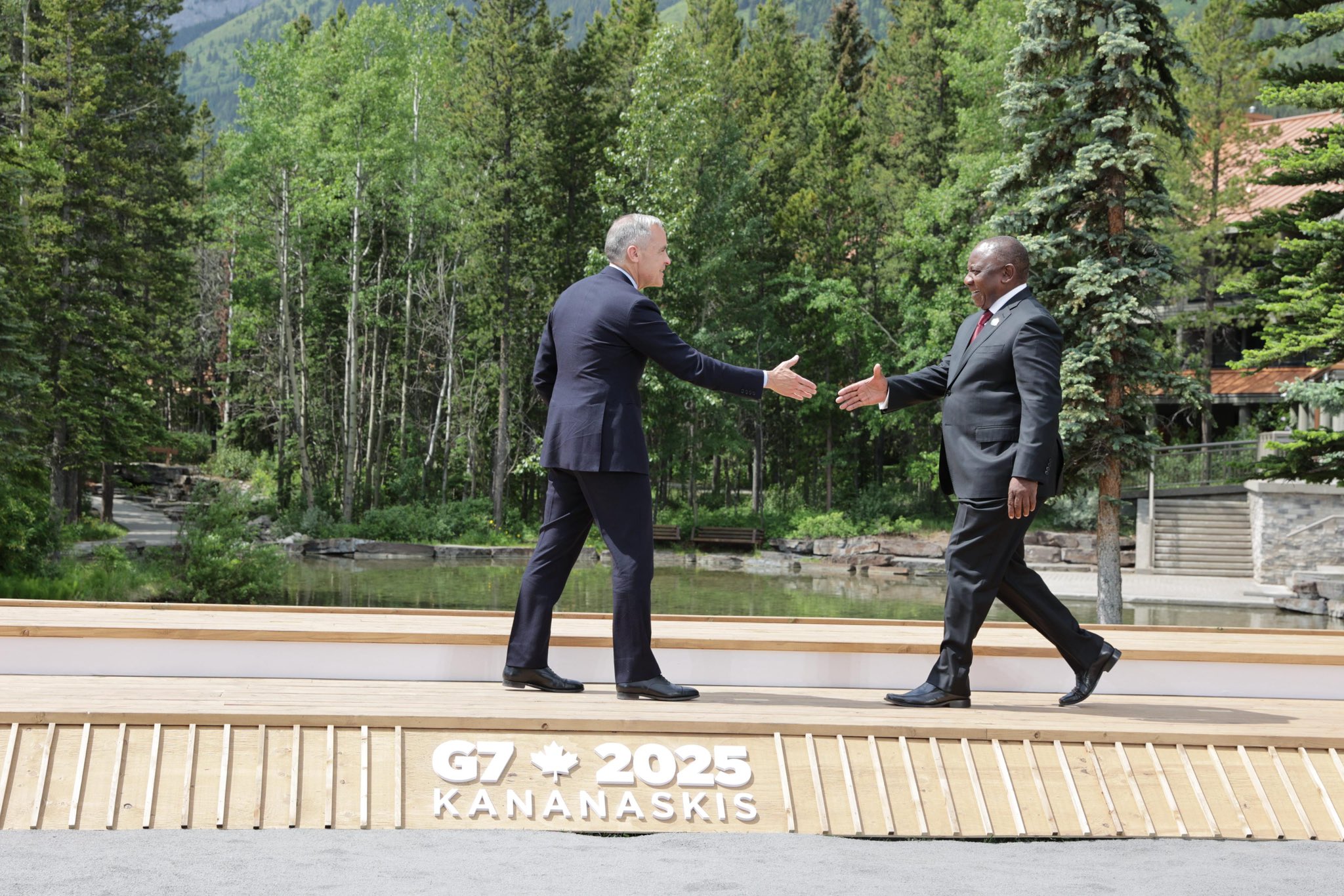
President Cyril Ramaphosa has concluded his working visit in Canada, for the Group of Seven (G7) Summit Outreach Session.
Canada assumed the Presidency of the G7 on January 1.
The G7 consists of the largest advanced economies Canada, France, Germany, Italy, Japan, the United Kingdom and the United States.
The EU also participates in G7 Summits, although it is not a member.
Ramaphosa participated in the G7 Summit Outreach Session, on the margins of the G7 Leaders’ Summit in Kananaskis, where he noted that South Africa views the G7 as a strategic partner.
The Outreach Session aimed “to explore leadership and collaboration in driving a comprehensive approach to energy security with a focus on technology and innovation; diversification and strengthening critical mineral supply chains; and infrastructure and investment”.
He noted that the G7 should support the efforts of the Global South to create a fair, just and inclusive global order that would foster sustainable development and that the G7 should support the reform of international institutions such as the United Nations Security Council and the global financial architecture.
Ramaphosa held bilateral meetings on issues of mutual interest with other heads of State and government, from Canada, France, Germany and South Korea.
Meanwhile six of the Group of Seven leaders discussed Russia’s war in Ukraine and the Israel-Iran conflict but failed to reach major agreements on those and many other top issues — closing a summit that was forced to try and see how the wealthy nations’ club might still shape global policy despite the early departure of US President Donald Trump.
Canada prime minsiter Mark Carney and his counterparts from the UK, France, Germany, Italy and Japan were joined during Tuesday’s final sessions by Ukrainian President Volodymyr Zelenskyy and NATO chief Mark Rutte.
“We need support from allies and I’m here,” Zelenskyy said, before adding, “We are ready for the peace negotiations, unconditional ceasefire. I think it’s very important. But for this, we need pressure.”
The remaining leaders agreed to jointly attempt to combat what they called non-market policies that could jeopardize global access to critical minerals. They also pledged to limit the downsides of artificial intelligence on jobs and the environment, while still embracing the potential of the “technological revolution.”
There was consensus on other issues, but though the summit was meant to showcase unity on top global concerns, no joint statement on the conflict in Ukraine was released.
Zelenskyy was scheduled to meet with Trump as world leaders convened at the Canadian Rocky Mountain resort of Kananaskis, however, that meeting was cancelled after Trump opted to leave the summit a day early on Tuesday citing escalations in the Middle East.
Additionally, the United States had earlier signed an agreement that allowed American access to Ukraine’s extensive mineral resources.
The summit was largely overshadowed by the showdown between Israel and Iran over the latter’s nuclear programme, which has the potential to escalate. Israel initiated an aerial bombardment campaign targeting Iran, while Iran retaliated with missile and drone strikes.
French President Emmanuel Macron warned against the US and other powers pushing for regime change in Iran, suggesting it could destabilize the greater Middle East.