
By Lehlohonolo Lehana.
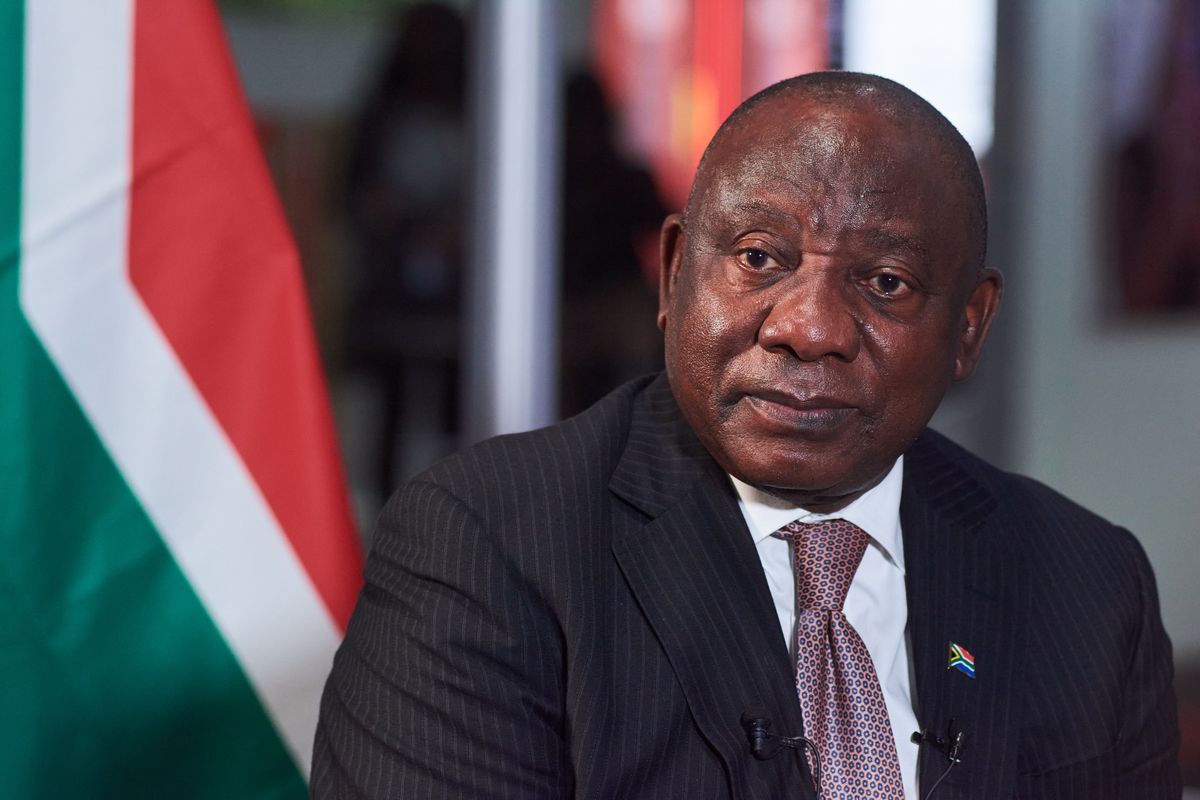
President Cyril Ramaphosa led an engagement between the National Executive and the Provincial Executive of the Northern Cape on catalytic projects to drive economic growth and service delivery.
The engagement tool place in Kimberley under the theme, “A Nation that Works for All”.
The visit is the sixth engagement between the National Executive and Provinces following interactions between the President and the Provincial Governments of KwaZulu-Natal, Limpopo, Mpumalanga, Gauteng and Eastern Cape.
The President met with Provincial Government Executive Members, led by Northern Cape Premier, Dr Zamani Saul, as well as Executive Mayors from the five district municipalities in the Northern Cape.
Ramaphosa stated that the province’s Green Hydrogen Masterplan was ambitious in scope and potential benefits – “not just for the Northern Cape but for the national economy, for the Southern African Development Community region, for the continent and globally”.
A 2022 Pulitzer Centre profile described the province as South Africa’s emerging economic powerhouse, especially in the clean energy revolution.
Ramaphosa suggested that: “Once the energy transition unfolds as envisaged, the Northern Cape could be the new heartbeat of the economy.”
The province’s Green Hydrogen Masterplan is a core component of this vision, promising significant regional and global economic benefits.
Ramaphosa noted ongoing multilateral discussions and business forums that position South Africa as a leader in renewable energy, calling the Nothern Cape “a critical driver of this transition.”
He said that the province aims to develop beyond energy as an industrial hub, leveraging traditional sectors like mining and expanding into special economic zones, industrial parks, and infrastructure projects such as port and rail upgrades.
In recent months Ramaphosa, and several members of the National Executive, had participated in multilateral discussions and business forums, articulating the vision of South Africa being a leader in the renewable-energy revolution.
He acknowledged that while the Northern Cape’s economy had been growing and creating jobs, with important progress in areas such as education, public infrastructure and basic services, persistent challenges remained.
He noted the National Treasury’s 2024 provincial socio-economic review, which pointed to an increase in the percentage of people living in poverty and a drop in the number of households with access to basic services such as water.
“Unemployment, especially youth unemployment, remains high. Fiscal constraints are holding back several projects particularly at a municipal level, including for disaster response, asbestos eradication, land restitution, rural electrification and public housing,”he acknowledged.
Ramaphosa pointed out that the province would need to find ways to support high-impact projects such as the Northern Cape Industrial Corridor, the R1-billion housing programme and the Kimberley Big Hole precinct to improve infrastructure development.
“We will also need to find creative funding mechanisms for projects like the Boegoebaai harbour. We need an urgent relook at the current delivery model to enable regulatory approval and investment activation,” he said.
He highlighted that integrated planning between national, provincial and local government must involve State-owned enterprises as important stakeholders with significant capabilities.
Ramaphosa stated that the integration of provincial planning into national priority planning must be prioritised through government’s District Development Model (DDM) and aligned with the Medium-Term Development Plan.
Watch Live in the video below:
Video Courtesy of Presidency.