
By Lehlohonolo Lehana.
South Africa received an update on the framework deal with the US with the provision that the tariffs will be reviewed as soon as the two countries reach a deal.
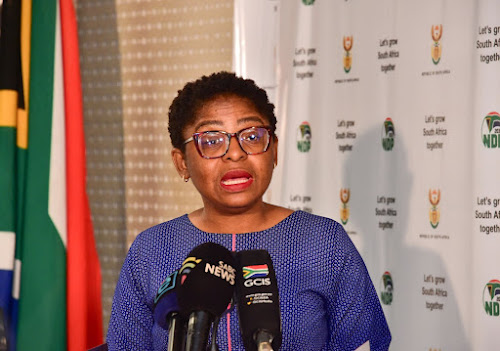
This was announced by Minister in The Presidency, Khumbudzo Ntshavheni, during a media briefing on the outcomes of the Cabinet meetings held on Tuesday, 22 July 2025 and Wednesday, 06 August 2025.
The announcement follows a direct conversation between President Cyril Ramaphosa and US President Donald Trump aimed at bolstering South Africa’s negotiation efforts concerning trade agreements.
Trump imposed 30% tariff on a number of South African products being exported to the US, arguing that introducing tariffs will protect American businesses from foreign competition and also boost domestic manufacturing and jobs.
Ntshavheni said, South Africa remained optimistic that the tariffs would be “reviewed” as soon as the two countries reached a deal.
No details were provided as to what changes South Africa was prepared to make relative to the ‘Framework Agreement’ presented during Ramaphosa’s visit to Washington in May, and which failed to avert the 30% tariffs. This, despite including proposals in relation to the importation of liquefied natural gas from the US, concessions on agricultural trade, as well as joint investment commitments.
Asked again whether South Africa was considering concessions in relation to black empowerment and affirmative action, alongside taking firmer action in relation to farm murders, Ntshavheni asserted that South Africa’s transformation agenda was “non-negotiable”.
“We are not pursuing the transformation agenda for its own sake, but it is to make sure that we build an equal, united and prosperous South Africa,” she said.
She announced that Cabinet had affirmed government’s commitment to “finding constructive and sustainable solutions through continued engagements with the United States of America including at a Presidential level”.
“Government’s efforts remain focused on growing the economy to save and create new jobs, which include intensifying diversification efforts and strengthening global supply chain integration as the country works to expand its export markets to Asia, Europe, the Middle East, and across Africa to enhance our economic resilience.”
Ntshavheni also confirmed that government was focusing on demand-side interventions for industries impacted by the tariffs, together with targeted interventions to ensure industry stability and to safeguard employment.
Government estimated that some 30 000 jobs a could be affected by the tariffs across various industries, including agriculture and automotives.
Details of the final support package would be unveiled at a briefing to be hosted by minister of Trade and Industry Parks Tau on Monday.
These include:
- Export Support Desk: Establishing a dedicated point of contact for affected companies to streamline assistance.
- Localisation Support Fund (LSF): Aiming to enable affected companies to contribute to national resilience.
- Export and Competitiveness Support Programme (ECSP): Offering a working capital facility and support for plant and equipment to address immediate industry needs.
- Collaboration with the Department of Employment Labour: Creating measures to mitigate potential job losses, utilising existing instruments within its entities.
- Block Exemption for Exporters: Following consultations with the Competition Commission, a draft Block Exemption will be published shortly, allowing for enhanced collaboration and coordination among competitors.
She also highlighted progress being made on the ‘South Africa-China Trade and Investment Package 2025 – 2029’, which had been proposed by South Africa as a “basis for economic engagement with China”.
The package includes trade, investment, industrial development and skills development components, with the trade component prioritising exchange of the top 100 products between the countries, establishing a permanent expo in China, as well as greater cooperation to address regulatory measures.