
By Lehlohonolo Lehana.
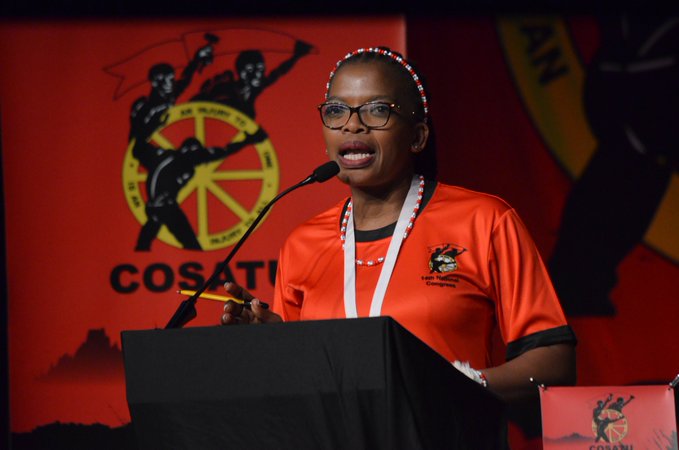
The Congress of the South African Trade Unions (COSATU) president, Zingiswa Losi, has cautioned against divisions within the tripartite Alliance.
Losi delivered the opening address at the trade union federation’s Central Committee meeting in Benoni on Monday.
The South African Communist Party (SACP) has reaffirmed its decision to contest the 2026 local government elections independently, citing the African National Congress (ANC) refusal to reconfigure their alliance.
The two parties have been at loggerheads over the ANC partnering with the DA in the Government of National Unity (GNU), prompting the SACP to say it will contest the 2026 elections on their own.
The SACP first resolved to explore electoral independence at its 2017 congress. A July by-election in Seshego marked the first time the party formally entered the fray, though it failed to win the ward.
The SACP has increasingly argued for a broader left-wing platform, independent of the ANC, that includes trade unions, NGOs and research bodies.
In its last congress, the party adopted a resolution to advocate for policies such as a universal basic income grant, public employment programmes, and resistance to austerity.
Losi urged the ANC and SACP not to cause rifts among workers.
“We love the ANC of Oliver Tambo and Nelson Mandela. We love the SACP of Joe Slovo and Chris Hani. We need our alliance partners to resolve their challenges and to engage the federation on these, said Losi.
“This is unity that has taken workers decades to build, and has been severely tested at times. We cannot afford, at this time when the National Democratic Revolution (NDR) is under such severe strain, nor when workers are under siege on so many fronts, to be divided.”
She added that measures need to be in place to reunite the alliance and reclaim the 60% vote share achieved during the late 1990s.
Losi has also decried retrenchments taking place across various sectors in the economy, saying they are tantamount to stripping workers of their dignity and will lead to the weakening of the state.
She likened the loss of thousands of jobs at ArcelorMittal SA (Amsa), Ford, Mercedes Benz, Glencore and Goodyear among others, as workers “being stripped of their dignity”.
ArcelorMittal has begun closing steel operations that employ 3,500 people after nearly two years of negotiations with government failed to address its complaints about high input costs and competition from cheap imports and subsidized rivals.
Ford intends firing 470 workers at plants near the capital, Pretoria, and the southern coastal city of Gqeberha. And Glencore announced plans to start talks with workers about job cuts at power-hungry ferrochrome plants that it closed in May.
Those retrenchments follow Goodyear’s firing of 900 workers after it closed a factory in Gqeberha in July, and Mercedes-Benz’s axing of 700 staff at a plant in the nearby city of East London in mid-2024.
The imposition of 30% tariffs on some South African exports to the US has exacerbated the challenges.
The tariffs the US has imposed on South Africa’s exports are the highest on goods from any sub-Saharan African nation, a reflection of President Donald Trump’s displeasure with Pretoria’s Black-empowerment laws and foreign policy. The US is South Africa’s second-biggest trade partner after China.