
By Lehlohonolo Lehana.
@ProudlySA.
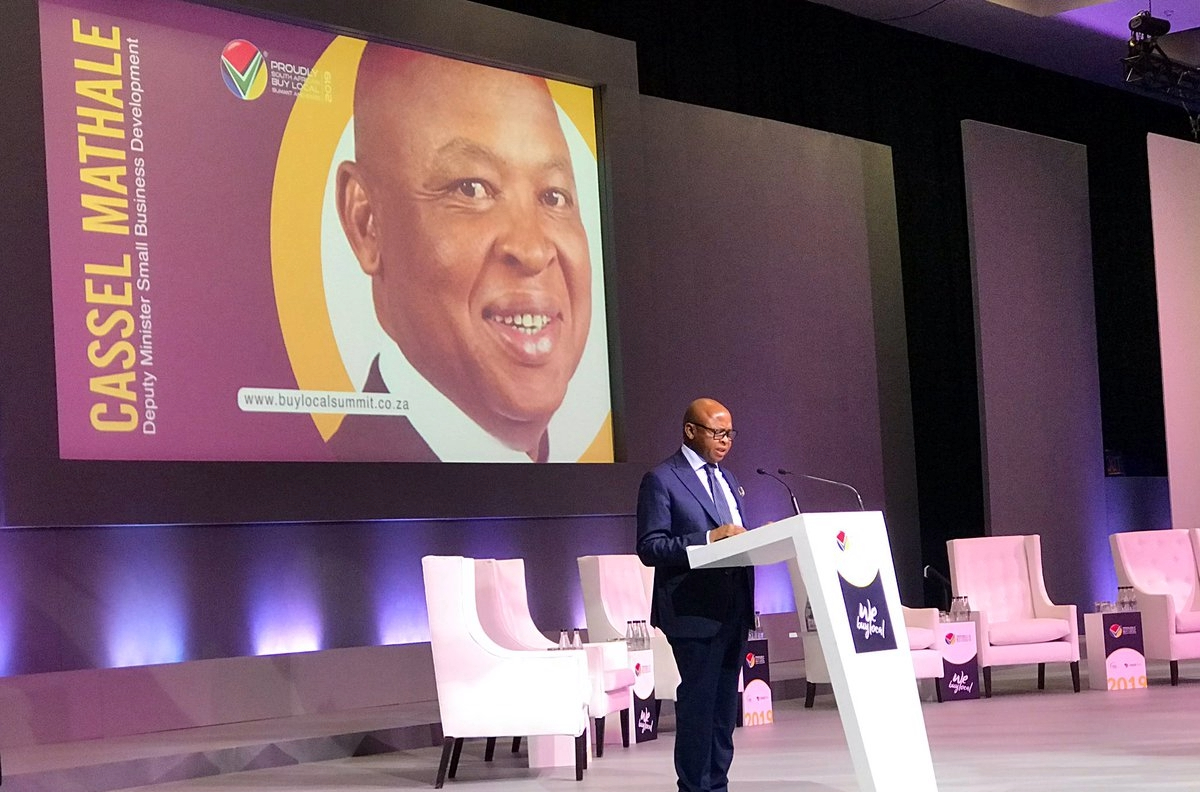
Deputy Police Minister, Cassel Mathale told the Parliament’s ad hoc committee on Tuesday that he learned of the disbandment of the Political Killings Task Team (PKTT) through social media.
Mathale testified before Parliament’s ad hoc committee inquiry in Cape Town on Tuesday.
Parliament’s ad hoc committee is investigating accusations that a drug trafficking cartel has infiltrated the country’s law enforcement and politics.
Mathale joined the growing list of officials who have indicated they were unaware of suspended police minister Senzo Mchunu’s order.
He said he learnt about Mchunu’s decision on social media, adding Mchunu later phoned “in early January to say that the letter that is circulating, he wrote the letter”.
Mathale said he first dismissed it as fake news, but when he “later realised it’s true”, he “didn’t understand what could have motivated him to pen such a letter in the manner that he did”.
Evidence leader Norman Arendse asked if Mathale or his co-deputy minister of police, Polly Boshielo, were consulted.
“Of course he didn’t consult. The only time that he spoke to me was after the letter was out and he was saying, ‘Yes, I’ve penned the letter, don’t be surprised, “Mathale said.
He didn’t question Mchunu for taking a strong executive stand against the task team, which he communicated within the police network.
However, Mathale said the task team had been doing a good job and saw no reason why Mchunu had singled it out.
“The effectiveness of the team is not in question; they did an excellent job. Since they were instituted, [there has been] progress around killings of activists, what we might call political killings, that took place, “Mathale said.
“In fact, their effectiveness has never been an issue that was questioned within the space.”
Mathale said he attended two briefings in KZN held by the task team. He added from the last task team briefing in March 2024, three months before Mchunu’s appointment, he “didn’t get an impression that there are problems around the team”, adding, “I think everybody was happy with what was presented and what they were doing.”
Mathale said he had often highlighted the need for Mchunu and national commissioner Fannie Masemola to have engagements and first align before making presentations in meetings or making decisions.
“There are many instances where we’ve had meetings and agreed that the two of them must have engagement outside ourselves because the absence of that will lead to misunderstanding amongst them, which can create a problem for us. And we are here now because of that,” Mathale said.
He worked “extremely well” with former police minister Bheki Cele, who told the ad hoc committee that his successor Mchunu, did not consult before disbanding the task team and did not respond to subsequent requests for a meeting.
Mathale said he had brief discussions with Mchunu about the structure and the need to strengthen police capacity to reduce the need for task teams. He said the discussions were not specific to the KZN task teams, but rather to strengthen internal capacity within the murder and robbery unit.
MPs raised concerns about the need for deputy ministers, questioning their role in the cabinet.
Mathale maintained that deputy ministers add value to policing while also asserting that Saps can function even without delegated responsibilities.
“There is relevance to their creation, and as I said that Saps is not like other ministries. It is a huge department that is complex in how it is structured.”
He shrugged off concerns that taxpayers’ money is being wasted.
“I would be the happiest to have my responsibilities clearly defined, but we are not sitting idle, waiting to be given responsibilities. We are working as a team.”
South Africa’s executive is among the largest in the world. Eliminating deputy ministers could drastically reduce the state’s annual spending, with each deputy earning R2.2-million and overseeing a team nearly as large as that of ministers, who typically manage about 10 staff members.
Salaries, benefits and operational costs continue to pile up, even as the country faces mounting fiscal pressures.
The debate over a bloated Cabinet, which includes ministers, and the executive, which also includes deputies, has lingered since 2018, when president Cyril Ramaphosa first took office and promised a more efficient, streamlined government.
That promise has largely fallen flat. Seven years later, the executive is even larger. Ramaphosa now cites political realities as the reason.
Despite his intention, the President expanded his executive after the 2024 elections instead of reducing it, choosing to accommodate political allies within the Government of National Unity (GNU).
Of the 43 deputy ministers, 33 belong to the ANC, with six from the DA, two from the IFP, and one each from the UDM and Al Jamah-ah.
Mchunu was accused of being influenced to order its disbandment on 31 December 2024 because certain crime suspects were under the impression this would have derailed investigations against them.
He joined the National Assembly in 2019 as public service and administration minister and then became water and sanitation minister in 2021. He was appointed police minister in June 2024.
He was suspended in July after allegations of corruption and interference in police operations. Firoz Cachalia was appointed acting police minister.
Watch Live in the video below:
Video Courtesy of Parliament.