
By Lehlohonolo Lehana.
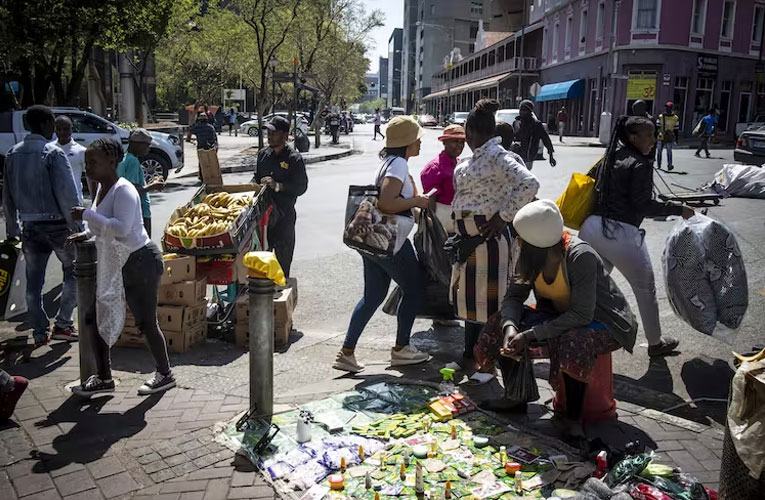
The Gauteng High Court has ordered the City of Johannesburg to speed up the verification and allocation of stalls to informal traders in the inner city.
The case stems from an ongoing conflict between the city and over 800 informal traders, represented by the Socio-Economic Rights Institute (SERI), who claim they were unlawfully removed.
In April 2022, the city approved an informal trading policy, a blueprint for regulating street trade to enhance order, safety and economic growth. The policy introduced a digital permit system and promised a transparent allocation of trading stalls.
The policy was not implemented, however, until early October 2025, when the Johannesburg Metropolitan Police Department (JMPD) evicted informal traders on De Villiers Street and other parts of the inner city and ordered them to apply for permits.
On Friday, 31 October, the Gauteng Division of the High Court in Johannesburg heard an application by the informal traders, represented by Seri, to declare the evictions illegal.
Joburg Mayor Dada Morero and the MMC for economic development, Nomoya Mnisi, have blamed Seri for the city’s failure to implement its informal trading policy.
“We are only implementing now because we have had those ‘slowdown litigations’ from Seri,” argued Mnisi.
However, Seri’s Deborah Raduba said, “We didn’t litigate last year. We only sent letters.”
Judge Brad Wanless gave the ruling on Monday after a weekend of mediation between the City and the Socio-Economic Rights Institute of South Africa (SERI).
Judge Wanless said the City of Johannesburg must conduct the process “expeditiously and transparently,” stressing that the outcome must be in line with the city’s own by-laws and national legislation governing informal trade.
The court ordered that the process must start on Tuesday and be finalised by November 18, giving officials just two weeks to complete the verification.
Judge Wanless emphasised the importance of procedural fairness and accountability, warning the city against arbitrary or discriminatory practices during the re-registration.
“This court cannot allow a situation where traders’ livelihoods are destroyed through administrative confusion or selective enforcement. The rule of law applies equally to the city and to the traders.”
He added that both the city and trader representatives must work together in good faith to ensure the process restores order and fairness to Johannesburg’s informal trading sector.
“Informal trade forms part of the lifeblood of this city, the city has an obligation to regulate it properly — not to suppress it. This order seeks to strike a balance between lawful governance and the right to earn a living.”
The ruling also directs that the dispute be referred to mediation under Rule 41A of the Uniform Rules of Court, with the City ordered to pay the mediation costs.
In 2014, in another matter between informal traders and the city, the Constitutional Court delivered a scathing judgment against the city, calling an operation to remove informal traders an act of “humiliation and degradation” and emphasising the right to earn a living.
Apart from granting the interdict preventing the city from interfering with the applicants ‘trading, the city was also slapped with the costs of the court action, including those of two counsel. The Constitutional Court also ruled that “verification” of permits was not a sufficient reason to evict traders.