
By Lehlohonolo Lehana.
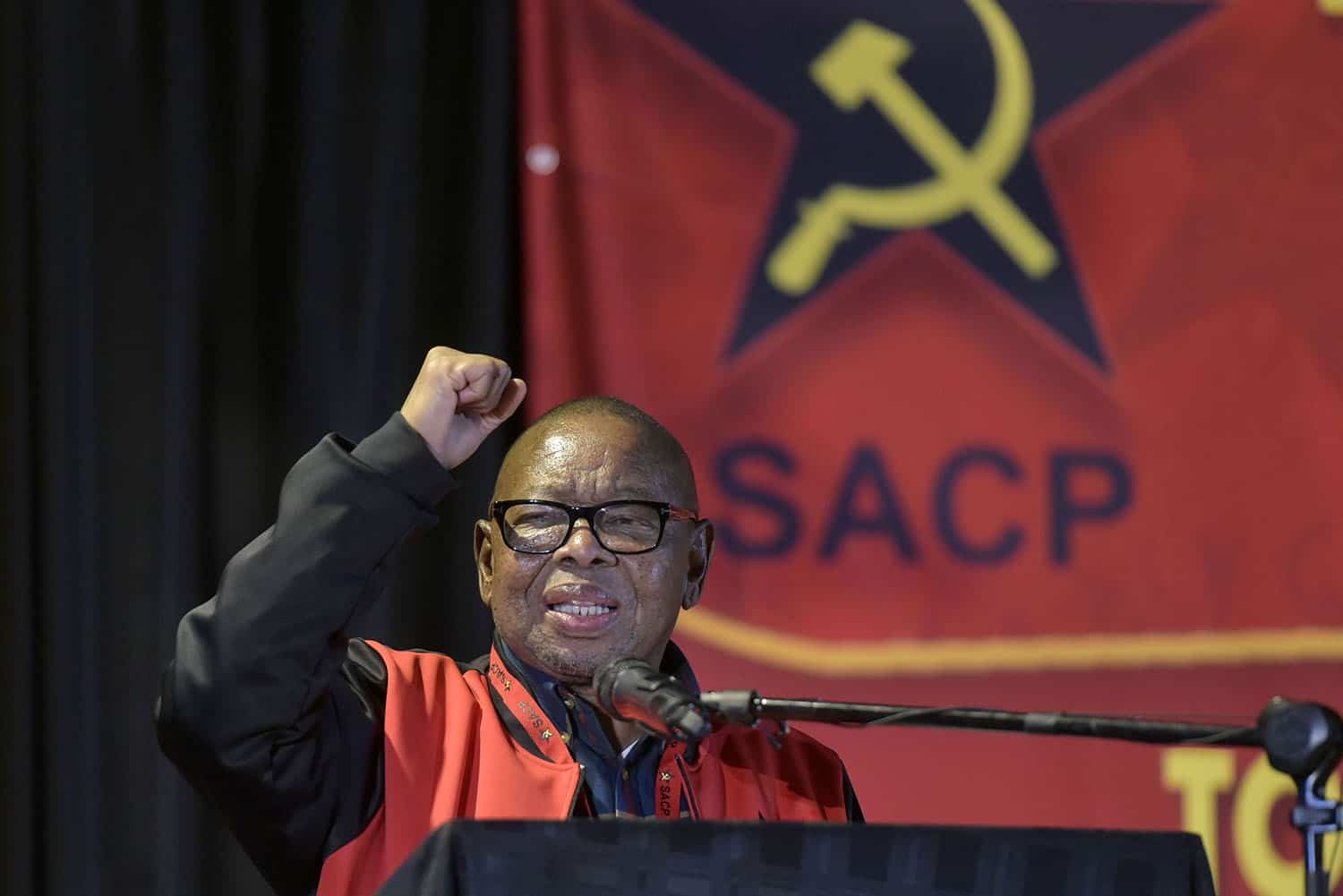
Caption: SACP general secretary Blade Nzimande speaks at the South African Communist Party (SACP) 15th National Congress at the Birchwood in Boksburg, 14 July 2022. Picture: Neil McCartney.
South African Communist Party (SACP) National Chairperson Dr Blade Nzimande has penned a hard-hitting letter to party members ahead of the 6th Special National Congress.
The SACP’s Special National Congress will be held in Johannesburg from the 14 to 16 November 2025.
The party’s Central Executive Committee (CEC) will convene to reflect on the posture and position assumed by the organisation in respect to domestic and global affairs.
The party is also expected to discuss the next Local Government Election (LGE).
It has has reaffirmed its commitment to contesting the local government elections independently, signalling a significant shift in its long-standing alliance with the African National Congress (ANC).
The SACP has more than 300,000 members, but it remains to be seen if it can win enough votes to make a political impact.
Nzimande has raised concerns about the lack of political training within the organisation, coupled with insufficient resources, saying that it has led the party to be unable to translate strategic resolutions, warning that it risked “devolving into bureaucratic proclamation.”
He further underscored the party’s need to reinvest massively in ideological training to strengthen its analytical edge, highlighting that lack of which might drive participants “dogmatise or reactive.”
“Revitalising political education is thus essential to prevent voluntarism and ensure that tactics serve strategy, not the other way around,” Nzimande reiterated.
Internally, the party now faces several structural and ideological challenges that impede full implementation,” he wrote. “Factional behaviour and personality-driven politics have supplanted collective leadership, weakening accountability and contradicting the Leninist conception of a disciplined vanguard.”
The SACP has long been a central partner in the Tripartite Alliance, alongside ANC and Cosatu.Over the years, it has supported the ANC during elections, had access to its election strategies, participated in workshops and played a role in processes such as the selection of public representatives.
Mounting tensions within the alliance, particularly under the presidency of Jacob Zuma, led the SACP to begin re-evaluating its position.
At its congress in July 2017, the party resolved to explore the possibility of contesting elections independently, especially in areas where the alliance was seen as dysfunctional or where the ANC was no longer viewed as representing the interests of the working class.
Later that year, the SACP contested its first by-election in Metsimaholo Local Municipality in the Free State. The party secured three out of 21 council seats and garnered about 6,000 votes. The by-election followed the dissolution of the 2016 municipal council due to political instability.
In August, the party contested yet another by-election, this time in Polokwane, and garnered only 70 votes, representing just 1%.
The secretary general Solly Mapaila made it clear that the SACP is on track to run independently, stating: “We are still going ahead to contest elections as the SACP. We are engaging with a variety of organisations in some areas, depending on the outcome of those discussions, we could participate as fronts.”
He blamed the ANC for repeatedly failing to address alliance issues, leading to a loss of trust. The party is already participating in all by-elections as preparation, viewing this as a way to reclaim leverage and anchor development from a working-class perspective.