
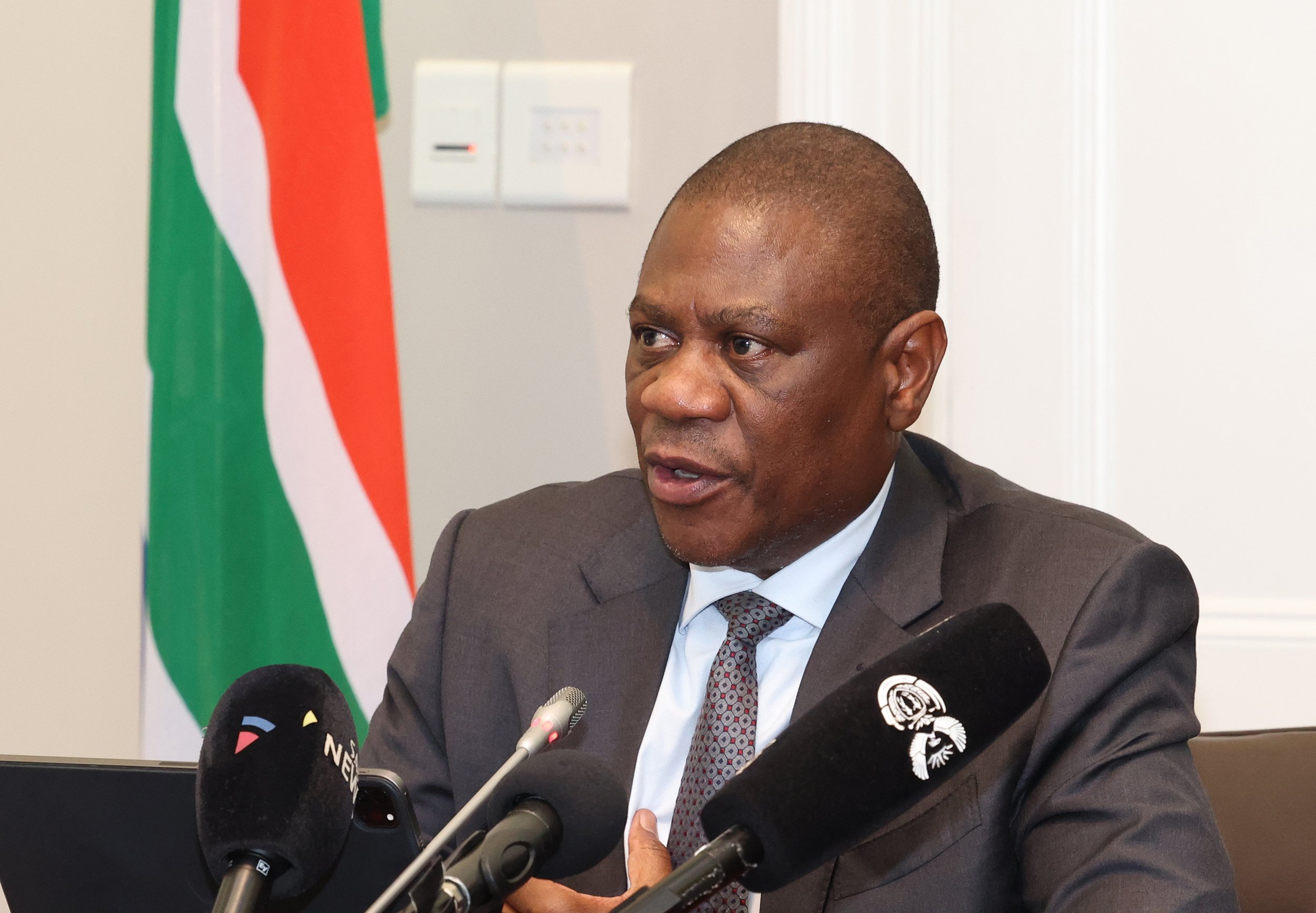
By Lehlohonolo Lehana.
Deputy President Paul Mashatile says the current Broad-Based Black Economic Empowerment (B-BBEE) framework is under review to address gaps and ensure legislation benefits the majority.
Mashatile was responding to questions in the National Assembly, in line with a constitutional mandate for Members of Cabinet to account to Parliament.
“We want to benefit the majority of the people, and to the extent that there may be weaknesses, let’s correct that,” he said, highlighting ongoing reviews of Black Economic Empowerment (BEE) policies.
The policies have come under increasing scrutiny recently, with political parties, CEOs, and think tanks being increasingly critical of BEE in particular.
The Democratic Alliance (DA), which is the second-largest party in the Government of National Unity (GNU), has even introduced a bill to scrap BEE and replace it with means-based redress.
Mashatile said there is no need for alternatives to existing BEE legislation.
However, he admitted that a review and possible changes to certain policies could be implemented to address the shortcomings of the legislation.
Mashatile told members of parliament that the Department of Trade and Industry was currently reviewing BEE legislation to find gaps in the legislation and assess ways to make it more inclusive.
“To the extent that there may be weaknesses, let’s correct that. Let’s make amendments, that is why there is this review. There is no need to ditch the legislation,” Mashatile said.
This makes a significant change in the government’s approach to criticism of BEE, with previous critiques dismissed out of hand and no reviews put on the table.
Former president Kgalema Motlanthe and Trade Minister Parks Tau both criticised the shortcomings of BEE policy at a B-BBEE dialogue last month.
They argued that the government’s policy of BEE has been tainted by corruption and cronyism, with its continued implementation in the current form being increasingly challenged from all directions.
Tau said this requires an overhaul of the policy to address and ensure it empowers a broader cross-section of South Africa and not just a handful of elites.
It has been estimated by some that around R1 trillion worth of BEE deals have circulated among approximately 100 well-connected individuals and businesses.
Tau’s proposed review and changes seek to remove loopholes that have been exploited by well-connected individuals to ensure they benefit from BEE deals at the expense of ordinary South Africans.
Mashatile also said the Government of National Unity (GNU) remains focused on key priorities to enhance the South African economy, including rapid and inclusive economic growth.
“Together with members of the Executive, we have been working on an investment drive to market our economic policy and to attract foreign direct investment to our economy,” the Deputy President said.
He told Members of Parliament (MPs) that GNU has adopted the Medium-Term Development Plan (MTDP) 2024-2029, which focuses on three strategic priorities – driving inclusive growth and job creation, reducing poverty and tackling the high cost of living, and building a capable, ethical, and developmental State.
The Deputy President said the MTDP is guiding the work of the GNU for the next five years in pursuit of these strategic priorities, which are informed by the Statement of Intent.
“The government’s goal of attaining sustainable and rapid economic growth has historically been a priority of the ANC-led government. Even before the seventh administration, we have introduced critical legislation and policy reforms to support this objective.”
He told the MPs that in October 2020, government introduced Operation Vulindlela, a significant initiative, aimed at accelerating economic reforms.
Operation Vulindlela focuses on enhancing the country’s growth trajectory and improving its overall economic performance through various strategies.
The Deputy President also noted that the infrastructure reform remains a key focus area. highlighting steps being taken to strengthen State-Owned Enterprises (SOEs).
“Through the National State Enterprise Bill, we are introducing reforms to strengthen our State-Owned Enterprises, focusing on improving governance, unbundling monopolies and introducing competition to reduce costs and boost efficiency, whilst at the same time transforming SOE boards to be fit for purpose,” he said.
In addition, he said government recently took steps to ensure more effective government service and transparency.
“The NCOP passed the Public Administration Amendment Management Bill. Rather, the Bill has been sent to the President for ascent. All these reforms demonstrate our commitment to deliver on the Medium-Term Development Plan and the strategic priorities of the Government of National Unity,” the Deputy President said.