
By Lehlohonolo Lehana.
@GettyImages.
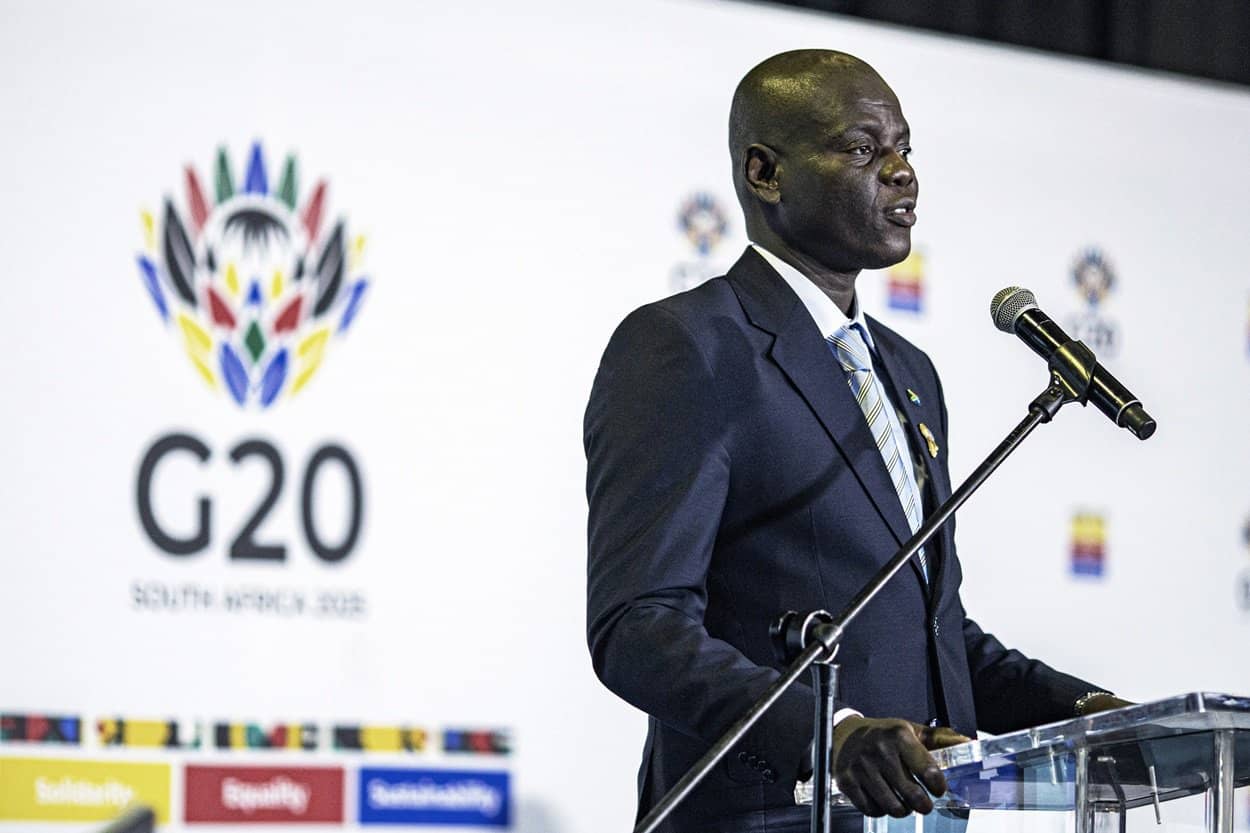
International Relations Minister Ronald Lamola says consensus can be reached for the adoption of the leaders’ declaration at the G20 summit, with or without the U.S. officials.
Lamola was speaking at the Johannesburg Expo Centre, Nasrec, where he was joined by Gauteng Premier Panyaza Lesufi and Finance Minister Enoch Godongwana.
He briefed the media on South Africa’s state of readiness to host the historic G20 Leaders’ Summit.
Thousands of international delegates, media representatives, and visitors are expected to gather at the Nasrec Expo Centre in Johannesburg for the two-day summit scheduled to take place from 22 – 23 November 2025.
The Johannesburg summit will revolve around three core sessions: inclusive and sustainable economic growth; building global resilience in areas such as disaster risk reduction, climate change and food systems; and shaping a fair and just future, with a focus on critical minerals, decent work and artificial intelligence.
Lamola said South Africa was actively persuading attending countries to agree on a Leaders’ Declaration before the summit closes.
The US is set to take over the G20 Presidency from South Africa and host the summit in 2026.
The reality is that they are not attending, they are not here. We view it as non-attendance. They are absent,” he said.
“In their absence, the countries that are present must take a decision. That is what is currently unfolding. The sherpas are negotiating the Leaders’ Declaration. We are moving towards making a decision in terms of a Leaders’ Declaration. Later in the week you will hear what is the outcome.”
Lamola said nearly all G20 member states will be represented at the head-of-state or head-of-government level, with only a small number opting to send ministers or sherpas instead.
“At this stage, we have confirmation that only four countries will not be represented at the head-of-state level,” he said.
“They will still participate, but through foreign ministers, sherpas or other ministerial representatives. These countries are Russia, Mexico and Argentina. Mexico and Argentina will be represented by their foreign ministers.”
Lamola said preparations were on track, with representation extending well beyond the G20 membership.
A total of 42 countries have confirmed their participation for the G20 Summit in Johannesburg. This includes 20 member states (excluding the USA), 16 guest countries, and six countries representing regional economic communities in Africa, the Caribbean and East Asia.
South Africa has used its G20 presidency to foreground issues that predominantly affect Global South countries, including sovereign debt burdens, the cost of capital and inequality.
Efforts include the establishment of the Extraordinary Committee of Independent Experts on Global Inequality, chaired by Nobel Economics Prize Laureate Joseph Stiglitz, to examine the impact of global inequality on growth, poverty and multilateralism.
Globally, the wealth gap has grown. In early 2025, an Oxfam analysis found that the world’s wealthiest 1% had increased their wealth by $33.9-trillion since 2015.
Nearly half the world’s population – about 3.7 billion people – live in poverty while just 3,000 billionaires own 43% of global assets. A 69-page report published by the Inequality Commission on 4 November found that 83% of countries have high wealth inequality – measured by a Gini coefficient of 0.4 – and these countries account for 90% of the global population.
Godongwana stressed that while employment is the best way to combat poverty, in its absence, SA has developed one of the strongest social protection systems globally.
“Part of the major instrument of dealing with poverty is employment. But in the absence of employment, you put mitigating measures that deal with poverty. In that respect, SA is second to none. The closest in terms of social protection we have is Chile,” he said.
Godongwana pointed to the national budget, noting that 61% of non‑interest spending is directed toward the social wage, including grants, healthcare, and education.
“This excludes what is called the subsidies of basic wages or basic services in municipalities. That in itself is a different package, which is R106bn. In order to deal with poverty in the absence of dealing with the major instrument of dealing with inequality, which is employment, we are turning the corner,” he said.
Godogwana added that the G20 leaders’ declaration will not be hindered by the US’s absence.
“The fact that the US is not here does not preclude a declaration. In fact, the countries that are participating now agree on a declaration. This is a declaration of the countries that participated, and in so doing, it excludes the Americans,” he said.
He added that the US has no grounds not to “invite” SA to the G20 next year.
The summit will mark the culmination of South Africa’s G20 Presidency.
Lesufi recounted the weekly meetings with the executive and national Ministers in the past four months and highlighted the resourcefulness shown.
“We’ve worked extremely hard to ensure that we fix the street lights, the traffic lights, fill the potholes and attend to issues that need to be attended to.
“And we’ve long agreed together with the Ministers, even after the G20, that those meetings will continue to be held so that we can continue to attend to some of the areas.”
The Premier noted that the city was nearly ready but warned against complacency.
“We are almost there… I always appreciate the rain. For the first time, I don’t want the rain because it reopens the potholes and creates problems. We’re crossing our fingers that by Wednesday, the weather will behave, and we’ll be able to do the final touch-ups.
Lesufi stated that the province is looking forward to attracting major tourists, hoping for returns beyond billions of rands from the summit.