
By Lehlohonolo Lehana.
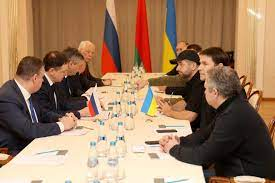
The talks are being held on the border with strong Russian ally Belarus [Sergei Kholodilin/BelTA/Handout via Reuters].
Zelensky calls for establishment of no-fly zone and harsher Russian sanctions in call with US lawmakers
Ukrainian President Volodomyr Zelensky called on the United States for assistance in establishing a no-fly zone over Ukraine during a Zoom call with US lawmakers, according to a person familiar with the session.
Zelensky asked US senators for greater sanctions on Russia, including on energy, and for more military assistance directed to Ukrainian forces. He thanked the US for the support it has delivered so far, but his overall message was that his country needs more help as it strains against Russia’s invasion.
Another senator on the call said that Zelensky advocated for banning Russian oil imports, suspending all commercial transactions — like Visa and Mastercard — and implored the lawmakers to help Ukraine get more planes that Ukrainian pilots are trained in and can fly. He said they would do the fighting and flying, but he needs the aircraft.
The call, which started at about 9:30 a.m., ET, lasted an hour.
At the end of the call, dozens of lawmakers unmuted themselves to thank Zelensky and voice their support, with some saying “Slava Ukraini,” according to someone who was on the call who said the Ukrainian president was clearly moved by the gesture.
His message was delivered amid ongoing conversations between the US and European allies about the possibility of providing Ukraine with fighter jet aircrafts from Eastern European countries, five sources familiar with the discussions told CNN.
Officials say there is a divide among countries about whether or not individual nations should provide Ukraine aircraft, given the associated risks. The US and NATO oppose creating a no-fly zone in Ukraine — such a move, they have warned, could lead to “full-fledged war in Europe.” Russian President Vladimir Putin said Saturday that countries that impose such a no-fly zone would be considered to be participating in the conflict.
US lawmakers pledge to release $10 billion in aid to Ukraine’s Zelensky
US lawmakers pledged in a video call Saturday with Ukraine’s president to provide a further $10 billion in assistance as the besieged country faces a Russian onslaught.
In the call with American legislators of both parties, President Volodymyr Zelensky reiterated a plea for Russian-made planes.
The US Senate majority leader, Chuck Schumer, cited by a source briefed on the call, said Democrats and Republicans were “working very hard” toward passing the relief package.
“We will get that assistance of over $10 billion in economic, humanitarian and security assistance to the Ukrainian people quickly,” he said.
The bipartisan effort was underlined by Republican Senator Steve Daines, who told Fox News after the call that lawmakers were “unified in our support for Ukraine”.
“We need to pass this $10 billion relief package,” he said, adding that half would go toward humanitarian aid and half would be in military assistance.
“They need more force on the ground,” he said, as Russian units pressed their offensive in Ukraine for a tenth day.
Zelensky, wearing a military-green T-shirt and seated beside a Ukrainian flag, also urged Congress to bolster already broad sanctions on Russia, including on its oil and gas sector – a move some US lawmakers have also called for as the war in Ukraine intensifies.
But the White House has ruled this out so far, fearing it might cause rising oil prices to go up even more and hurt US consumers stung by record inflation.
Statement released by the Ministry of Foreign Affairs after ceasefire collapses:
Violating the agreements reached, the armed forces of the Russian Federation continue to launch missile and bomb strikes on Mariupol, Volnovakha and other Ukrainian cities.
The ongoing shelling makes it impossible to open humanitarian corridors for the safe evacuation of civilians and the delivery of medicines and food.
The allegations of the Ministry of Defense of the Russian Federation that it is the Ukrainian authorities who are hindering the departure of residents of the cities under siege are not true and constitute disinformation to justify the criminal actions of the Russian armed forces.
The Russian side ignores the appeals of international humanitarian organizations, in particular the International Committee of the Red Cross, to ceasefire in order to create safe conditions for the departure of civilians and wounded.
Russia’s actions are a gross violation of the Geneva Conventions and are classified as a war crime under the Rome Statute.
We call on the international community – states and international organisations – to immediately condemn Russia’s gross violation of the agreements on the opening of humanitarian corridors, and call on Moscow to order Russian troops to ceasefire.
Ukraine, together with the humanitarian organisations involved, is ready to evacuate the civilian population as soon as safe conditions are in place.
ANC calls EU sanctions on Russia ‘draconian’
The ANC calls the European Union’s (EU) sanctions on Russia, including its media operations, “draconian”, and wants it to justify its position.
“The ANC notes the draconian decision by the EU to impose sanctions on Russia and its [entities], including global media organisations, following the escalation of hostilities between Ukraine and Russia,” ANC spokesperson Pule Mabe stated on Saturday.
“Subsequently, this has resulted in the South African MultiChoice platform unilaterally withdrawing Russian TV from its offerings, impacting negatively on the freedom of choice to subscribers and limiting their consumption of news on the developments in the Ukraine–Russia conflict.”
The ANC calls it censorship, which negatively impacts the plurality of views and media freedom.
It also wants MultiChoice to unblock RT.
“Stifling the plurality and diversity of views undermines internationally agreed principles on freedom of speech, choice and association,” Mabe said. “Even at this late hour, the EU must still provide legal justification for this course of action.”
MultiChoice said it had no control over the block on the feed.
The party does not accept this explanation on the ‘censorship’ of the channel,” said Mabe.
Russia and Ukraine agree to temporary ceasefire to let civilians leave two Ukraine cities
Russia and Ukraine have agreed to a temporary ceasefire in Ukraine to allow civilians to leave the cities of Mariupol and Volnovakha.
The ceasefire was expected to begin at 10 a.m. Moscow time (2 a.m. ET) Saturday, but there was no immediate confirmation that attacks by Russian forces had stopped.
A Ukrainian official tweeted that “humanitarian corridors” were being prepared.
“In Mariupol and Volnovakha, evacuation humanitarian corridors are being prepared for opening, and columns of those to be evacuated are being formed. The parties temporarily ceased fire in the area of corridors,” Mykhailo Podoliak, an advisor to the Ukrainian Presidential Office who took part in negotiations with Russian officials this week, said on Twitter.
Mariupol and Volnovakha have born the brunt of some of the most intense fighting in Ukraine over recent days.
Their location — in Ukraine’s extreme southeast corner, near the Russian border and Crimea — makes them strategic targets for the Moscow. If they fell to Russia, its troops could join forces with those in Crimea, a peninsula Moscow seized from Ukraine in 2014.
Mariupol is a port city, on the Sea of Azov.
Both cities are within Donetsk, one of two Ukrainian regions that Russian President Vladimir Putin’s government recognized as independent just before his troops invaded Ukraine.
On Thursday, Moscow had encouraged residents of Mariupol to begin leaving the city, but residents said they could not move because there had been no break in the shelling.
The situation on the ground in Ukraine is extremely volatile, and individual accounts are difficult or impossible to verify.
This is a breaking news story and will be updated shortly.
Zaporizhzhia nuclear power plant staff say radiation levels look normal
Staff at the Zaporizhzhia nuclear power plant (ZNPP), which was occupied by Russian forces after a fire broke out on Friday, say radiation levels in the region look normal.
“Currently, the ZNPP attending personnel monitor the condition of power units and control their operation,” Ukraine’s State Nuclear Regulatory Inspectorate said in a statement Saturday.
“No changes in the radiation status in the Zaporizhzhia region have been detected, the gamma radiation background is within normal limits.”
The State Nuclear Regulatory Inspectorate also said the heating and hot water supply in the city of Enerhodar, where the plant is located, have been disrupted “due to a damage to the connecting heating main, which is a result of the fierce fighting between the defenders of ZNPP and the Russian occupiers.”
Repairs are underway but “the work is complicated by multiple damage to the heating main,” the regulatory body said.
Fire at the plant: A blaze broke out on Friday after shelling by Russian forces, Ukrainian officials said. Fears rose as firefighters were initially unable to access the site.
The fighting eventually stopped, and emergency teams were able to put out the fire. Though staff at the plant are continuing their duties, the plant has been “occupied” by Russian forces, the regulatory body said Friday after the fire was contained.
Elon Musk declines to block Russian propaganda from Starlink
In a tweet Friday night, Elon Musk claimed foreign government officials had asked his satellite internet company Starlink “to block Russian news sources” following the unprovoked invasion of Ukraine.
“We will not do so unless at gunpoint,” Musk said in the tweet. “Sorry to be a free speech absolutist.”
It’s unclear which governments Musk is referring to in the tweet, though he added it was not Ukraine.
Amplifying propaganda: Russian news sources, such as RT, serve as Russian President Vladimir Putin’s global megaphone, misleading audiences and deflecting from the issues at hand. On Friday, Putin signed a censorship bill into law making it impossible for news organizations to accurately report the news in or from Russia.
Delivery to Ukraine: Musk sent a truckload of Starlink antennas — which can be used to connect to the company’s satellite-based internet service — to Ukraine this week, responding to a plea from the country’s vice prime minister amid fears that Ukrainians could lose internet access if Russia continues its attacks on communication infrastructure.
The Nelson Mandela Foundation has been following closely the invasion of Ukraine by Russian military forces. We are grieving for those who are losing so much. We are troubled by the complexity of the challenge to the world order, and by the vagaries of international rules of engagement. We see the unspeakable danger of nuclear plants coming under attack. We call for a cessation of hostilities and the restoration of peace in the region.
Nelson Mandela Foundation on Ukraine.
In 2003 Nelson Mandela spoke publicly, and angrily, about failures of leadership and an absence of credible justification when the United States and other Western countries invaded Iraq in defiance of the United Nations. Indeed, at what point is a country justified in invading another? At play here are notions of the sovereignty of nation states and the perceived right of such states to act in their own legitimate interests, and their assessment of the benefit or drawbacks of their actions. It is about nations being aware of both the extent and limits of their power and the conditions in which that power can be exercised. Today, the Foundation sees significant failures of leadership at many levels among contesting nations as the crisis in Ukraine unfolds.
One of the ironies of the public discourses swirling around the Ukraine invasion has been the outrage expressed by the United States, a country which for sometime has perfected the arts of invasion, occupation, and a contemptuous dismissal of international bodies. Of course, literal invasion is but one form of this phenomenon. The title of a new book by Susan Williams points to another form of invasion – White Malice: The CIA and the Neo Colonisation of Africa. Control of wealth, technologies, data, markets, idioms, languages and other apparatuses of power arguably define imperialism in the twenty-first century.
Underlying what is happening in Ukraine is a profound contestation around the notions of ‘belonging’ in the context of spheres of influence. For President Putin and his constituencies, Ukraine belongs to Russia’s sphere of influence. Over months and years now we’ve listened to Putin’s representations of Russian and European history to justify Ukraine staying within that sphere. Whatever we may think of this logic it informed the United States acting against Cuba in the 1960s and Grenada in the 1980s, who were within its perceived sphere of influence. To accept this logic in respect of the behaviour of the United States but deny its pertinence to the current conflict over Ukraine is to put a hand over one eye and claim to see everything.
The conflict over Ukraine has foregrounded another global fault line: racism. There have been disturbing reports of Black people and people of colour, being denied seats in buses evacuating refugees, and turned away from the Polish border. This illustrates once more a common global phenomenon in which the sufferings of white people in conflict situations habitually receive more attention and care. White lives are seen to matter far more than the lives of others. Racism remains as insidious and ubiquitous as it has ever been.
The horrors which have unfolded in recent times in Mali, DRC, Ethiopia, Somalia, South Sudan, Zimbabwe and Eswatini are often experienced by white people as diminishing the human value of Africans as if white people are of a human order incapable of, and beyond, self-directed atrocity. Two European wars in the twentieth century, inaccurately called world wars, confirm that European people are neither worse nor better than the rest of humanity. Beyond that, Europe may often be seen to be of the disposition that many of the problems its former colonies experience have no historical European origins. The complex historical relationship between the two continents imposes an obligation of mutual respect. If we are ever to achieve solidarity in the global community, we must recognize our shared humanity and defend equally all victims of war and prejudice. All peoples of the world must strive for a just, equitable, and caring global community.
We have urged the South African government to show leadership at this critical moment and press for a ceasefire so that rigorous negotiations on the future can be mapped out. We have indicated to the government our availability to assist in this regard. A lesson to be relearned is that whether we are talking about Ukraine or about the many other crises around the world, when the rule of law is cast aside and strategies of violence adopted, the resulting misery is far more devastating among weak and vulnerable countries. It is imperative that channels for peacemaking, negotiation and dialogue be pursued urgently and relentlessly.
Ukraine top Winter Paralympics medal table with three golds on opening day
Ukraine topped the medal table with three golds on the first day of the Winter Paralympics in Beijing.
Biathlete Grygorii Vovchynskyi triumphed in the men’s sprint standing event to win Ukraine’s first gold at these Games.
Oksana Shyshkova then won the women’s sprint vision impaired, before Vitaliy Lukianenko led a Ukrainian one-two-three in the men’s event.
Ukrainian athletes claimed seven medals in total on the opening day.
There are 20 Ukrainian athletes and nine guides in Beijing. The delegation travelled to China despite the Russian invasion of their country, which began on 24 February.
“It was difficult for me when the war began. I cried every day,” Vovchynskyi said.“I didn’t understand what happened.
“What can I do? I can dedicate this race to Ukraine, for peace [for the] people in Ukraine.
“Please stop war, it’s very important for our children.”
Vovchynskyi, who won gold in the long distance event in Sochi in 2014, beat Germany’s Marco Maier by 45.8 seconds to win his event.
He said: “I was thinking before the race, I must try to do everything for Ukraine. I must think about war, about my country, about my people, about my president. I love Ukraine.
“I love sport, but today I ran because I want life in Ukraine to move to the future.”
Shyshkova held off Germany’s Linn Kazmaier to claim Ukraine’s second gold.
Lukianenko added a third in the men’s sprint vision impaired event, with compatriots Oleksandr Kazik and Dmytro Suiarko claiming silver and bronze respectively.
There were also silvers for Liudmyla Liashenko and Taras Rad. Liashenko, 28, won her fifth Games medal in the women’s sprint standing where China’s Guo Yujie, 17, emerged victorious.
It was a second Paralympic medal for Rad, 23, following his middle distance gold from Pyeongchang, after he finished 17.5secs adrift of China’s Liu Zixu in the men’s sprint seated event.
Before the Games, Valeriy Sushkevych, the Ukrainian Paralympic chief, said his team’s presence at the Games was a “symbol that Ukraine is alive” and that it was a “miracle” they made it to the competition.
They were warmly welcomed into the Bird’s Nest Stadium for Friday’s opening ceremony. The Russian Paralympic Committee and Belarus were banned from competing.