
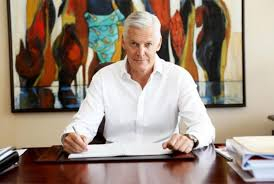
By Lehlohonolo Lehana.
Eskom has warned that loadshedding may be increased to Stage 4 should the demand far exceed the supply it can offer.
The power utility announced it would implement Stage 3 loadshedding on Monday and Tuesday evening.
Thereafter, loadshedding would be reduced to Stage 2 for the rest of the week, it said.
However, in a media briefing that included Eskom’s CEO Andre de Ruyter and COO Jan Oberholzer, the power utility warned that loadshedding stages may be increased to a higher stage and for a longer period in the day in the week .
“The outlook currently is that we will implement loadshedding Stage 3 today and tomorrow and Stage 2 on Wednesday, Thursday and Friday. But, loadshedding may be increased from Stage 3 to Stage 4. We are still going to be burning a lot of diesel and may be forced to implement loadshedding throughout the day and not just in the evenings.
“We will try to avoid that but there is always a risk,” Oberholzer said.
He revealed that Eskom has already burnt about 40million litres of diesel for the month of May.
Oberholzer explained that breakdowns occurred on a unit each at Tutuka, Camden and Majuba power stations over the weekend.
A unit that supplied more than 700 MegaWatts of power also tripped on Friday and is only expected to return to service by Wednesday at the latest.
Oberholzer explained that since boilers are high pressure vessels, work needed to be done and assessed according to extremely high industry standards and safety of the technicians were always most important.
De Ruyter added that a significant diesel theft syndicate has also resulted in two units completely out of order which contributed to a loss of about 900 MegaWatts of capacity.
Meanwhile Busi Muvaso, chief executive officer of Business Leadership South Africa (BLSA) says businesses need to look beyond the “doom and gloom” and start preparing for a much better power scenario.
According to Muvaso, it is easy for South Africans and businesses, in particular, to lose sight of the longer-term outlook for electricity generation and distribution while being besieged by seemingly never-ending load shedding.
“But this should not blind us to the fundamental changes that are occurring in the policy environment. They lead inevitably to a world in which the private sector is going to be largely responsible for generating and selling electricity, and I expect distributing some of it too,” she said.
Despite the current energy crisis, Eskom’s unbundling into three distinct units is progressing – and the Electricity Regulation Act (ERA) has been amended to allow companies to build electricity plants that produce up to 100MW for own use, she said.
This points to a future where South Africa will have an independent system operator, free to buy electricity from whoever can sell it at the lowest price.
“Eskom’s generation unit will be one of those bidding to supply, but perhaps most of the supply will come from other generators from the private sector,” she said. “Dedicated generation companies can be set up which can wheel across the grid directly to customers. Larger generators can obtain licences and also wheel,” said the business leader.
“You can start to imagine how this will look – a competitive electricity supply market, selling to customers or the independent system operator as supply and demand patterns shift.
“The opportunities for business are obvious – as generators and consumers. Plants created for own-use can become viable in the knowledge that excess capacity can be sold into the grid. Investment that is now impossible because of electricity insecurity can be made viable through contracts with future suppliers.”
Muvaso said that this outlook is some years out, but encouraged businesses to start planning for it – while also being aware of some “serious impediments “that still lie in the way.
“The ERA amendment has hit a new roadblock with the National Electricity Regulator of South Africa insisting on a registration process that is almost as cumbersome as licensing.
“The Eskom unbundling is going to be difficult – Eskom’s balance sheet remains stressed and debt holders will have to agree to an unbundling that will change the asset mix that they currently have rights to. These are daunting obstacles to navigate, “she said.
Livestream Video Below
Video Courtesy of ENCA.