
By Lehlohonolo Lehana.
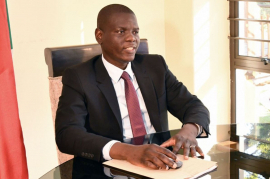
Justice and Correctional Services Minister Ronald Lamola has called for the University of Stellenbosch to pull out all the stops in investigating a racist incident that has dominated media headlines.
Lamola said this when he tabled the Department of Justice and Correctional Services’ Budget Vote on Tuesday.
“I would like to take this opportunity from the onset to condemn the racist incidents that continue to raise their ugly heads in some of our high schools in the country and the recent one at the University of Stellenbosch,” he said.
This comes after a white student was suspended after he urinated on the property of his roommate at the university’s residence. The roommate recorded the incident on his phone.
“The university must leave no stone unturned in investigating the incident. All of us must send a clear and unambiguous message that that there is no space for racism in our country. Parents must teach their kids love and diversity and not racism.”
The first-year student Babalo Ndwayana has since laid criminal charges against Theuns du Toit on Tuesday.
“In dealing with the incident that occurred in Huis Marais on early Sunday morning, decisive disciplinary action has already been taken on Monday including the suspension of the alleged perpetrator,” the university said.
It said in line with the law and governance of the university, further investigation is under way towards a swift and final outcome in the matter.
“Permanent expulsion and/or criminal charges are definitely not excluded from the possible available outcomes based on the investigation’s findings. SU is committed to supporting the victim of the incident with equipment and counselling to ensure his academic progress is not affected by the incident.”
The University on Tuesday said it was probing yet another racial incident which occurred recently at the institution.
In a statement, the university said: “An investigation is also under way into an alleged incident that occurred at the law dance on Thursday 12 May when racist remarks were allegedly made towards a female student.
“University authorities are in discussion with individuals, attendees of the dance, faculty leadership and student representatives to ascertain the facts at hand as well as more information about the formal complaint by the affected student.”
It said authorities had met the affected student and she had been helped in the process of reporting the matter to the university’s equality unit.
Bills that criminalise GBV bystanders
Meanwhile, Lamola said gender-based violence and femicide (GBVF) is entrenched by patriarchal social norms and belief systems, gender disparity, socio-economic inequality, family dysfunctions, the low social value attached to women and girls, and the lack of accountability at all levels of responsibility.
“If men, in particular, do not take personal accountability, GBVF will continue to traumatise our society unhindered.
“For this reason, articles 1 and 2 of the Presidential Summit Declaration against Gender-based Violence and Femicide of 2019 unequivocally holds every person living in South Africa accountable for actions and omissions that are contrary to the realisation of a South Africa free from this kind of violence.”
Lamola said in support of the aspirations of the Summit Declaration and the National Strategic Plan, and particularly in response to the demands of those women who took to the streets in 2018 against the scourge of GBVF, he introduced the GBV Bills in August 2020, which the President recently assented into law on 28 January 2022.
“The three Gender-Based Violence Amendment Acts do not only ground the principle of a victim-centric justice system but also inculcate the spirit of accountability by all for all.
“For example, the Domestic Violence Amendment Act of 2021 criminalises bystanders by adults in domestic violence matters perpetrated or suspected to be perpetrated against children, persons with disabilities or older persons.
“Section 54 of the Criminal Law (Sexual Offences and Related Matters) Amendment Act No 32 of 2007 criminalises and punishes the failure to report knowledge of a sex crime against a child or person with a mental disability.
“With these laws in place, we should not have any surge in cases of child abuse, statutory rape and even child pregnancies.”