
By Lehlohonolo Lehana.
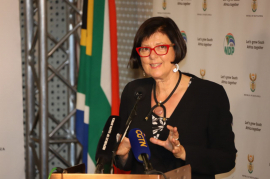
Minister of Forestry, Fisheries and the Environment, Barbara Creecy, has emphasised the importance of paying special attention to particularly vulnerable individuals, households and communities as the country feels the effects of the global climate change.
Delivering her department’s 2022/23 budget vote to the National Assembly on Wednesday, the Minister said climate change induced disasters are the most significant threat to people, economies and the natural world today.
She said the recent floods in KwaZulu-Natal illustrated the human tragedy behind the 6th International Panel on Climate Change Report.
“Women and girl children living in rural areas are directly impacted by climate change and the increase in changing weather patterns and natural disasters.
“It is imperative that we face the urgency of the climate crisis. Climate resilience will need to be built across the system and special attention must be paid to particularly vulnerable individuals, households and communities.
“As the providers of food, fuel and water for their families, they have an important role to play in climate change policy development and management in South Africa,” Creecy said.
The current work by the Presidential Climate Commission to support the co-creation of a Just Transition Framework for South Africa emphasises that all people affected must be part of developing solutions, and that there must be an equitable distribution of risks and opportunities so that vulnerable workers and communities do not carry the burden of change.
“The process can only succeed if it helps us with our broader developmental objectives, namely, economic inclusion, employment and building a more equal society.
“In line with our revised ambitious Nationally Determined Contribution (NDC) to reducing greenhouse gas emissions, we have developed the Sectoral Emission Targets (SETs) framework that outlines emission reduction goals for key sectors of the economy. The process of allocating SETs will start in the 2022/23 financial,” the Minister said.
The adoption of the Climate Change Bill by Parliament is expected to put in place the domestic architecture for Climate Change mitigation and adaptation. The adoption is expected to take place this year.
Through the National Climate Change Adaptation Strategy, all 44 district municipalities have been supported to develop climate change adaptation strategies. Current work includes support to ensure integration of climate priorities into the Integrated Development Plans.
“A Presidential Climate Finance Task Team, headed by Daniel Mminele, is leading a technical team to understand the full details of an offer by developed countries to mobilise $8.5 billion (R131 billion) over the next three to five years to support the implementation of our revised NDC and to begin our Just Transition, “the Minister said.
Upgrading Weather Service infrastructure
Creecy has dismissed recent media coverage that casts doubt on the Weather Service’s ability to predict severe weather events and protect citizens from the impact of climate change.
“These reports are untrue. Weather warnings were issued ahead of the floods from 11 – 12 April and were updated with the intensity of the weather event, to a Level 5 warning on the morning of 11 April, and to a Level 8 warning or severe impact by 8pm that night.
“To ensure, despite revenue shortfalls, our forecasting ability is state-of-the-art, we have allocated the South African Weather Service an amount of R100 million over three years to upgrade its infrastructure, starting with R15 million in 2021 – 2022,” Creecy said.
South Africa continues to face severe air pollution in the three highly industrialised priority areas of Vaal Triangle, Highveld and the Waterberg-Bojanala areas.
The regulations for implementing and enforcing priority area air quality management plans will be published before the end of 2022.
“To improve waste management in municipalities, the department is not only assisting in the development of their Integrated Waste Management Plans and training local government on sustainable waste management practices, we are also donating vehicles required to transport waste to landfill. This includes skip loader trucks, front-end loaders and compactor trucks,” the Minister said.
Protecting wildlife
Cabinet is expected to consider the White Paper on Conservation and Sustainable Use of Biological Resources, emanating from the policy work linked to the High Level Panel (HLP) Report on the management, breeding, hunting, trade and handling of elephant, lion, leopard and rhinoceros, in June this year. Thereafter, it will be published for public comment.
On the recommendation to close the captive lion breeding industry, the Minister intends to establish a Panel of Experts to formulate and oversee implementation of a voluntary exit strategy by those who wish to participate.
“I believe that by engaging and working with stakeholders, we can develop a voluntary strategy that can mitigate risks, including the effect on the local economy, job creation and the welfare and well-being of the lions themselves,” the Minister said.
The panel will have clearly defined terms of reference, and tight timelines, so that effect can be given to the HLP recommendation, and the decision emanating from the 2018 Parliamentary Colloquium on Lions.