
By Lehlohonolo Lehana.
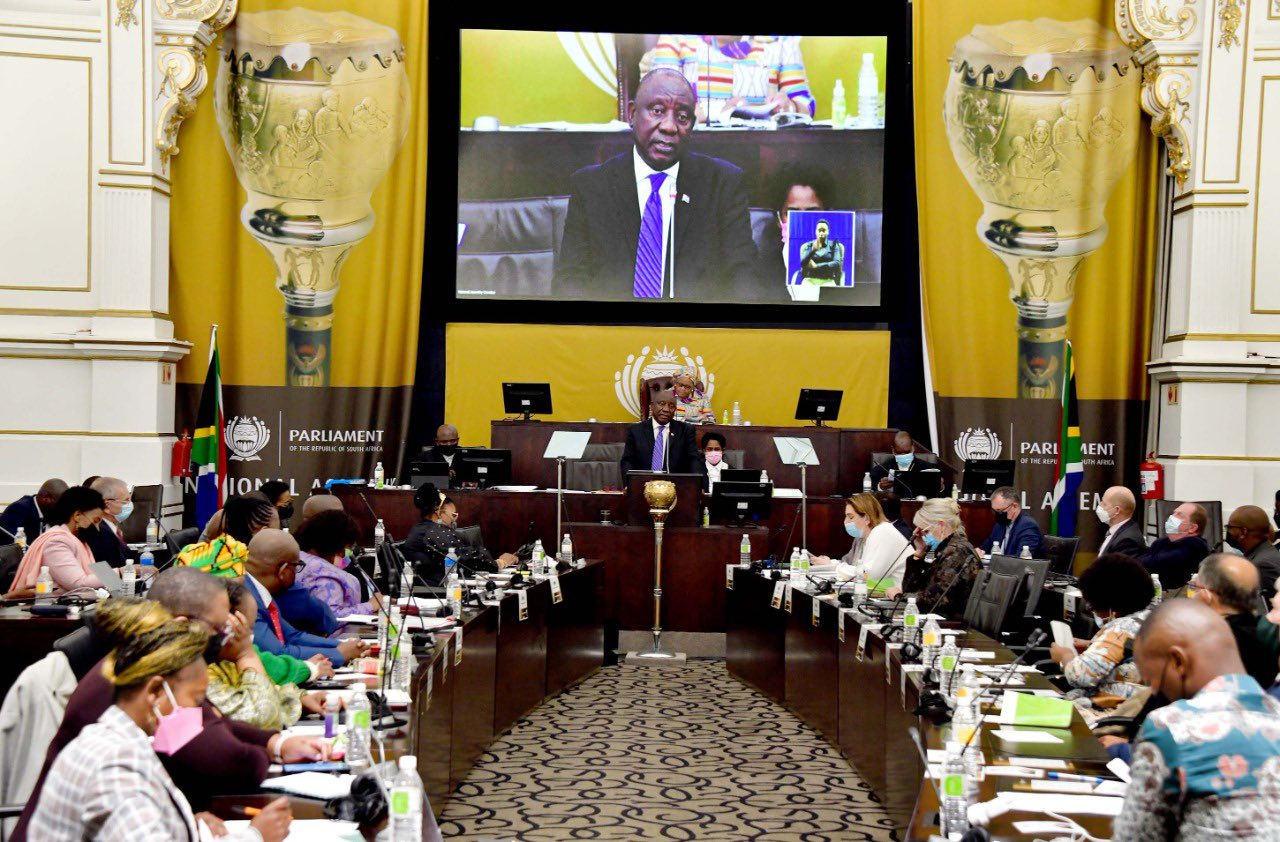
President Cyril Ramaphosa outlined six steps for addressing the country’s electricity shortfall in a Budget Vote speech that was delayed and disrupted by Economic Freedom Fighters who objected to the address from proceeding in light of a criminal complaint having been lodged against Ramaphosa in relation to the alleged theft of foreign currency from his Limpopo farm in 2020.
Answering in a parliamentary Q&A session, Ramaphosa said that once these changes are implemented, the country will have multiple generators competing with Eskom to supply electricity at the lowest cost and sell power directly to customers.
“We will unleash new public and private sector investment in generation capacity at a massive scale. In the short term, however, we are seized with the need to get as much new generation capacity onto the grid as possible, as quickly as possible. “The current electricity shortfall is estimated at up to 6,000 MW, Ramaphosa said.
The president added that government plans to close the electricity gap in six ways:
Improve the performance of existing power stations and ensure that additional units at Medupi and Kusile come online according to schedule.
Ensure that projects from existing procurement programmes, including Bid Window 5, are able to reach close and connect to the grid as quickly as possible.
Accelerate private sector investment in generation capacity under 100 MW.
Enable Eskom to purchase surplus power from existing power producers.
Support municipalities to procure power independently.
Encourage households and businesses to invest in small-scale solar power installations and feed energy to the grid.
Ramaphosa also confirmed that the government was finalising new legislation which will see the separation of Eskom into separate operating units.
“The Electricity Regulation Amendment Bill provides for the establishment of a separate transmission company and a competitive market for electricity has been published for comment. We are working to table the final version in Parliament in the coming months,” he said.
The government is also making progress in signing deals with independent power producers, he said.
“In April, Bid Window 6 of the renewable energy procurement programme was opened for 2,600MW of solar and wind power. The first three risk mitigation projects have signed their power purchase agreements.