
By Lehlohonolo Lehana.
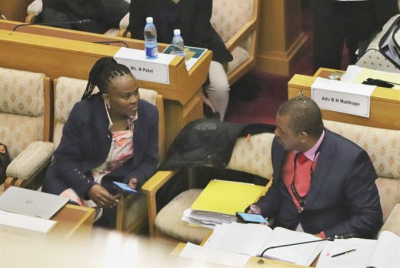
Public Protector investigator Livhuwani Tshiwalule, who was involved in the Public Protector Reserve Bank investigation is testifying before the Section 194 Committee.
Evidence leader Nazreen Bawa SC led the inquiry through certain of the rulings given in relation to the CIEX Reserve Bank matter – where public protector Busisiwe Mkhwebane unlawfully sought to amend the mandate of the Reserve Bank.
She had also ordered Absa to pay R1.1-billion for an apartheid-era bailout provided to its predecessor Bankorp by the Reserve Bank.
Her findings were contested by the Reserve Bank and Absa, which applied to the court for the report to be set aside and to declare that Mkhwebane had abused her powers. They succeeded in that application.
The investigation into the CIEX/SARB matter started under former public protector Thuli Madonsela.
Mkhwebane’s eventual report ignited much controversy, one of the reasons being that she included remedial action that Parliament must amend the Constitution to change the SARB’s mandate and nationalise it.
Mkhwebane, in an affidavit, later admitted she was wrong to instruct Parliament to amend the Constitution. Still, her report was reviewed and set aside with scathing findings by the High Court, reinforced by a majority ruling from the Constitutional Court.
At the time the investigation came to a head in 2016 and 2017, a battle to take control of South Africa’s financial institutions and National Treasury – which resisted, among other things, the since-aborted nuclear deal with Russia – was in full swing by those favourable to state capture.
Tshiwalule joined the Office of the Public Protector in 2014.
At that stage, the SARB investigation was at a fairly advanced stage, he said.
Former SARB governors Tito Mboweni, Gill Marcus and Chris Stals had been interviewed, as had former finance minister Trevor Manuel and former president Thabo Mbeki.
Tshiwalule testified Madonsela wanted to complete the CIEX investigation before her term ended in October 2016, but this target was not reached. There was, however, a draft provisional report to which Madonsela suggested changes.
Shortly after Mkhwebane took over – with Tshiwalule the only member of Madonsela’s private office staff remaining – she wanted to review the investigation.
Mkhwebane told him there was “pressure from society” to release the SARB/ CIEX report. Tshiwalule said Black First Land First (BLF) had a “keen interest” in the report.
At the time, the BLF was aligned with the Guptas’ interests. Tshiwalule later testified they camped outside the Public Protector’s office and received KFC.
Tshiwalule handed the report to Mkhwebane with Madonsela’s suggested changes.
He also delivered two boxes with evidence and electronic files. Mkhwebane later asked him to investigate the ownership models of other countries’ reserve banks.
He looked at the US, Chinese, Nigerian, Russian and Zimbabwean reserve banks. He did not understand why he had to do it, because it had nothing to do with the complaint, he told the committee.
The complaint was laid by Accountability Now’s advocate Paul Hoffman SC.
Mkhwebane signed a provisional report, which was to be sent to implicated parties on 21 December 2016.
Tshiwalule said in his affidavit there were changes made to the provisional report released by Mkhwebane. These changes were made without his involvement, and he did not know where they came from.
He said he could confirm the provisional report signed and sent out by Mkhwebane “did in material respects differ” from the report left behind by Madonsela.
Among the changes was the complete executive summary, which was, according to Tshiwalule, “entirely new”.
Another change was the findings they made against the “three TMs” – Manuel, Mbeki and Mboweni – were removed during Mkhwebane’s term.
Livestream Video Below:
Video Courtesy of Parliament.