
By Lehlohonolo Lehana.
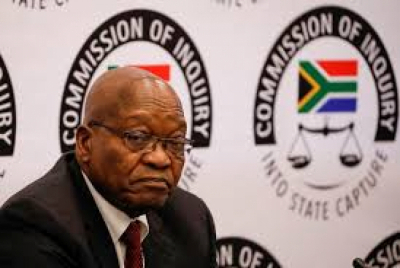
The Supreme Court of Appeal (SCA) has reserved judgment in former president Jacob Zuma’s appeal application to overturn a high court ruling that set aside his release on medical parole.
Zuma was granted medical parole after being admitted to hospital days after he handed himself in.
In July last year the Constitutional Court found him guilty of contempt of court and was to serve 15 months in prison.
The Gauteng High Court in Pretoria has ruled that former correctional services boss Arthur Fraser’s decision to place Zuma on medical parole was unlawful – and ordered that he should return to jail.
The SCA bench hearing the appeal bought by Zuma and the department of correctional services was led by Judge Nambitha Dambuza.
The four other judges on the bench were Tati Makgoka, Clive Plasket, Nolwazi Mabindla-Boqwana and Glenn Goosen.
The Supreme Court of Appeal has heard submissions by lawyers representing the commissioner of correctional services defending the granting of medical parole for Zuma.
Advocate Mantlheng Mphahlele, acting on behalf of the Department of Correctional Services (DCS), argued that Fraser was well within his powers to release the former president on medical parole in September 2021, even though the Medical Parole Advisory Board recommended against Zuma’s release from jail because he did not suffer from a terminal illness.
Mphahlele argued that Fraser used his discretionary powers because the independent recommendations of the Medical Parole Advisory Board were not binding on him.
“The report by the Medical Parole Advisory Board cannot be the one that makes that determination as to whether the sentenced offender is terminally ill or not.
“That report is an additional one where it will make a recommendation in terms of whether medical parole should be granted or not. Therefore, it is not binding on the national commissioner as has been submitted by the respondents,” Mphahlele said.
The Democratic Alliance (DA), the Helen Suzman Foundation and AfriForum successfully challenged his release on parole at the high court.
Advocate Mphahlele argued that in terms of the Correctional Services Act, Fraser considered the reports from Zuma’s doctors that he should be released on medical parole, but he was not obliged to follow the recommendations of the Medical Parole Advisory Board.
“The national commissioner has discretion on whether to accept that report of the Medical Parole Advisory Board or not, because the discretion to grant or refuse the medical parole lies with the national commissioner and it does not lay with the board,” Mphahlele said.
SCA Judge Mabindla-Boqwana grilled Mphahlele on Fraser’s discretionary powers to grant an offender medical parole.
Mabindla-Boqwana questioned whether Fraser chose to ignore the recommendations of the Medical Parole Advisory Board, as an independent statutory body, and went with the reports supplied by Zuma’s doctors.
The terminal illness or medical condition that Zuma allegedly suffers from has not been disclosed in public or in the courts, in order to protect his privacy and human rights.
Zuma’s lawyer, advocate Dali Mpofu, made the argument, during the former president’s appeal of a high court ruling that set aside his release last year on medical parole.
Mpofu contended that Zuma’s terminal illness or medical condition was determined by his doctors who are registered with the Health Professions Council of South Africa (HPCSA), and therefore their conclusions could not be questioned.
“How can a court of law know better than medical experts? Nobody has said they were bribed or belonged to some faction or what what.
They are experts in respect of whom we must assume that they have discharged their professional duty and they say the man is suffering from a terminal disease.”
He argued that if the DA, the Helen Suzman Foundation and AfriForum wanted access to Zuma’s full medical records, they should have fought for them in order to determine whether Fraser’s decision was unlawful or not.
This is despite the fact that the organisations had initially sought access to Zuma’s health records on a confidential basis, but when they tried to get them – the former president’s lawyers refused to grant them that limited access.
The respondents ended up agreeing to accept the redacted record of Fraser’s decision.
Mpofu said the absence of Zuma’s medical records before the SCA could only prejudice the three organisations.
Max du Plessis SC – for the Helen Suzman Foundation – took the SCA through the steps required before medical parole can be granted. He stressed that it is required that medical parole applications must be referred to doctors who are specifically appointed by the correctional services department. Dr Mafa did not fall within that category, he said.
Advocate Labuschagne, arguing for Afriforum, made a very brief submission before handing over to Advocate Margaretha Engelbrecht SC, for the Institute of Race Relations. She argued that Fraser was not empowered to grant Zuma medical parole – because he was found guilty of civil contempt of court.
Livestream Video Below:
Video Courtesy of ENCA.