
By Lehlohonolo Lehana.
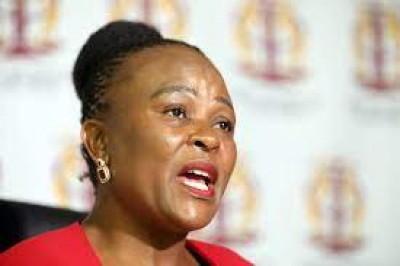
Suspended Public Protector Busisiwe Mkhwebane brought an urgent application in the Western Cape High Court to invalidate the order of her suspension.
Last week Friday, Western Cape High Court Judges Lister Nuku, Matthew Francis and James Lekhuleni ruled that President Cyril Ramaphosa’s decision to suspend Mkhwebane – after she sent him questions about the break-in at his Phala Phala farm in Limpopo – was invalid and “improper”.
The judges based that finding on, among other things, the fact that Ramaphosa had suspended Mkhwebane the day after she publicly announced her Phala Phala investigation.
Mkhwebane said the Democratic Alliance’s argument that she “should have nothing to do” with the ongoing Phala Phala investigation was “baseless” – and she rubbished claims that her involvement “will only undermine” the probe’s legitimacy.
Mkhwebane wasn’t present in court. She has been booked off sick from Tuesday until Friday.
Advocate Dali Mpofu who was representing Mkhwebane has focused on addressing the arguments by the DA and the President that the High Court’s invalidation of Mkhwebane’s suspension needed to be confirmed by the Constitutional Court to become effective – and points out that 172 (2)(b) states that: “b. A court which makes an order of constitutional invalidity may grant a temporary interdict or other temporary relief to a party, or may adjourn the proceedings, pending a decision of the Constitutional Court on the validity of that Act or conduct.”
Section 172(2)(a) of the Constitution provides that: “(2)(a) The … a High Court of South Africa … may make an order concerning the constitutional validity of … any conduct of the president, but an order of constitutional invalidity has no force unless it is confirmed by the Constitutional Court”.
Mpofu argued that the abuse of power that the High Court found that Ramaphosa was guilty of constitutes “exceptional circumstances” justifying Mkhwebane’s immediate reinstatement.
Mpofu said Mkhwebane’s predicament is that she has been suspended for three months and a week, while all that she has done, is her work.
“The only predicament of the DA is vindictiveness and vengeance and hatred,” said Mpofu.
Adv Vuyani Ngalwana representing the ATM, UDM and PAC argued that Mkhwebane was removed “for daring to investigate” Ramaphosa over Phala Phala. But neither he nor Mpofu acknowledges that the suspension was followed by a two-year process and protracted litigation that led to Mkhwebane now facing an ongoing inquiry into her fitness to hold office.
An independent panel has found that there was prima facie evidence of misconduct and incompetence against Mkhwebane, a decision that led to a section 194 committee being set up to investigate her. It was after the inquiry began its work that Ramaphosa suspended Mkhwebane.
Adv Karrisha Pillay SC, on behalf Ramaphosa said Mkhwebane and the opposition parties supporting her have tried to contend that Ramaphosa’s decision to suspend the Public Protector did not amount to conduct and therefore did not require confirmation from the Constitutional Court.
This is not correct, she argued – and said the constitution states, in unambiguous terms, that an order relating to conduct of the president has no force until it is confirmed by the apex court.
Pillay said there is jurisprudence that decisions made by the president, amounts to presidential conduct.
While 172(2)(b) of the Constitution enables the granting of an interim interdict in relation to cases involving invalid conduct by the president, Pillay pointed out that Mkhwebane failed to raise this when she sought the urgent enforcement of the High Court’s order invalidating her suspension. Instead she pursued her case under section 18(1) of the Superior Courts Act.
Pillay said Section 18 does not apply to this case – precisely because the constitution requires that an order of invalidity must be confirmed by the ConCourt to become effective.
Pillay argued that: “Section 18(1) of the Superior Courts Act provides for exceptional circumstances as the threshold for a Court to depart from the default position that the operation and execution of a decision which is the subject of an application for leave to appeal or of an appeal, is suspended pending the decision of the application or appeal.
It follows that the exceptionality of the circumstances must relate to the underlying question, namely whether the default position should be departed from. It is not enough to argue (as Adv Mkhwebane does) that this is a very unusual case, or a very important case, or even a unique case. That fact, if proved, does not bear on why there should be a departure from the default position.”
Pillay submitted that an application for leave to appeal would suspend the order, and it is incumbent on the litigant to provide exceptional circumstances to justify lifting the suspension.
Another exceptional ground Mkhwebane advanced is to that her suspension delayed the Phala Phala investigation. Pillay said no facts to prove this has been provided. Furthermore, Ramaposa’s lawyer provided an affidavit that he cooperated with the investigation, and Acting Public Protector Gcaleka also denied that the investigation has been delayed.
Adv Steven Budlender on behalf of the DA, said he will not be drawn into Mpofu’s political grandstanding and insults. He’ll focus on points of law.
Budlender said the argument that when presidential conduct has been overturned on common law grounds it is not subject to Constitutional confirmation, has been rejected by the Constitutional Court 20 years ago.
Budlender argued that Section 18 of the Superior Courts Act – under which Mkhwebane bought this case for urgent reinstatement – has no bearing on this case. As a result, he suggests, this litigation is dead in the water.
Judgment has been reserved.
Livestream Video Below:
Video Courtesy of JRSA.