
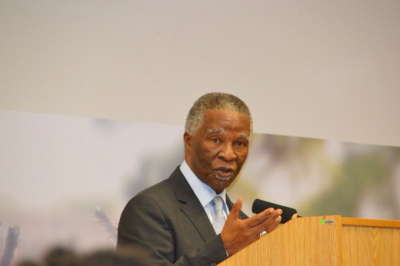
By Lehlohonolo Lehana.
Former president Thabo Mbeki has pointed the finger at the political leadership for South Africa’s challenges, including the energy crisis that for the second time in two months has plunged the country into some of the worst rolling blackouts.
Mbeki has not minced his words, and used every possible opportunity to speak publicly about the country’s challenges.
Speaking during a dialogue with UNISA students on Wednesday, Mbeki said the country was facing serious challenges, ranging from leadership, energy crisis, safety and security and the economy among others.
As South Africans contend with rolling power cuts, which have recently been lowered to stage 5, following the weekend announcement of stage 6 load shedding, Mbeki quoted former statistician-general Pali Lehohla on the crisis at the national power utility.
Just before I came, Lehohla made an interesting observation regarding the energy issue, that Eskom is a big engineering institution but also a big business. And he said, therefore, in terms of its leadership, you need engineers and economists, but instead we have politicians and accountants. I am not saying he was right, but he was looking at the issue of the quality of leadership in the country.”
Why do we seem to be incapable to address this matter? Is it because of what Lehohla is raising? Maybe it’s the answer.”
Mbeki said he thinks Lehohla was right, considering the situation around the new power stations Medupi and Kusile.
“Why are the new power stations misbehaving like the old ones,” Mbeki asked.
Mbeki further said understanding the problems at Eskom would require a look at its history and the decisions, especially around the construction of the Medupi and Kusile power stations that were made in 2007 when South Africans were first plunged into darkness.
The two power stations have been fraught with challenges which include maladministration, negligence, and a flawed design process – resulting in continuous delays adding close to a decade to completion and a ballooning budget.
Mbeki says instead of implementing a turnkey project, Eskom’s leadership at the time broke up the contract to construct the power stations into 20 to 30 contracts, which has had calamitous results.
The roots of the current electricity crisis can, ironically, be traced back to Mbeki’s tenure as president.
Mbeki infamously believed that investing in electricity infrastructure was not a priority, and that the private sector would step in to plug the cracks which were beginning to show as far back as the early 2000s.
In 2006, he told the National Assembly that there was no energy crisis, and that load shedding, which was then a new phenomenon, was simply an “opportunity for economic growth through infrastructure expansion”.
Mbeki also bemoaned the leadership vacuum in South Africa and the role of the African intelligentsia in deciding the future of the continent.
He charged that many Africans had a legitimate claim for being in SA, having contributed to the liberation struggle against apartheid.
For instance, he said, the Nigerian government as part of its input had done crowdfunding among ordinary Nigerians for the ANC’s fight against apartheid.
Such people had an emotional attachment to SA and to think they could be chased away was impractical and impossible.
“Part of the reality here is that you have many people crossing from Eswatini into SA to collect grants. It is the same for Lesotho,” said Mbeki.
“Now, do you want to put an electric fence there to stop those people coming? These are foreign national who are coming to take your grants. SA has got to be bigger than that,” he said.
Mbeki said SA has always been “the engine of the transformation of the continent for the better” and benefit of all Africans.
The ANC was formed as a Pan-Africanist-leaning political formation which cannot change now by spitting out other Africans who are in the country.
Instead, African countries as a whole should seek integration of its peoples in all aspects of life as regional blocs and SA should be part of this mission.
Said Mbeki: “We have had a SADC agreement which provides for free movement of people as part of that process of integration. The African continent has a similar protocol which addresses the same thing — free movement of people.
The former president also responded to a question on HIV/AIDS. He was asked: “Is there anything you feel you would have done better, especially with regards to HIV/AIDS policies?”
His response: “The questions I asked then, I still ask them today.”
“When people say to me HIV causes AIDS, I say one virus causes a syndrome. You can’t say one virus causes all of these illnesses. What you can say is that this virus impacts negatively on the immune system.”