
By Lehlohonolo Lehana.
Various civil society organisations have objected to the Electoral Amendment Bill, which is up for adoption in the National Assembly on Thursday after the Portfolio Committee on Home Affairs completed its work on the legislation last week.
The groups, including the Organisation Undoing Tax Abuse (Outa), Build One South Africa and Solidarity, said that the bill relies solely on the minority view provided by the minister of home affairs, Aaron Motsoaledi, and if passed, will disenfranchise voters significantly.
“The foundations of our electoral system are based on the long traditions of the liberation struggle that call for ‘one person, one vote of equal value.”
The proposed system regarding how individual candidates are dealt with in the electoral significantly erodes the equality of vote, betraying the Consitution and centuries of the liberation struggle, said the group.
Changes to the electoral system stemmed from a ruling by the most authoritative court in South Africa, the Constitutional Court, that in the case of New Movement NPC and Others v President of the Republic of South Africa, in 2020, gave parliament 24 months to amend the Electoral Act to make it possible for independent candidates to contest national and provincial elections – this deadline has since lapsed.
Parliament was tasked with renovating the law to allow individual candidates to run for political office while not being affiliated with a specific political party. The “workable solution” now met by parliament is under pressure.
The case resulted in two opposing views, the majority and the minority, the latter being the foundation of the new amendments.
The majority view
“The majority view suggested that South Africa should adopt a mixed electoral system, with 200 seats in the National Assembly being voted directly from single-member constituencies and the remaining 200 being determined from proportional representations lists, as it pertains in local government with the 50/50 split of seats.”
This view contended that this would result in fairness for individual candidates and achieve the constitution’s requirement for an electoral system that results in general proportionality of the outcome, said the group.
The minority view
This view, which was subsequently relied on, adopted a ‘minimalist approach’ for the inclusion of such candidates.
It defines whole provinces as constituencies and forces independent candidates to compete with political parties – and not individuals representing a party – as it pertains to a municipal level.
“It is a system that does not exist anywhere else in the world and is patently unsuitable for enabling independent candidates to fairly contest in elections.”
Government Response
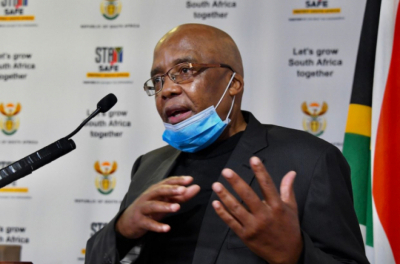
Motsoaledi said the outpouring of opposition to the Electoral Amendment Bill on the eve of its expected adoption in the National Assembly is part of the democratic process.
Motsoaledi was speaking at a press briefing after the opening of the 5th General Assembly and International Conference of the Association of World Election Bodies (A-WEB).
Motsoaledi appeared unperturbed by this development.
He added that it is not the first time that there has been opposition to a bill so close to its adoption, with accompanying calls for the president not to sign it.
“It’s exactly what democracy is all about.”
Motsoaledi dismissed concerns that the bill was unconstitutional as something that “happens almost every day”.
He said before a bill goes to Parliament, it is first submitted to the Cabinet. Among the documentation presented to the Cabinet is a certificate that a bill is constitutional.
The bill was necessitated by an 11 June 2020 Constitutional Court ruling that declared the Electoral Act unconstitutional “to the extent that it requires that adult citizens may be elected to the National Assembly and provincial legislatures only through their membership of political parties”.
The apex court then suspended the declaration of unconstitutionality for “24 months to afford Parliament an opportunity to remedy the defect giving rise to the unconstitutionality”.
Parliament initially deferred working on the amendment to the Department of Home Affairs.
Motsoaledi appointed a ministerial advisory committee (MAC), chaired by former minister Valli Moosa in February 2021, more than six months after the court order.
The MAC’s majority recommendation envisaged a system that provided a mixed single-member constituency and proportional representation (PR) system.
Motsoaledi and his department went with the minority advice and drafted a bill that relied solely on a PR system, amending the current system as little as possible.