
By Lehlohonolo Lehana.
President Cyril Ramaphosa has allayed the fears of UK business leaders’, saying a number of reforms in South Africa are in place to boost investor confidence in the country.
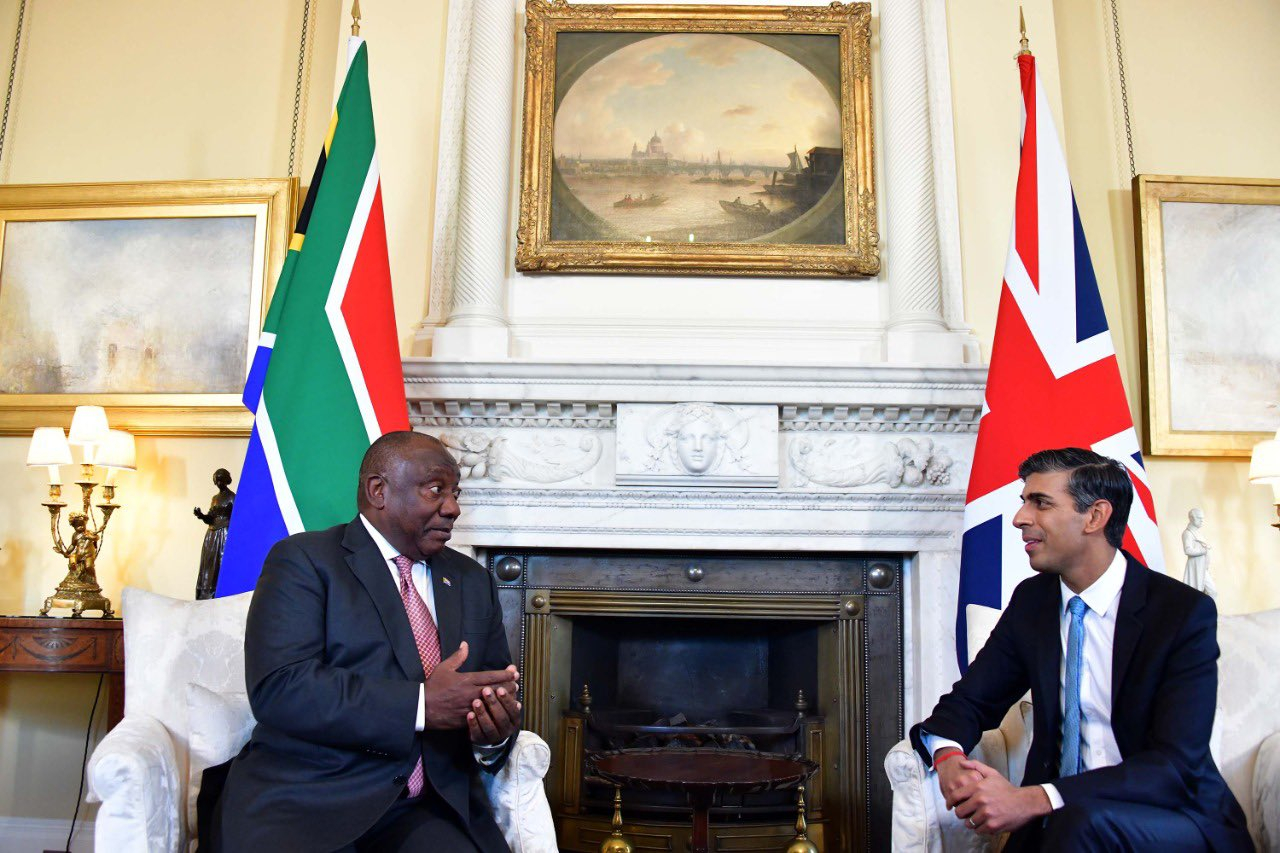
Ramaphosa, who met UK Prime Minister Rishi Sunak at Number 10 Downing Street earlier in the day to discuss trade and investment, met South African and UK business leaders in a bid to convince them South Africa was open for business.
“There are few countries that have the depth of experience and knowledge of the South African economy than Britain,” Ramaphosa noted.
He added: “British companies need to use this advantage to greater effect, to seek out the opportunities in our country for investment and for trade.”
While there were many attractions and much potential for investors in South Africa, Ramaphosa said, there are “admittedly a number of constraints on economic growth and social development”.
He said for more than a decade South Africa had been confronted with a shortage of electricity.
“We have taken urgent steps to remedy this dire situation by significantly and rapidly increasing the construction of new generating capacity.
“We have accelerated the procurement of renewable energy and have removed many of the regulatory hurdles to greater private investment in embedded generation,” he said adding that government is working closely with Eskom to improve the fleet of the utility’s power stations.
The UK is the largest foreign investor in South Africa while several South African companies have a presence in the UK.
He said that government is also undertaking far-reaching reforms to improve the capacity and competitiveness of railways and ports, to open up the telecommunications industry and to improve the supply and pricing of water.
Mechanisms like the Infrastructure Fund have been established to leverage funding from various sources, including the private sector, for substantial infrastructure investment.
In addition, decisive measures to tackle crime and corruption have been taken with law enforcement agencies being rebuilt and being provided with the resources needed to prosecute those responsible for the criminal capture of state institutions.
South Africa is also strengthening the ability of the police and other security services to respond to economic crimes, such as extortion and damage to infrastructure.
“It is important for the South African government to understand the issues, concerns and expectations of British companies and business leaders. We are therefore keen to hear from you on what we can do to encourage you to increase your investment in South Africa,” said the President.
Exports from South Africa to the UK are estimated to support 134,000 South African jobs.
“Bilateral trade is at its highest yet, with goods and services worth £10.7 billion being traded between the United Kingdom and South Africa in the 12 months ending in June this year,” he said.
Meanwhile, a number of UK companies have attended the annual South Africa Investment Conference that the country has held since 2018 – during which significant new investment commitments were made.
Ramaphosa added that South Africa which has free trade agreements with the United Kingdom and European Union, has over the past four years, been putting in place an African Continental Free Trade Area that will connect 55 national economies and more than 1.3 billion people.
“The legal instruments have been completed and countries and customs unions are now finalising their tariff offers, with the intention that trade would commence next year.”
With the UK being the largest foreign investor in South Africa, “it is our intention and our ambition to substantially increase the value and diversify the composition of both trade and investment,” said Ramaphosa.