
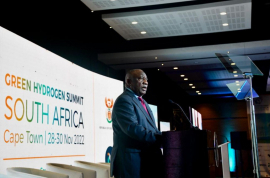
By Lehlohonolo Lehana.
President Cyril Ramaphosa has challenged the global scientific community to find innovations and green tech-driven solutions for the challenges humanity faces, including the climate change crisis.
Ramaphosa was delivering his keynote address on Tuesday at the opening session of the World Science Forum (WSF) in Cape Town.
“We need to ensure that this forum will not only be a platform for vibrant discussion but will also lead to concrete actions harnessing science as an instrument for social justice.”
“The theme for the forum – Science for Social Justice – should guide our deliberations. This theme expresses our conviction that inequality within and between countries is neither just nor sustainable.
Ramaphosa challenged researchers to consider the role science should play in protecting and enhancing human dignity and in fighting poverty, unemployment and inequality.
“For example, the inequality in access to vaccines during the COVID-19 pandemic was a gross violation of human rights and contributed to further loss of life.
“The global scientific community demonstrated the value of cooperation in responding with unprecedented urgency to produce COVID-19 vaccines.”
Meanwhile, he called on the scientists to look at Just Climate Transition, minimising the social and economic impact, and securing the livelihoods of those most vulnerable to climate change.
“Innovation and green technologies must be at the forefront of our response to this challenge and must enable developing economies to exploit new growth opportunities,” he said.
“This is part of the motivation for South Africa’s significant investment in developing a hydrogen economy, which will be presented at this forum.”
He asked how the forum could ensure that contribution of African science is recognised as a global resource that is part of the global responses to global challenges.
“It is fitting that the World Science Forum coincides with a special ceremony to celebrate the start of construction of the global Square Kilometre Array (SKA) radio telescope hosted in South Africa,” he said, adding that the SKA is one example of African-led science excellence on the global stage.
South Africa said it will add 133 dishes to its 64-dish MeerKAT radio telescope to create SKA-Mid in the next phase of developing a so-called Square Array Kilometre (SKA).
Today has huge significance for all of us … working towards building a large, exploratory instrument that can serve our community and advance a number of scientific frontiers,” Joseph McMullin, deputy director-general at the SKA Observatory (SKAO) intergovernmental organisation said.
MeerKAT, which will be incorporated into SKA-Mid, has delivered images of phenomena including stellar nurseries and the chaotic region around the supermassive black hole at the centre of our galaxy, some 25 000 light years from earth.