
By Alex Mitchley.
Following the unrest in July 2021, which saw widespread violence and looting, 4 000 new recruits will be deployed to the Public Order Police (POP) unit.
This was announced by President Cyril Ramaphosa who attended the passing out parade of more than 2 900 recently-trained recruits in Pretoria on Tuesday morning.
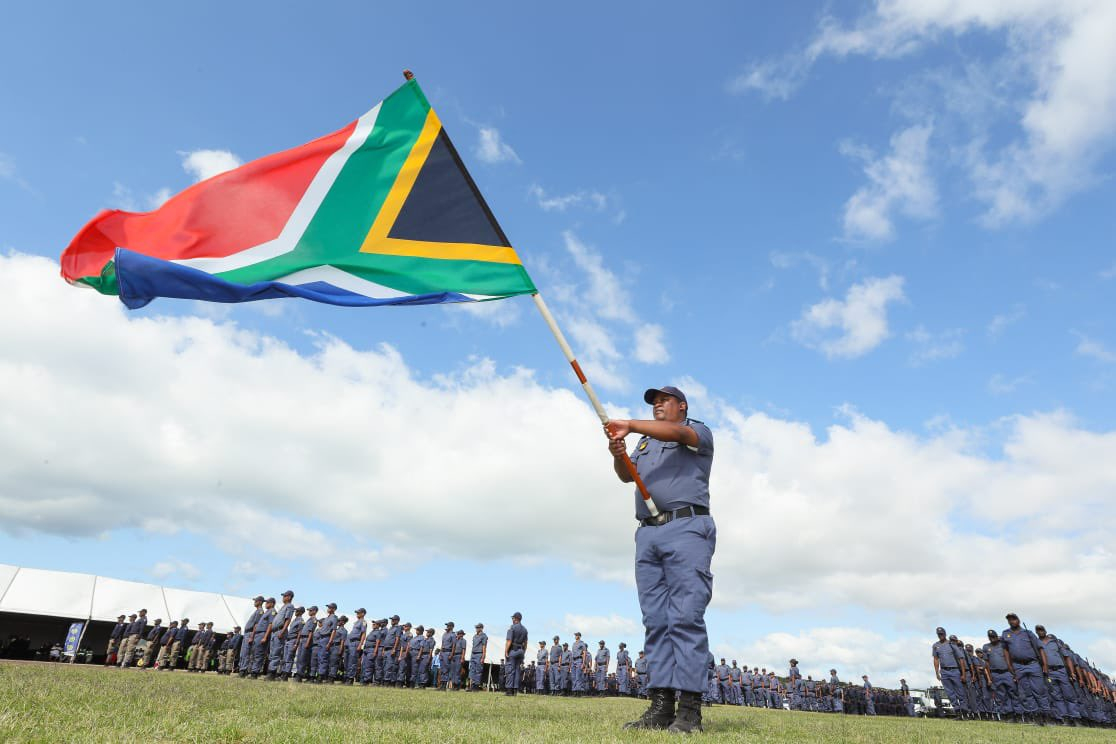
The 2 938 new constables – who are are just some of the 10 000 new recruits – lined up and marched during their passing out parade at the South African Police Service Training Academy on Tuesday morning.
Ramaphosa congratulated the new officers on making it through training.
“This is a culmination of a long and demanding training programme,” he said.
“Your success attests to your grit, determination and sacrifice to ultimately reach the finishing line.
“Congratulations to you and to your other colleagues who will be holding the passing out parade at different training centres across the country this week.”
The president stressed that being a police officer demanded commitment beyond the call of duty.
“It is a role that will test your resolve in fighting crime, upholding the law, and making South Africa a safe and peaceful country.
“If we do not tackle crime, we will not be able to build the better society that we seek.”
July unrest
Ramaphosa said that nearly half the new recruits would be used to strengthen the public order policing.
“During the State of the Nation Address, I also said that the staffing of the SAPS Public Order Policing unit will be brought to required levels, with appropriate training courses in place.
“This was in direct reference to the findings and recommendations from the report of the Expert Panel into the July 2021 Civil Unrest.
“In this regard, 4 000 recruits will be deployed to the Public Order Policing unit.”
He added that some of the newly-qualified constables would also be deployed to other specialised units within the police.
“These include the Family Violence, Child Protection and Sexual Offences units to bolster our capacity to fight the scourge of gender-based violence and femicide.”
National police commissioner General Fannie Masemola said, of the 10 000 recruits, 9 248 were new constables, who “are competent and have the required acumen to embark on their respective policing careers”.
Masemola said the shortfall in making up the 10 000 could be ascribed to different factors, such as non-arrivals, medical reasons, and resignations.
“We are, however, excited to report that we have another 558 trainees at SAPS Academies All Saints, Thabazimbi and Mthatha who started the training on 4 October 2022 and will be finalising their training on 30 June 2023.”
Police Minister Bheki Cele said the latest phase of recruitment was ground breaking.
“On 1 April 2022, following a rigorous recruitment process, 10 000 were called up and ultimately, 9 831 young men and women presented themselves to various police academies across the country,” he said.
“This, Mr President, has been a ground-breaking milestone given that the maximum 10 000 trainees were recruited and trained. Historically, one intake has never in the past exceeded 5 000, as this is what SAPS academies can accommodate.”
Cele said the new constables had successfully completed the longer and more intensive nine-month Basic Police Development Learning Programme.
“All trainees were orientated on the SAPS in general, and taken through the SAPS Code of Conduct, covering professional and ethical conduct.
“The trainees also underwent rigorous training in law, focusing on, to cite a few, the Criminal Procedure Act, the SAPS Act, and other related legislation such as the Constitution within the context of policing.”
Cele said the new recruits were also given the “necessary insight” into crime detection and are trained in understanding the elements of crime, statement taking, and investigations across the spectrum.
The trainees have also been exposed to crime prevention and have received insight into sector policing, community policing, and partnership policing, the minister added.
In addition, the trainees were also exposed to “street survival and the use of firearms where they were equipped with knowledge and skills relating to tactical policing and use of firearms,” he said.