
By Lehlohonolo Lehana.
The African National Congress (ANC) opened its five-yearly elective conference after a more than six-hour delay caused by registration glitches.
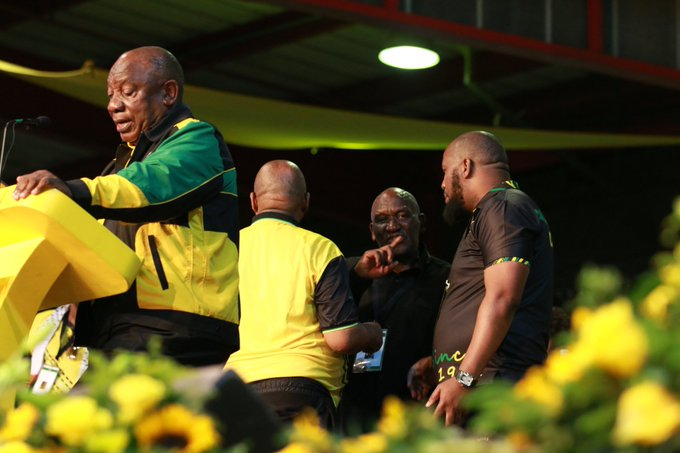
Delegates were summoned to the party’s plenary session shortly before 3 p.m. at the Nasrec convention center on the outskirts of Johannesburg. President Cyril Ramaphosa delivered a political report, which sets the the tone for proceedings that will continue until December 20.
Ramaphosa was interrupted by delegates from KwaZulu-Natal, who want him to be replaced as party leader by the province’s former premier, Zweli Mkhize. They sang songs in support of Jacob Zuma, Ramaphosa’s predecessor who was forced to step down as president in 2018 after being implicated in a succession of scandals.
In his speech, Ramaphosa acknowledged the myriad of challenges the country is facing including rampant poverty and unemployment, low levels of economic growth and ongoing corruption. It was unacceptable, he said, that a quarter of the population live below the food poverty line.
Ramaphosa added that the ANC and previous management at Eskom were responsible for load shedding; he explicitly named four issues that caused the poor situation of our electricity supply: poor policy, poor management, poor maintenance and state capture.
He said the Covid-19 pandemic, the “Russia/Ukraine conflict” and the 2021 July unrest are events that constrained the economy.
Ramaphosa also highlighted several government achievements, including increasing access to welfare grants and education, While 96% of children at the age of six were enrolled at school “we should also be concerned about the drop-out rate from school is unacceptably high, with the result that less than half of the children that start school drop out before they get to grade 12,” he said.
On the state of the economy, Ramaphosa said that, to date, around R1.14 trillion in investment commitments had been raised, and some R300 billion had already been invested in projects.”
The investment drive was accompanied by a range of structural reforms to make the economy more competitive, efficient and capable of growth.
“These reforms have focused on the network industries of energy, telecommunications, water, railways and ports. The insecurity of electricity supply continues to be one of the greatest impediments to economic recovery,” he said.
Meanwhile outgoing ANC spokesperson Pule Mabe said on Friday morning that the decision to halt proceeding against Dlamini Zuma, Mervyn Dirks, Thandi Mahabalela, Mosebenzi Zwane and Supra Mahumapelo had been taken at the special NEC meeting held on Thursday.
The five had voted with the opposition in favour of parliament adopting the report by the section 89 panel, appointed to investigate whether Ramaphosa had a case to answer over the Phala Phala scandal.
Mabe said the NEC had confirmed that MPs backing the party line was “important” and that any members — including MPs — who failed to do so were “undermining the integrity and the unity of the ANC”.
But the body had felt that “we should not use disciplinary measures to stifle debate” and had decided to ask the incoming NEC to “pay attention to the unity of the ANC” while dealing with the disciplinary breaches.
“There is no member who will be coming before the national disciplinary committee,” Mabe said.
The new NEC would “pay attention” to what had happened in the section 89 vote “and other incidents similar to it in the past” and would decide whether to refer them to the national disciplinary committee or any other disciplinary structure.
After Ramaphosa concludes his speech the conference was expected to deal with credentials. The conference room is filling up but not everyone is inside. It’s unclear whether the conference will be able to deal with credentials with some delegates missing.