
By Kevin Rademeyer.
By the time Calum Scott stepped onto the SunBet Arena stage in Pretoria on 17 January 2026, the tone for the evening had already been set. Fans had waited several years for his return to African shores and the anticipation felt unmistakably personal.
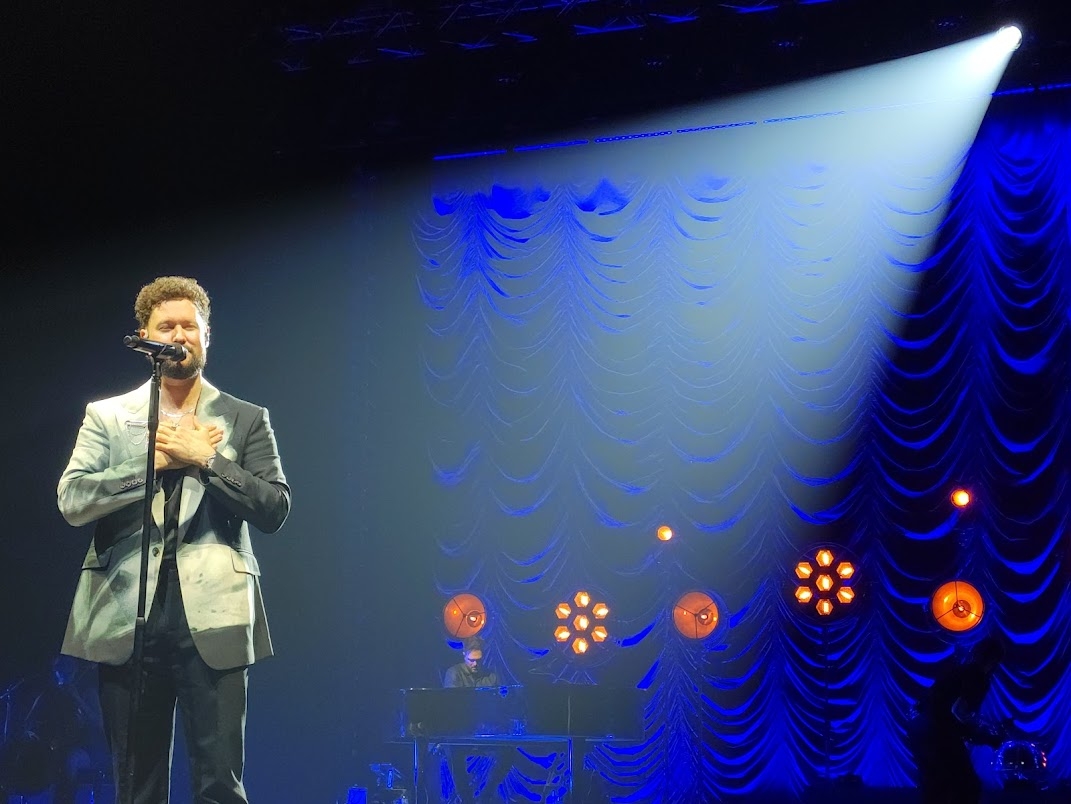
In a sold-out arena packed with 8,500 people, Scott delivered a performance that was intimate, generous and quietly powerful, reaffirming why South Africa continues to hold a special place in his touring life.
Opening with material from Avenoir and the stirring God Knows, Scott leaned immediately into the reflective mood of his third and most confident album to date. Roots followed soon after, lifting the room with its warm pulse and signalling that this would not be a night spent wallowing in sadness, but one carefully balanced between catharsis and celebration. From the first notes, his voice cut cleanly through the arena, elastic and emotionally precise, filling the space without ever feeling forced.
Scott has long been praised for his ability to connect, but in Pretoria that connection felt unusually raw. Between songs he spoke openly about his journey, reminding the audience that not long ago he was working in a grocery store, quietly dreaming of moments like this. He repeatedly thanked fans for choosing to spend their hard-earned money on seeing him perform, a gesture that landed with sincerity rather than rehearsed humility.
The setlist drew heavily from Avenoir while honouring the songs that first bound his audience to him. At Your Worst and Peripheral Vision were met with mass sing alongs, while Biblical brought a near reverent hush across the arena. The much-loved Crying Corner section stripped the show back entirely, Scott alone under soft light, delivering his songs with an emotional clarity that left little distance between performer and crowd.
One of the evening’s most unexpected highlights came during his reimagined I Wanna Dance with Somebody, with Whitney Houston’s vocals echoing through the arena. The moment was theatrical yet restrained, allowing nostalgia and innovation to coexist without spectacle overwhelming sentiment.
As the tempo lifted with Where Are You Now and Whistle, the seated arena rose to its feet. What had begun as a contemplative evening briefly turned euphoric, with Scott encouraging the crowd to dance, laugh and let go.
The closing stretch felt like a shared release. Die For You was sung with emotional rawness and that was followed by Lighthouse, a song that felt almost autobiographical in this setting. Scott left the stage only to be summoned back for an encore that delivered the expected, and still devastating, one-two punch of ,You Are the Reason and Dancing On My Own.
It was during this finale that two separate couples became engaged, each proposal greeted by roars of approval and visible emotion from Scott himself, who paused to congratulate them and joked that his songs seemed to have that effect. During Dancing On My Own the arena transformed into a constellation of phone lights Thousands of voices carried the final chorus, drowning out the arena speakers entirely.
After the show, Fullview spoke to concertgoers whose reactions reflected the breadth of the evening’s impact. Thandi Mokoena from Johannesburg described the concert as “emotionally overwhelming in the best way. You feel like he is singing directly to you, even in a room this big.” Mark van der Westhuizen, who travelled from Midrand, praised Scott’s honesty, saying: “He never pretends to be bigger than the moment. That is rare”
Not everyone knew what to expect. Lerato Nkosi, attending her first ever concert, admitted she was surprised. “I did not realise how loud it would be or how physical the sound feels. But it was beautiful. I will never forget it.”
Scott closed the night by promising he would be back, a statement met with cheers that suggested the bond between artist and audience remains firmly intact. If his Pretoria debut proved anything, it is that Calum Scott does not need spectacle or excess to command an arena. He needs only his voice, his stories and an audience willing to meet him halfway.