
By Kevin Rademeyer, Sports Journalist.
Analysis- The release of the Rugby World Cup 2027 fixture list has crystallised both the promise and the underlying tensions of a tournament that World Rugby hopes will redefine the global game.
Set across eight Australian cities and built around an expanded 24 team format, the schedule delivers spectacle, commercial heft and logistical complexity in equal measure. It also reopens familiar debates about competitive balance and the cost of innovation.
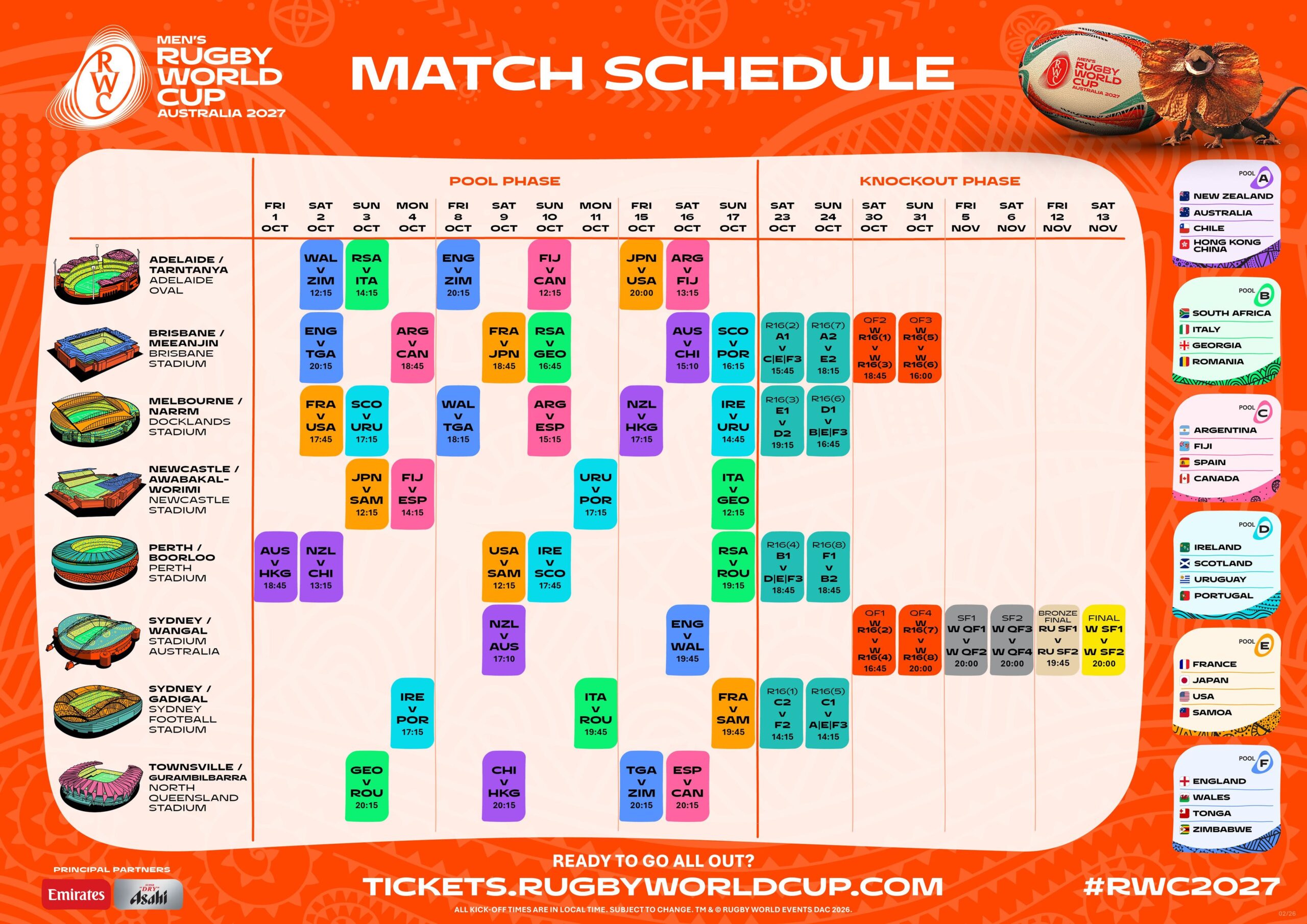
At the centre of the conversation sits Pool A and, in particular, the meeting of Australia and New Zealand in Sydney on 9 October. This is the first time the trans Tasman rivals have faced each other in the pool stages of a World Cup, a fact that instantly elevates the fixture into historic territory. For World Rugby, it is a marketer’s dream. For the Wallabies, it is both an opportunity and a burden.
Hosting the All Blacks in a pool match removes the safety net that has traditionally allowed top nations to build momentum quietly before the knockouts. Accor Stadium will be full, the scrutiny unforgiving, and the result will shape the tone of Australia’s entire campaign.
Yet the same pool also illustrates the softer edge of the new tournament structure. Australia open the competition in Perth on 1 October against debutants Hong Kong China, a moment of enormous symbolic value for Asian rugby. Chile then complete the group, marking their second World Cup appearance and their first ever meeting with the Wallabies.
Alongside the All Blacks, Australia are overwhelming favourites to finish in the top two, and even a slip would not be fatal. With 16 of the 24 teams progressing to the round of 16, the jeopardy that once defined the pool stage is undeniably diluted.
This is the core criticism of the 2027 format. The introduction of a round of 16 was designed to create more knockout rugby and give emerging nations a tangible target. In practice, it risks turning large parts of the group phase into extended preparation blocks for the elite. The possibility that top sides can rotate heavily, manage workloads and still qualify comfortably has unsettled traditionalists. It raises an uncomfortable question about whether the World Cup is drifting towards entertainment at the expense of competitive edge.
South Africa’s schedule embodies this tension. The defending champions begin their title defence in Adelaide against Italy on 3 October, before moving through Brisbane and Perth to face Georgia and Romania.
It is a demanding travel itinerary, yet competitively forgiving. Few doubt the Springboks’ ability to top or finish second in Pool B, which would place their first knockout match in Perth before a likely shift east to Sydney for the quarter finals and beyond.
Head coach Rassie Erasmus has already highlighted the five hour flight and time difference between Perth and Sydney as a planning consideration, underlining how the fixture list shapes preparation as much as performance.
Elsewhere, the draw has reopened old wounds. Scotland once again find themselves paired with Ireland, reprising a rivalry that ended their tournaments in both 2019 and 2023. Their meeting in Perth on 10 October has been greeted with gallows humour by Scottish supporters and quiet satisfaction in Dublin.
It also feeds into the broader critique that the draw was conducted too early, locking in pools before the global hierarchy had time to shift. That administrative decision, taken in late 2025, continues to cast a shadow over the 2027 event.
From an Australian perspective, the fixture list is clearly designed to maximise national engagement. Matches are spread across Perth, Sydney and Brisbane for the Wallabies, ensuring geographic reach and sustained attention. Should Australia win Pool A, they would face a third placed team from Pool C, E or F in the round of 16. Finish second, and the reward could be a clash with one of England, Wales or Tonga. Either route promises narrative weight, if not immediate peril.
The final act of the tournament is more traditional. Quarter finals split between Sydney and Brisbane, semi finals and the final at Stadium Australia, and a showpiece decider on 13 November that World Rugby hopes will rival 2003 in scale and atmosphere. With ticket presales opening in February 2026, the commercial machine is already in motion, and demand for the Australia New Zealand match in Sydney is expected to be ferocious.
In sum, the 2027 fixture list delivers exactly what World Rugby intended. Big matches early, global inclusion, and a long runway of knockout rugby. Whether it also delivers the intensity and uncertainty that define a great World Cup remains an open question. The answers will come not from the schedule itself, but from how seriously the game’s leading nations treat the road laid out in front of them.