
By Lehlohonolo Lehana.
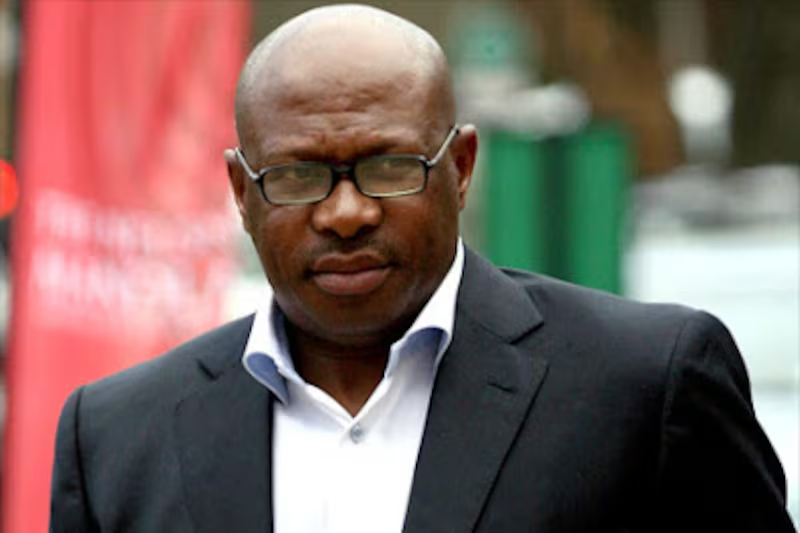
Caption: Former NPA boss Bulelani Ngcuka did not charge former deputy president alongside his financial advisor due to lack of evidence, the institution has revealed. (Photo: Bafana Mahlangu).
Former head of the National Prosecutions Authority (NPA), Advocate Bulelani Ngcuka, has denied allegations of political interference in the failure to prosecute apartheid-era cases.
Ngcuka, who served as national director of public prosecutions from 1998 until 2004, testified before the TRC Commission of Inquiry on Monday.
The commission is investigating allegations regarding efforts or attempts having been made to stop the investigation or prosecution of Truth and Reconciliation Commission cases since 2003.
His evidence was delayed earlier after an application was brought by his team to oppose cross-examination by the Calata family and 24 other families.
The application to cross-examine Ngcuka was brought under the commission’s Regulation 83 and Rule 3.
Ngcuka’s lawyer, Advocate Rafik Banna SC, argued that the application was defective, saying the rules allow cross-examination only by implicated persons.
He said, Ngcuka’s statement does not implicate the applicants and that they, therefore, lack standing to seek cross-examination as required by the commission’s rules.
“The threshold requirement is not met. You are not told in the application why the other remedies are not sufficient.”
Banna also stressed that there is no automatic right to cross-examine witnesses before commission and that such permission lies solely within the chairperson’s discretion.
In response, the lawyer representing the Calata group argued that the objection to cross-examination was without merit and advanced arguments for condonation to be granted.
The chairperson, Sisi Khampepe, has ruled to allow Ngcuka to face examination at a later date, while his evidence in chief will proceed on Monday.
Ngcuka said there was a great expectation from the government that his office would solve problems that were prevailing at the time.
“We really had a challenge. We inherited a country that was bankrupt… the resources to start this were really, really bad, and we greatly relied on sharing the resources with other government [departments]. [Although conditions improved by 2004]…we never had enough resources, and we had serious tensions with Treasury because those guys are trained to say no,” he said.
Last week, former acting NPA head Silas Ramaite testified that he was directed by former Justice Minister Bridgette Mabandla to stop prosecutions in these cases until guidelines were developed on how to proceed.
Ngcuka stressed that there were no political attempts to interfere with the prosecution of TRC cases.
He also pointed to the NPA Act, which requires it to work closely with the Minister of Justice. But nothing of the sort happened during my tenure.”
Ngcuka explained that his office had created the priority crimes unit to handle cases deemed viable, while non-prosecutable cases, such as the death of Steve Biko, were not pursued due to insufficient evidence.
He said under his direction, the unit identified 21 cases, at least six of which were taken to court during his tenure.
Ngcuka is expected to return to the commission in two weeks to face cross-examination.
The establishment of the commission of inquiry is part of an agreement reached in settlement discussions in a court application brought by families of victims of apartheid-era crimes.
The commission will be expected to complete its work within six months from the date of the proclamation and submit its report within 60 days after the completion of its work.
While the families of victims and government have agreed to the establishment of the Commission of Inquiry, they were not able to reach a settlement on other matters in the application. Government believes that these matters will be addressed through the commission of inquiry while the families want the matters to be determined by a court.
Meanwhile Kaizer Kganyago is leaving the Special Investigating Unit (SIU) and will join the National Prosecuting Authority (NPA).
In an internal communication to staff, NPA boss Andy Mothibi said Kganyago joins the prosecuting body as part of enhancing its communications capacity.