
By Lehlohonolo Lehana.
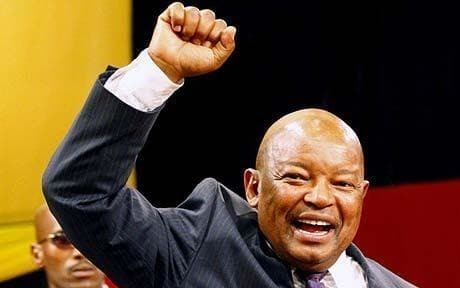
Former Congress of the People (Cope) leader and liberation struggle icon Mosiuoa “Terror” Lekota has died at the age of 77, his party confirmed his passing.
Lekota died in the early hours of Wednesday morning at a Johannesburg hospital.
“The Lekota family has requested privacy during this difficult time, and the party asks the public and media to respect their wishes. The party will issue regular media statements to inform the nation about developments,” said Cope in a statement on Wednesday morning.
“On behalf of the leadership, membership, and supporters of COPE, we extend our deepest condolences to the Lekota family and all South Africans who mourn this loss.”
Further details regarding memorial arrangements and tributes will be communicated in due course.
Lekota had been leading Cope since 2008, when the party was launched following the African National Congress (ANC) Polokwane conference.
He stepped back from active politics after the 29 May 2024 elections, with the party confirming the decision was due to ill health.
Born in Kroonstad in the Free State, Lekota’s activism began at an early age. He was expelled from the University of the North for his involvement in student politics and the Black Consciousness Movement (BCM).
As an organiser of the South African Students’ Organisation (SASO), he was arrested and sent to Robben Island in 1974.
Released in 1983, he was again imprisoned during the 1985 Delmas Treason Trial.
Lekota later served as Free State Premier, First chairperson of the National Council of Provinces (NCOP) and Minister of Defence, before co-founding COPE.
Lekota was one of 11 cabinet ministers who resigned days after former president Thabo Mbeki was recalled. Ten days later, he served the “divorce papers” on the ANC, a move that prompted him, his former deputy Mluleki George and former Gauteng premier Mbhazima Shilowa to found COPE.
The factional struggles within COPE led to its gradual decline and its failure to win any parliamentary seats during the 2024 general elections, ending Lekota’s career as a lawmaker.
Messages of condolence have poured in since the announcement of the passing of Lekota.
President Cyril Ramaphosa hailed Lekota as a patriot with intellect and a personable nature who fought for an inclusive, non-racial South Africa.
“South Africa has lost a patriot, a freedom fighter and a servant of the people whose life story is closely intertwined with our journey of struggle and the realisation of democracy. His life was one of resilience, courage and steadfast belief in justice,” Ramaphosa said.
“We honour him especially for his principled dedication to non-racialism during our struggle and in a liberated South Africa. We deeply value his service to his home province, where he served as premier, and to our armed forces and our national security in his role as minister of defence.”
African National Congress (ANC) secretary-general Fikile Mbalula took to social media, calling the former ANC chairperson a brother.
“As the ANC we remember our former national chairperson and extend our condolences and gratitude to his family and comrades for sacrificing their son for a non-racial, non-sexist and democratic South Africa. We also extend our condolences to COPE, the party he formed.”
The South African Federation of Trade Unions (SAFTU) described him as a committed democrat who dedicated his life to South Africa’s liberation and constitutional order.
“We extend our heartfelt condolences to his family, friends, comrades, and colleagues in the Congress of the People, as well as to all those in the broader democratic movement who worked alongside him over many decades of struggle,” SAFTU said in a statement.
It said Lekota’s life “cannot be understood outside the broader traditions of the African National Congress and the United Democratic Front,” noting that he belonged to a generation that carried “the enormous burden of confronting apartheid at great personal cost.”
The federation highlighted his imprisonment during apartheid and his role within the United Democratic Front (UDF), which it described as a powerful mass democratic movement that united civic organisations, churches, youth and women’s formations, and trade unions.
“Together, they helped build the internal resistance that ultimately made apartheid ungovernable,” SAFTU said, referencing leaders such as Archie Gumede, Albertina Sisulu, Frank Chikane, Popo Molefe, Murphy Morobe, Cheryl Carolus, Beyers Naudé, Allan Boesak, Trevor Manuel and Mewa Ramgobin, alongside Lekota.
“He decided to leave the ANC and formed COPE with other South Africans, by doing so he literally strengthened the opposition parties,” said Bantu Holomisa, South Africa’s deputy minister of defense and leader of the opposition United Democratic Movement party.
“His role was not doubted, because he and others from the ANC did understand the passage of the struggle. And they knew very well what was the original agenda, which seemed to have been hijacked,” Holomisa said.
Lekota earned his nickname on the soccer field as a fearsome attacking player. One could be forgiven for thinking it had been coined by one of Lekota’s political enemies or even allies. Nobody escaped outspoken scrutiny if he vehemently disagreed with them. Lekota is survived by his wife Cynthia and six children.