
By Kevin Rademeyer, Sports Journalist.
Photo Credit: Suresh Rajcoomar.
LIV Golf’s debut in South Africa has reached a pivotal inflection point, where competitive tension and commercial success are now reinforcing one another.
Friday’s second round at Steyn City did more than tighten the leaderboard. It confirmed the event’s capacity to function as both a serious sporting contest and a fully realised entertainment property.
The most immediate signal of that dual success is demand. Organisers confirmed that both Saturday and Sunday are officially sold out, a development that speaks not only to local appetite but to the event’s broader positioning within the global LIV calendar.
In response, Saturday’s third round start has been brought forward, with play now set for a 9:35 am shotgun start after gates open at 8:15 am. The adjustment reflects both logistical necessity and an expectation of sustained high footfall throughout the day. Yet the scheduling shift also underlines a deeper reality. This is no longer a tournament building towards a climax. It is already operating at peak intensity.
At the centre of the competitive narrative remains Bryson DeChambeau, whose 14 under total gives him a narrow but far from secure advantage. His second round encapsulated the volatility of both the course and the field. A remarkable eagle at the opening hole and a rapid early surge suggested separation was possible. Instead, a mid-round stall and a double bogey reintroduced uncertainty.
“Felt like it could’ve been a nine, ten under round today,” DeChambeau admitted, a remark that reveals both dominance and missed opportunity. His lead is intact, but not decisive.
That nuance defines the tournament heading into the weekend. Eleven players sit within four shots of the lead, a compression that places a premium on momentum rather than mere position.
Among those best placed to capitalise is Branden Grace, whose five under 66 moved him to 12 under and into a share of second. His performance was measured rather than explosive, built on control and consistency. In analytical terms, Grace represents the most stable threat. He leads the field in greens in regulation across two rounds and has missed just three targets, a statistic that suggests sustainability under pressure. “This is exactly where I want to be going into the weekend,” he said. “Tomorrow is going to be even more electrifying.”
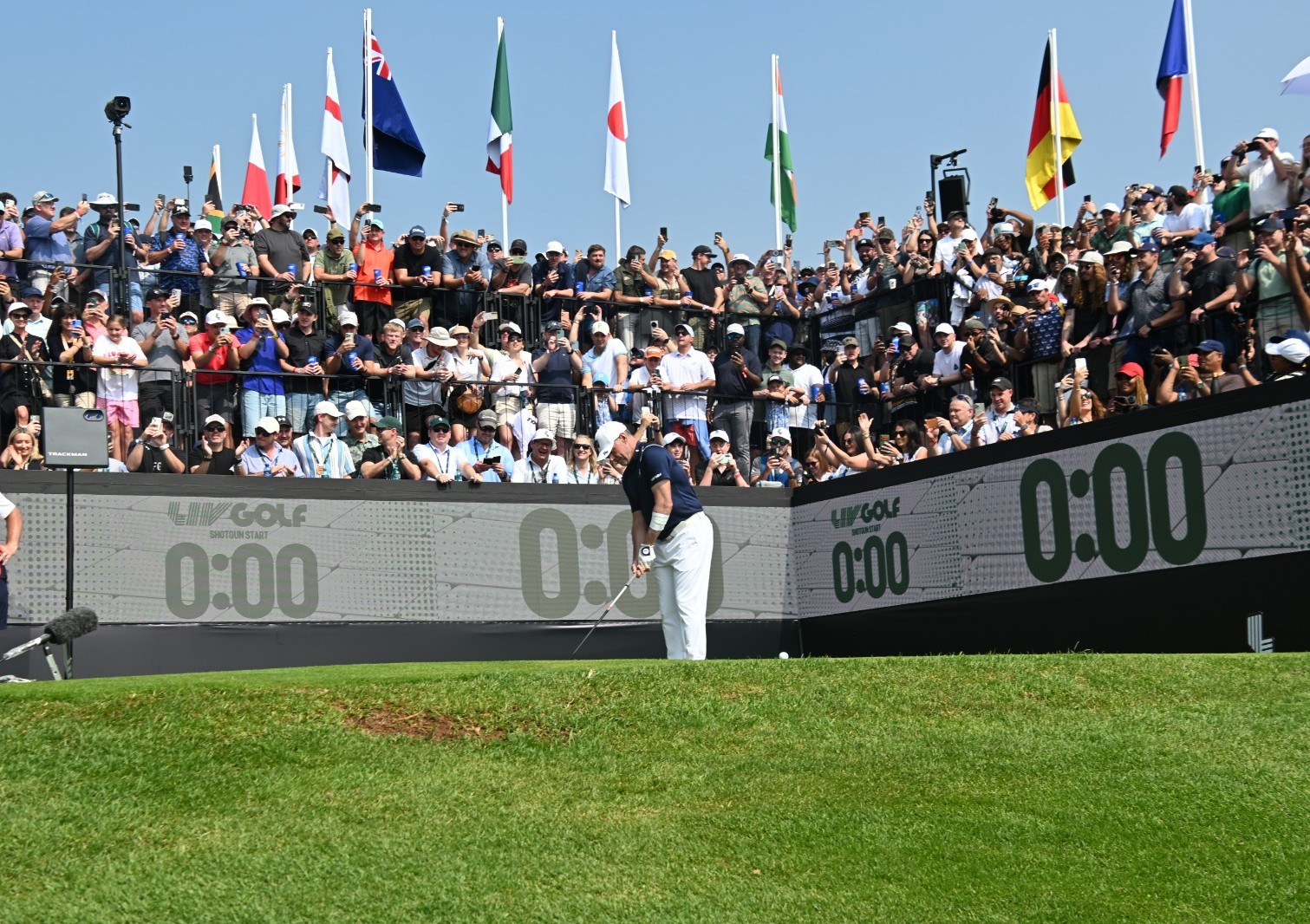
If Grace embodies control, Dean Burmester represents volatility in its most productive form. His seven under 64, matched only by David Puig, was both a scoring statement and a cultural moment. Nowhere was that clearer than at the par three 17th, the “Lion’s Den”, where Burmester’s near hole in one and crowd interaction elevated the hole into a defining symbol of the event. “I’m having a hell of a lot of fun,” Burmester said. “It’s hard not to smile out there.”
This interplay between player expression and crowd energy is not incidental. It is structural. The “Lion’s Den” has emerged as a case study in how LIV’s format seeks to compress entertainment and competition into the same space. The result is a feedback loop where atmosphere influences performance and vice versa.
From a purely competitive standpoint, the presence of players such as Jon Rahm adds further complexity. Rahm remains bogey free through two rounds and sits at 11 under, three shots back. His position is analytically significant. While others have relied on bursts of scoring, Rahm’’ error free approach suggests he may be best equipped to exploit any instability from those ahead.
The team contest mirrors this dynamic equilibrium. Torque GC lead at 36 under, driven by collective consistency from Joaquin Niemann, Abraham Ancer and Carlos Ortiz. The South African backed Southern Guards remain two shots behind at 34 under, still firmly within reach of a result that would carry both competitive and symbolic weight.
What distinguishes this event, however, is that the sporting narrative does not exist in isolation. Off course programming has become integral to the overall experience. Friday’s post round performance by Black Coffee extended the day beyond golf, while Saturday’s schedule reinforces that trajectory, with St. Lucia performing at 4:15 pm followed by a headline set from Calvin Harris at 5:30 pm.
This sequencing is deliberate. It ensures that the event retains its audience beyond the final putt, transforming a traditional sporting day into a sustained cultural gathering. The broader implication is clear. LIV Golf South Africa is not merely testing competitive formats. It is testing audience behaviour. The sold out weekend suggests that, at least in this market, the model is resonating.
As play resumes on Saturday morning, the competitive picture remains finely balanced. DeChambeau leads, but without insulation. Grace carries national expectation with statistical credibility. Burmester brings momentum and crowd energy. Rahm waits with quiet precision.
In analytical terms, the tournament has reached its most unstable phase. Margins are narrow, variables are numerous, and external factors, from crowd intensity to course conditions, are increasingly influential.
What is already certain is that the final two rounds will unfold in front of full galleries, heightened expectations, and an atmosphere that has, by the admission of its leading contender, already begun to feel like Sunday.