
By Kevin Rademeyer, Sports Journalist.
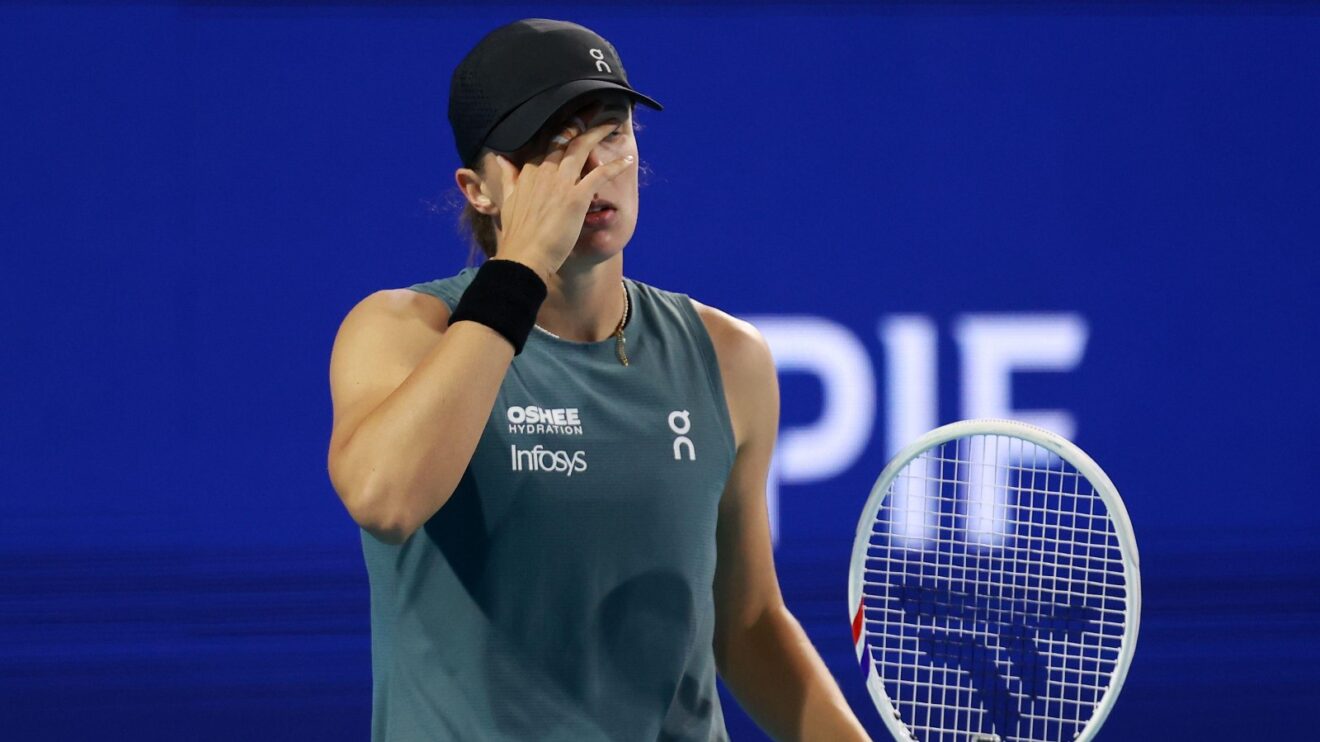
The Miami Open has entered an unexpectedly volatile phase, where external disruption and on court uncertainty have combined to reshape the tournament’s early trajectory. What began as a routine progression for the top seeds has instead evolved into a study of fragility at the highest level, underscored by the shock exit of Iga Swiatek.
The Polish world number three arrived in Miami with a record of near complete reliability in opening matches, having won 73 consecutive first round encounters on the WTA Tour. That consistency appeared intact as she swept through the opening set against compatriot Magda Linette, dictating play with authority and winning the vast majority of points behind her first serve. What followed, however, marked a significant departure from that established pattern.
Linette, ranked outside the top 50, shifted the dynamic by increasing aggression and disrupting Swiatek’s rhythm. The match turned incrementally rather than dramatically. A break in the second set altered momentum, while Swiatek’s tactical clarity began to erode. By the deciding set, control had fully transferred, with Linette closing out a 1–6, 7–5, 6–3 victory to deliver the tournament’s first major upset.
“I stopped doing anything well tactically,” Swiatek admitted. “It was a bad match for me in the second and third sets. I need to work to get back from that, because I haven’t felt things like that for like five years.”
Her assessment points to a deeper issue than a single defeat. This was not simply a loss of execution but a loss of structure. Swiatek described the game as feeling “complicated” in her mind, an indication that the breakdown was as much cognitive as technical.
Linette, by contrast, framed the result in measured terms, emphasising process over occasion. “I was just trying to take more initiative and be a bit more aggressive,” she said, downplaying the scale of the upset while acknowledging its personal significance.
From an analytical perspective, the result exposes a rare vulnerability in one of the sport’s most consistent performers. Swiatek’s dominance has typically been built on control, repetition and clarity of decision making. In Miami, those pillars faltered under pressure, allowing an opponent to dictate terms over extended passages of play.
The upset also unfolded against a backdrop of logistical disruption that has further complicated the tournament’s rhythm. Persistent rain forced organisers to cancel an entire day’s schedule, with all 37 matches wiped out after repeated delays. Both day and night sessions were ultimately abandoned, compressing the timetable and increasing the physical and mental demands on players moving forward.
This convergence of factors, an already congested draw and an early exit for a leading contender, has altered the competitive landscape. Matches are no longer unfolding within a predictable structure. Instead, momentum, recovery and adaptability are becoming decisive variables.
For Swiatek, the immediate consequence is an abrupt halt to a run of sustained opening round dominance. The broader implication is more nuanced. Her comments suggest a period of recalibration may be required, particularly in simplifying tactical approaches under pressure. “I’ll just get back to work, try to get something positive out of the practices and try to figure it out,” she said.
For the tournament, her exit removes a central axis of predictability. In its place is a more open, less certain field, shaped as much by resilience as by ranking. In that sense, the Miami Open has already shifted from expectation to examination. Not of who should win, but of who can adapt when the familiar structures of performance begin to give way.