
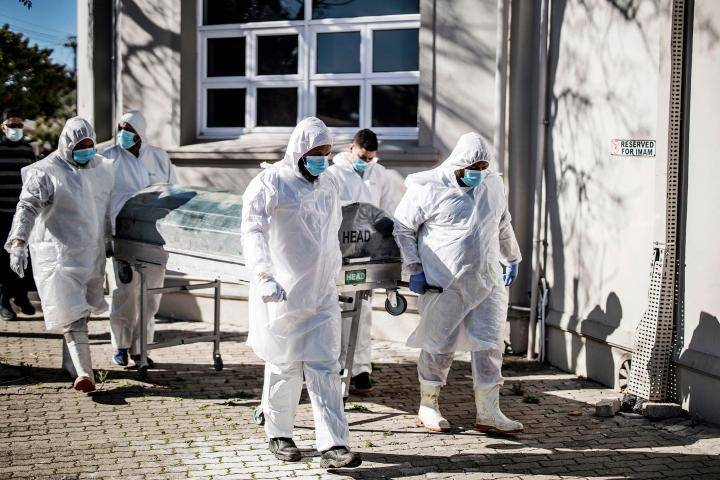
Health minister Dr Zweli Mkhize said in a statement that 6,041 new Covid-19 infections had been recorded in the past 24 hours, taking the cumulative national total to 1,423,578 cases.
The cumulative total of tests conducted to date is 8 058 768 with 39 529 new tests conducted since the last report.
Mkhize said a further 680 more COVID-19 related deaths were reported: Eastern Cape 86, Free State 28, Gauteng 141 , Kwa-Zulu Natal 306, Limpopo 4, Mpumalanga 18, Northern Cape 2 and Western Cape 95 which brings the total to 41 797 deaths.
The most fatalities recorded in 24 hours was 839, on January 19. This is followed by 806 on January 13, the 755 recorded on January 12 and the 712 recorded on January 14.
This means that all five of the country’s most deadly Covid-19 days have come in the past two weeks.
Mkhize added that the recoveries now stand at 1 254 674, representing a recovery rate of 88%.
Meanwhile more than 60 percent of adults would definitely or probably take a COVID-19 vaccine, a survey has found, as the country gears up to administer its first doses of the jab in the next coming weeks.
This is contained in a survey by the University of Johannesburg (UJ) and Human Sciences Research Council (HSRC) on the public’s willingness to take a COVID-19 vaccine and reasons for their decision.
According to the research, 67% of adults would definitely or probably take a vaccine if it was available compared to the 18% who said they would definitely not or probably not take a vaccine, while 15% were undecided.
The findings are from the latest round of the UJ/HSRC COVID-19 Democracy Survey completed by 10 618 participants.
The institutions’ findings were weighted by race, education, age and are broadly representative of the population at large, the researchers said.
“The briefing demonstrates that race, education and age play a role in shaping vaccine acceptance.”
White adults were least “accepting” of a vaccine; 55% responding that they would take the vaccine compared to 69% of Black African adults.
Sixty-nine percent of men indicated that they would take the vaccine in comparison to 65% of women, even though researchers said this was based on a small number of responses.
“Acceptance among adults with less than matric-level education was 72%, compared with 59% for those with tertiary education.”
For those who were either unsure or against taking the jab, the most common explanations related to concerns about side-effects (25%) and overall effectiveness of the vaccine (18%).
Also a majority of people said they needed more information.
“Explanations related to conspiracy theories or the occult did not appear frequently, 7% and 4% respectively.”
In addition, the most common explanations that people gave for wanting to vaccinate were to protect oneself (29%), closely followed by the desire to protect others (25%).
“Another notable finding was that those who expressed a willingness to sacrifice certain human rights to stop the spread of the virus were far more favourable towards vaccination than those opposed to sacrificing rights.”
The HSRC’s Professor Narnia Bohler-Muller has called for education around vaccines and its rollout.
“The analysis shows that vaccine hesitancy comes down to a range of legitimate concerns about a vaccine developed and rolled out in record time, as well as some distrust in the government and corporations. We need a vaccine literacy campaign that provides factual information that will sway the waverers,” Bohler-Muller said.
Her colleague, UJ’s Professor Kate Alexander welcomed the findings.
“It is excellent news that such a large and representative survey shows that 67% now want to take the vaccine. The biggest challenge is to make sure that the majority get what they want,” Alexander added.
In his weekly newsletter, President Cyril Ramaphosa reiterated government’s mass vaccination campaign strategy would reach all corners of the country, prioritising those most in need as the country prepares to receive its first consignment of COVID-19 vaccines.
In coming weeks, the country will receive a batch of 1.5 million AstraZeneca vaccine doses from the Serum Institute of India, the world’s largest vaccine producer.
The President wrote that this would signal the start of a mass vaccination campaign that will be the most ambitious and extensive in the country’s history.
Compiled by Lehlohonolo Lehana.