
By Kevin Rademeyer, Sports Journalist.
Photo Credit: CSA.
There are innings that win matches, and then there are innings that redraw the limits of what feels possible. At the Wanderers Stadium on Wednesday evening, Laura Wolvaardt produced the latter.
For those who have followed her arc closely, this was not a sudden eruption. It was an accumulation. Over the past eighteen months, Wolvaardt has shifted from the game’s most dependable metronome into something far more unsettling for opposition attacks. The timing remains. The balance remains. What has changed is the intent, and with it, the inevitability.
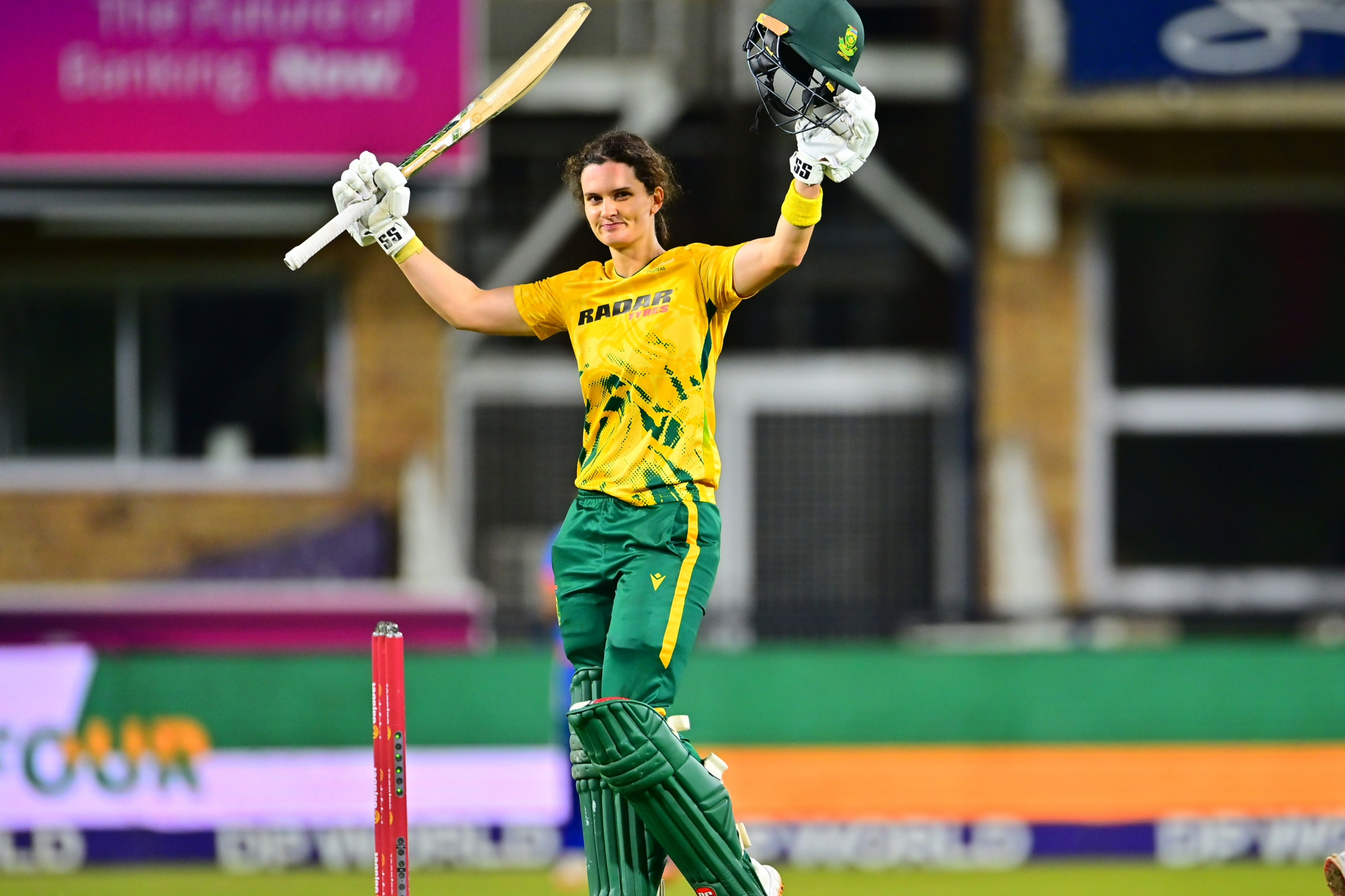
Her 115 from 53 balls against India was an assertion of control against an attack that had, not long ago, dictated terms in global tournaments. Fourteen boundaries were threaded with the precision that first defined her as a prodigy. Five sixes, struck cleanly over long on and through the arc, spoke of a player who has added force without surrendering finesse.
There was a moment, early in the chase of 193, when the equation demanded clarity. Wolvaardt supplied it within a powerplay that yielded 72 without loss, the fastest fifty of her career arriving in just 23 balls. It is here that the transformation is most evident. Where once she absorbed pressure, she now relocates it. Bowlers, even the most experienced, are forced into reaction.
The partnership with Suné Luus, worth 183, will occupy record books for years. Yet even within that stand, there was a hierarchy of influence. Luus was excellent, composed, and increasingly authoritative. Wolvaardt, however, dictated tempo with a quiet authority that has become her hallmark. There were no theatrics at milestones. No flourish at three figures. Just a steady narrowing of the contest until India were, effectively, spectators.
It is tempting to frame this as a peak. That would be a mistake. Those who recall Wolvaardt’s early years will recognise a familiar pattern of progression. Educated at Parklands College, where she achieved seven distinctions, she balanced academic ambition with a burgeoning cricket career, even embarking on medical studies while travelling the global circuit from Australia to England to India.
She debuted for South Africa at 16, the youngest South African to score an international century. The foundations were always exceptional. The expansion has been methodical. What distinguishes this current phase is not only output, though 220 runs in three matches against India tells its own story.
It is the manner in which she now shapes contests. Against spin, she advances or sweeps with conviction. Against pace, she trusts her hands and placement, manipulating fields that once constrained her. Most tellingly, she finishes what she starts. Chases are no longer guided. They are closed.
After the match, her words were revealing in their restraint. The focus remained on the group, on the rarity of a series win against India, on the work still to be done. There is a captaincy thread here that mirrors her batting. Calm, unsentimental, quietly exacting. “We are in a very good space. We are improving every single game,” Wolvaardt said, though she had already thought of the next challenge. “It is a good surface, and we have been getting the better of the tosses. Once we lose the toss and have to bat first, that will be a different story but that’s what this five-match series is for”.
South African cricket measures its greats not only by numbers, but by moments that alter expectation. It is the territory once occupied by figures like Graeme Smith, AB De Villiers and Mark Boucher, where leadership and performance converge under pressure. Wolvaardt’s innings belong in that conversation.
South Africa’s nine wicket victory and unassailable 3 nil series lead will be recorded as a dominant result. Yet the deeper significance lies in what it reveals about their captain. This is no longer a player finding her way through an innings. This is a cricketer who understands precisely how to dismantle one.
India posted 192 for four, a total built on authority and intent. South Africa replied with something colder, more exact. They reached the target with 21 balls remaining, not through recklessness, but through sustained precision. “I just tried to win the game as quickly as I could,” Wolvaardt said afterwards. “I realised pretty early on that the ball was sliding on nicely.
My main thought was to max the Powerplay and once we got out of the Powerplay, just try to stay with the rate. “I knew chasing 190, we needed a pretty good start so I just came out with a lot of intent. The wicket was nice and flat”
There is a sense now that when Wolvaardt walks out, the parameters of the contest shift subtly in South Africa’s favour. Not through noise, but through certainty. Bowlers search for plans. Captains adjust fields. And still, she finds the gaps.
But with expectations, comes a new pressure. Laura Wolvaardt is no longer simply South Africa’s most elegant batter. She is their most decisive one. One that can win a World Cup in less than two months’ time.