
By Kevin Rademeyer, Sports Journalist.
The Betway SA20 tournament is still in its relative infancy, and the language of “growth” can often feel routine, even rehearsed. Yet the figures attached to this latest edition resist that cynicism. This was the competition’s most complete season to date, not only in numbers, but in authority. On the field, in the stands, and across broadcast markets, SA20 is beginning to look less like an ambitious project and more like a settled force within the global franchise landscape.
The ambition has always been clear. To position itself just behind the Indian Premier League in stature, while becoming South Africa’s definitive summer spectacle. Season Four suggests that ambition is no longer aspirational. It is measurable.
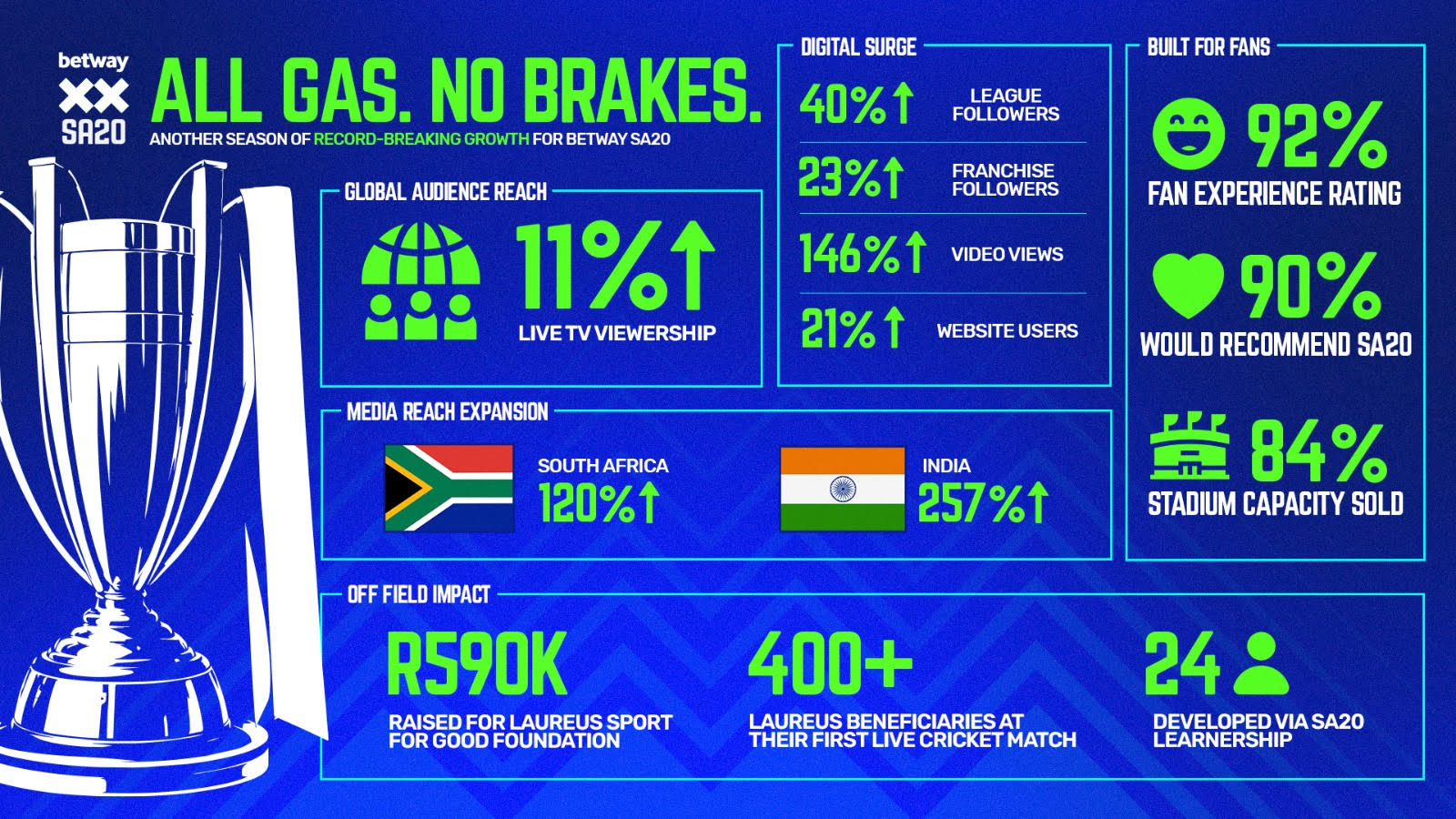
Start with the most immediate barometer: the crowd. 22 of the 34 matches were sold out. Overall attendance hovered at 84 percent of capacity. The final, staged at a packed Newlands Cricket Ground, was sold out for a fourth successive year. These are not inflated festival figures.
They reflect repeat engagement, reinforced by a match day experience that drew a 92 percent satisfaction rating, with nine in ten spectators willing to recommend the event. This matters. South African cricket has long understood that atmosphere is not an accessory. It is currency. In SA20, it is being spent wisely.
The cricket itself matched the stage. A season that featured the competition’s first Super Over, a cluster of centuries and five wicket hauls, and a league table unresolved until the final group fixture, delivered the unpredictability that sustains interest beyond novelty. The awards list underlined a deeper point. Quinton de Kock, Ottneil Baartman, Marco Jansen and Dewald Brevis headlined a cohort in which local players did not merely participate, but dominated. That balance between international draw and domestic strength remains the league’s most valuable asset.
There is, too, a pipeline being quietly reinforced. The emergence of 19 year old Nqobani Mokoena, rewarded with a Proteas call up, is precisely the outcome administrators would have hoped for when mandating youth inclusion across squads. It is not development by slogan. It is development with consequence.
The final itself provided a fitting crescendo. Sunrisers Eastern Cape secured a third title, confirming a dynasty in the competition’s early years, but only after a contest that demanded nerve. Tristan Stubbs and Matthew Breetzke combined for an unbroken 114 to close out a chase that had seemed beyond reach, particularly in the wake of Brevis’s remarkable 101. It was high quality cricket played under genuine pressure, the sort that builds credibility rather than merely filling schedules.
Off the field, the numbers for Season 4 are equally instructive. Domestic broadcast audiences rose sharply, with SuperSport recording a 17 percent increase in unique viewers per match and a 30 percent rise in overall consumption. Internationally, the footprint expanded steadily, with notable traction in India through platforms such as JioStar and JioHotstar, where digital engagement surged.
Digital growth more broadly tells its own story. A 146 percent increase in video views and a 40 percent rise in followers point to a product that translates effectively beyond the boundary rope. Modern leagues do not survive on attendance alone. They require relevance in the fragmented attention economy. SA20, increasingly, has it.
Commercially, the tournament has matured into a platform rather than a sponsorship vehicle. Partners such as Betway, Suzuki and Absa leveraged the competition to deliver tangible engagement, from high volume fan activations to direct consumer rewards. These were not peripheral gimmicks. They were integrated experiences, designed to deepen connection between brand and audience.
There is also a quieter layer of impact. Learnership programmes involving two dozen young professionals. Hundreds of first-time attendees were brought into stadiums through social initiatives. Funds raised for the Laureus Sport for Good Foundation. In isolation, these may appear modest. Collectively, they signal a league aware of its broader responsibility.
Graeme Smith, once the custodian of South Africa’s Test ambitions, now oversees a different kind of innings as commissioner. His assessment of growth, both in player confidence and structural strength, carries weight. SA20 is not simply exporting entertainment. It is reinforcing an ecosystem.
There remains, of course, the question of longevity. Early success is one thing. Sustained relevance is another. Yet as the league moves towards its fifth season, the indicators are reassuring. Crowds are returning. Players are invested. Broadcasters are expanding. Sponsors are committing.
In a sporting landscape crowded with short format leagues, differentiation is essential. SA20’s lies in its blend of local identity and global aspiration, in full stadiums rather than half empty promises, and in cricket that, more often than not, justifies the noise around it. Betway SA 20, Season 4 did not just advance the competition. It legitimised it.