
By Lehlohonolo Lehana.
President Cyril Ramaphosa has reaffirmed government’s commitment to protect collective bargaining and workers’ labour rights.
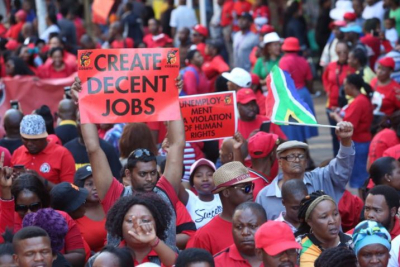
Speaking at a Cosatu event in Johannesburg in honour of workers on International Workers’ Day, Ramaphosa said he believes government’s representatives and public sector unions should return to the Public Service Coordinating Bargaining Council (PSCBC) and work on a solution to the current deadlock over wage negotiations.
He addressed the event in his capacity as the president of the ANC.
Unions in the public service are threatening to embark on mass industrial action over workers’ demand for a 7.1% wage increase.
This after the government stuck to its 0% wage hike last month and presented a revised offer that included a review of allowances and leave for public servants, among other benefits, at the PSCBC.
The Department of Public Service and Administration has described the wage talks as the most difficult in years due to the effects of the Covid-19 pandemic on the state’s coffers and the need for urgent reforms in the public service.
Ramaphosa said South Africa was already in a precarious economic position even before the pandemic.
“The precarious economic situation is having a negative impact on our people as a whole as the reprioritisation of spending affects expenditure in a number of areas.
“The precarious economic situation has also had an impact on our ability to finalise a wage agreement with public servants. The government reaffirms its commitment to protecting collective bargaining and all other labour rights that many sacrificed so much for,” he said.
Ramaphosa said the ANC heeded the call to return to the wage bargaining table and have thorough negotiations.
Social partners working mainly through the National Economic Development and Labour Council (Nedlac), have put together the elements of the Economic Reconstruction and Recovery Plan.
This plan sets out a series of actions aimed at fundamentally changing the economy and the jobs market and making it more inclusive and equitable.
“Some of these programmes are beginning to show positive effects such as the Presidential Employment Stimulus, which was established in response to the economic impact of COVID-19 and is the most rapid expansion of public employment in South Africa’s history,” the President said.
The stimulus supports a range of programmes from expanding traditional public employment to protecting existing jobs and providing support for livelihoods.