
By Lehlohonolo Lehana.
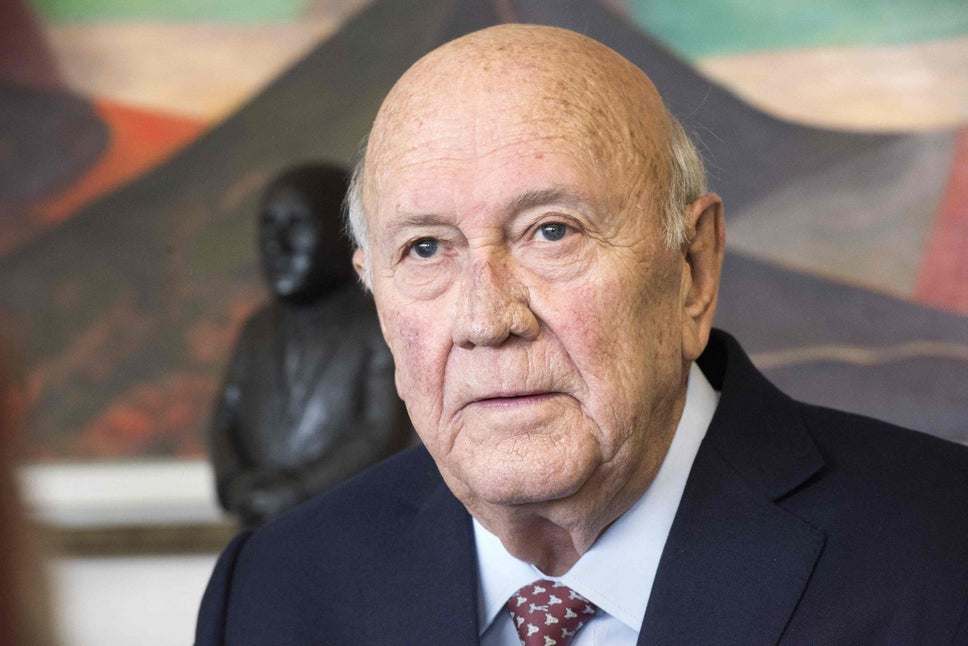
FW de Klerk, the former president of South Africa and the last white person to lead the country, has died at the age of 85.
Messages of condolences poured in on Thursday, for late president de Klerk.
The Nelson Mandela Foundation is saddened to hear of the passing of F W de Klerk. We send our condolences to his wife Elita and their family.
De Klerk will forever be linked to Nelson Mandela in the annals of South African history. As head of state, he oversaw the release of Madiba from prison on 11 February 1990. In 1993 they were jointly awarded the Nobel Peace prize for ushering in a negotiated settlement that led to South Africa holding its first democratic election in 1994. De Klerk also served as deputy president of South Africa in Madiba’s government of national unity until he resigned in 1996.
Over the years we worked productively with him and the De Klerk Foundation on a number of projects.
Speaking at De Klerk’s 70th birthday celebrations, Madiba said:
“You and I have had our differences, some of them very public. Our basic respect for one another has, however, never diminished. And it was that respect for the other irrespective of all differences that made it possible for us, and our organisations, to work together and to negotiate that historic compromise that the world marvelled at. If we two old, or ageing, men have any lessons for our country and for the world, it is that solutions to conflicts can only be found if adversaries are fundamentally prepared to accept the integrity of one other.”
De Klerk’s legacy is a big one. It is also an uneven one, something South Africans are called to reckon with in this moment.
The Democratic Alliance (DA) notes with sadness the passing of former State President and Nobel laureate, FW de Klerk, at the age of 85 in his home in Cape Town after a battle with cancer.
Mr de Klerk‘s contribution to South Africa‘s transition to democracy cannot be overstated. His decision, within a year of taking over the presidency from PW Botha in 1989, to unban liberation movements, release Nelson Mandela from prison, lift the ban on political marches and begin the four year negotiation process towards our first democratic election was a watershed moment in our country‘s history. De Klerk also took the decision to dismantle the country‘s nuclear weapons programme. These things were not considered possible under any of his predecessors.
Importantly, he was also able to bring the majority of white voters along with him, and this played a critical role in ensuring that the transition happened peacefully and that the 1994 elections, as well as the constitutional negotiations, were embraced by all South Africans. This process required calm heads and responsible leadership on both sides of the table, and it was fitting that both he and Nelson Mandela were honoured in 1993 with the shared Nobel Peace Prize.
Swapping the presidency for his new role as leader of the official opposition, de Klerk continued to play a pivotal – and robust – leadership role in Parliament, as well as in the Government of National Unity, where he served as Deputy President under President Mandela.
He continued this work through the FW de Klerk Foundation, which he established in 1999, and which sought to further democracy, accountability and constitutionalism, as well as supporting a number of charities that care for disabled and disadvantaged children.
The DA extends its deepest condolences to the de Klerk family – his wife, Elita, his children, Susan and Jan, and his grandchildren. May they find strength and comfort in this difficult time. And, rather than dividing our country, may his passing and his memory make us even more determined to work towards a united South Africa.
FW de Klerk occupied an historic but difficult space in South Africa, the Office of Archbishop Desmond Tutu says.
“He was the last head of state of a minority government after 350 years of colonial and apartheid rule, who ceded power to a hugely popular President Nelson Mandela after the country’s first democratic elections in 1994,” said Dr Mamphela Ramphele, acting chairperson of the Archbishop Desmond Tutu IP Trust and co-ordinator of his office.
“He was jointly awarded the Nobel Peace Prize with Mandela for his contribution to setting South Africa on the road to peace and justice. Although some South Africans found the global recognition of Mr De Klerk hard to accept, Mr Mandela, himself, praised him for his courage in seeing the country’s political transformation process through.”
Ramphele said after De Klerk appeared at the Truth and Reconciliation Commission before Tutu, the Archbishop addressed the media to express disappointment that the former President had not made a “more wholesome apology on behalf of the National Party to the nation for the evils of apartheid”.
“But in more recent years, the Tutus and De Klerks developed closer relations. The late FW De Klerk played an important role in South Africa’s history. At a time when not all of his colleagues saw the future trajectory of the country unfolding in the same way, he recognised the moment for change and demonstrated the will to act on it.’
The reactions here in South Africa echo the divisions that have stalked FW de Klerk for decades. Some see him as a decent man, a rare politician who took the unusual step of negotiating a path – for himself and for his party – out of power, and in doing so, helped to steer the country away from the racial civil war that many feared would engulf South Africa in the late 1980s and early 1990s.
But others, including Nelson Mandela, were more guarded, seeing de Klerk as a political opportunist, a conservative Afrikaaner, who realised that with the Cold War over and international sanctions biting, he had no alternative but to negotiate with the black majority.
In recent years, a younger generation of South Africans – some encouraged by populist politicians – have sought to question the compromises that accompanied South Africa’s transition to democracy, and have argued that De Klerk and other apartheid leaders should be held responsible for the death squads that targeted members of the liberation movement.
[WATCH] Former president FW de Klerk has apologised for his role in apartheid. In a video released by his foundation shortly after his death, de Klerk apologises for the pain and the indignity of apartheid. #DStv403 #eNCA pic.twitter.com/6ivKxxeZds
— eNCA (@eNCA) November 11, 2021
De Klerk did apologise for elements of apartheid, but right up until his death he still struggled to acknowledge that the apartheid regime’s actions – in treating millions of black South Africans as second class citizens, limiting their education, and banishing them to black “homelands” – constituted a crime against humanity.