
By Kevin Rademeyer, Sports Journalist.
The United Rugby Championship (URC) has reached the point where systems are tested. Quarter finals are often about emotion and momentum. Semi-finals are about detail. A missed cleanout, one defensive disconnect or a poor exit can decide a season.
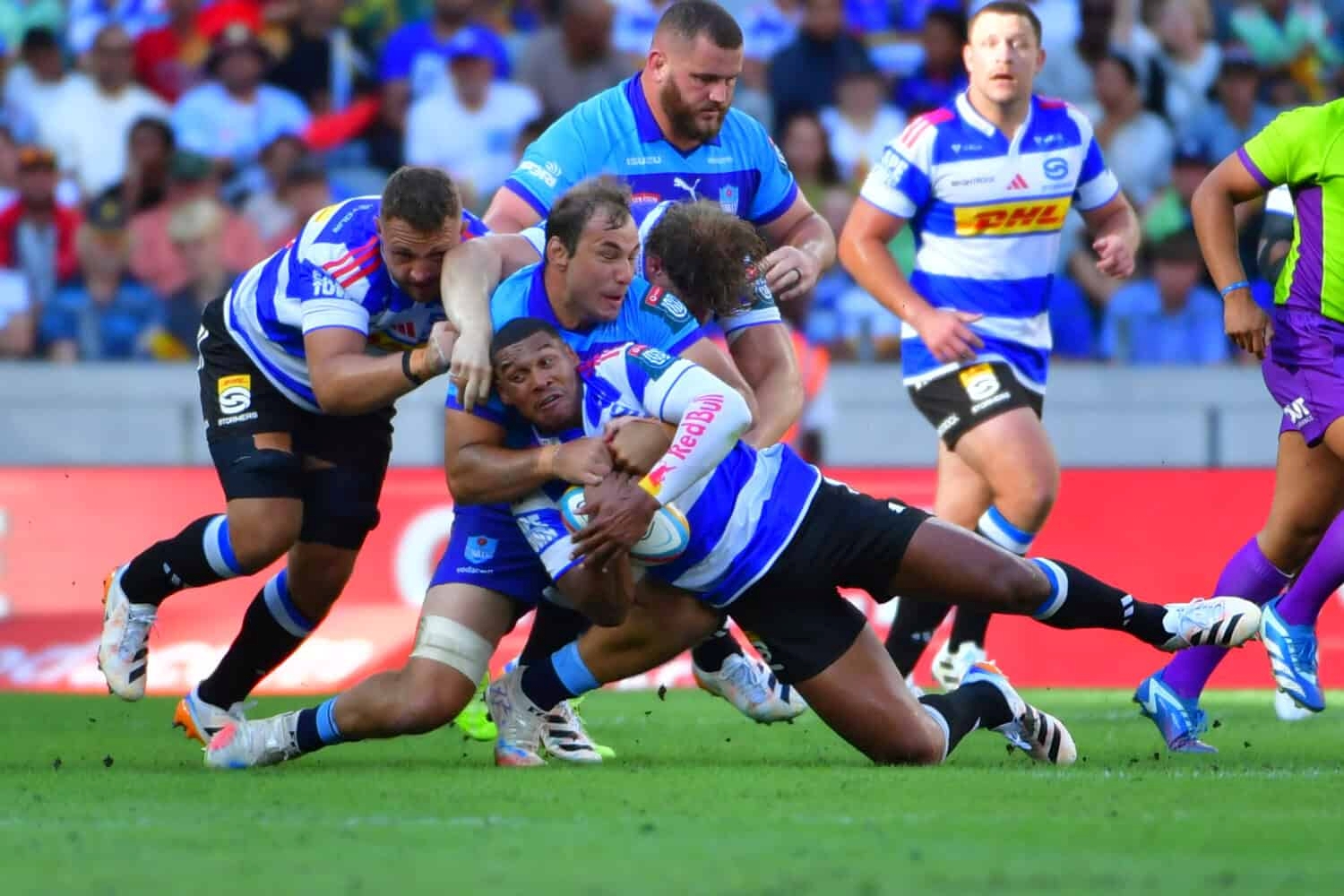
That is exactly where the Vodacom Bulls and DHL Stormers find themselves this weekend as they travel north for two very different challenges against Glasgow Warriors and Leinster.
On paper, both South African sides are underdogs. In reality, both have clear routes to victory.
The Bulls’ trip to Edinburgh feels like a collision between the competition’s most dangerous attack and its most complete defence. Glasgow finished the regular season at the top of the standings because they rarely beat themselves. Their defensive system is aggressive without being reckless, and they are exceptionally good at forcing opponents into long sequences where patience eventually breaks down.
The Bulls arrive with a different weapon.
They have scored more points than any other team in the competition and are entering the semi-final on the back of seven consecutive URC victories. Last week’s dismantling of Munster showcased exactly why they remain one of the most dangerous knockout teams in the competition.
The biggest tactical subplot may sit at scrum time.
Because Glasgow have shifted the match from Scotstoun’s synthetic surface to Murrayfield’s natural grass, the Bulls pack could become a far greater factor than many anticipated. Johan Ackermann’s decision to retain Francois Klopper ahead of Springbok Wilco Louw suggests continuity and momentum are being prioritised, but Louw’s impact from the bench could prove decisive during the final quarter.
The Bulls will also believe they can challenge Glasgow through Embrose Papier and Handré Pollard. Few halfback combinations in world rugby manage territory as effectively. Glasgow thrive when George Horne can accelerate the game and create quick ball. Pollard’s challenge will be to slow that rhythm, force Glasgow into longer kicking exchanges and turn the contest into a field-position battle.
Ackermann described the match as a “game of inches” and that feels accurate. Glasgow’s defence against the Bulls’ attack is arguably the defining contest of the weekend.
The second semi-final presents an entirely different puzzle.
Leinster remain the most structured team in the competition. Their attack is built on relentless phase pressure, repeatable patterns and an ability to stretch defensive systems until cracks appear. The challenge facing the Stormers is not simply stopping Leinster. It is disrupting the machinery before it starts rolling.
John Dobson has been unusually direct in his assessment. “Leinster are a machine,” he said this week. “The question is how you put them under pressure and how you break down that machinery.”
Recent evidence suggests there may be a blueprint.
Bordeaux’s Champions Cup final victory exposed weaknesses when Leinster were denied clean possession and forced into uncomfortable transition moments. The Lions also found success by slowing Leinster’s rhythm around the breakdown and challenging their ability to generate quick ball. The Stormers will attempt something similar.
That task becomes significantly harder without Sacha Feinberg-Mngomezulu and Ruben van Heerden. Feinberg-Mngomezulu’s injury removes a game-breaking playmaker while Van Heerden’s absence weakens a pack already facing one of the most physical forward units in Europe.
The spotlight therefore shifts to Damian Willemse. Dobson admitted there were discussions about moving Willemse to the wing to combat Leinster’s kicking game, but his influence from fullback proved too valuable to sacrifice. Expect Leinster scrumhalf Jamison Gibson-Park to challenge the Stormers aerially throughout the afternoon, making Willemse’s positioning and decision-making crucial.
Another key figure could be Dan du Plessis. Leinster’s attack is built on subtle movements around forward pods, short passing options and layered runners. Much of the defensive work required to stop those patterns happens away from the ball. It is often invisible to spectators but essential to defensive cohesion. Dobson described Du Plessis’ defensive contribution against Cardiff as exceptional, and the Stormers will need another performance of that level in Dublin.
The psychological element is equally fascinating. Leinster enter the match carrying the scars of their Champions Cup final defeat to Bordeaux. Jacques Nienaber’s defence was dismantled on the biggest stage in European club rugby. The response this weekend will reveal much about the defending URC champions.
The Stormers, meanwhile, arrive with nothing to lose and the memory of a 35-0 victory over a depleted Leinster earlier this season.
That result will not decide Saturday’s contest, but it does provide belief. And belief matters in knockout rugby. The broader South African picture adds another layer of intrigue. Since the inception of the URC, either the Bulls or Stormers have reached every final. That tradition is under serious threat this weekend. Yet both teams possess the tools to extend it.
The Bulls have the forward power and game management to unsettle Glasgow. The Stormers have the attacking instincts and defensive resilience to challenge Leinster’s structure.
Whether that is enough to secure two away victories remains to be seen. What is certain is that both semi-finals will be decided by moments rather than margins. A scrum penalty. A kick chase. A turnover on halfway.
At this stage of the season, championships often turn on details that barely register in real time. The teams that handle those details best will be playing for the URC title in two weeks’ time.
Glasgow Warriors v Vodacom Bulls
Date: Saturday, 6 June
Venue: Murrayfield, Edinburgh
SA Time: 15h30
Glasgow Warriors – 15 Josh McKay, 14 Kyle Steyn (c), 13 Stafford McDowall, 12 Sione Tuipulotu, 11 Kyle Rowe, 10 Dan Lancaster, 9 George Horne, 8 Jack Dempsey, 7 Rory Darge, 6 Matt Fagerson, 5 Alex Samuel, 4 Scott Cummings, 3 Zander Fagerson, 2 Gregor Hiddleston, 1 Patrick Schickerling.
Bench: 16 Seb Stephen, 17 Rory Sutherland, 18 Sam Talakai, 19 Jare Oguntibeju, 20 Euan Ferrie, 21 Sione Vailanu, 22 Jamie Dobie, 23 Adam Hastings.
Bulls – 15 Willie le Roux, 14 Kurt-Lee Arendse, 13 Canan Moodie, 12 Harold Vorster, 11 Stravino Jacobs, 10 Handré Pollard, 9 Embrose Papier, 8 Cameron Hanekom, 7 Elrigh Louw, 6 Marcell Coetzee (c), 5 Ruan Nortjé, 4 Ruan Vermaak, 3 Francois Klopper, 2 Johan Grobbelaar, 1 Gerhard Steenekamp.
Bench: 16 Marco van Staden, 17 Jan-Hendrik Wessels, 18 Wilco Louw, 19 Cobus Wiese, 20 Jeandré Rudolph, 21 Zak Burger, 22 Stedman Gans, 23 Nizaam Carr.
Leinster v DHL Stormers
Date: Saturday, 6 June
Venue: Aviva Stadium, Dublin
SA Time: 18h30
Leinster – 15 Hugo Keenan, 14 Jimmy O’Brien, 13 Rieko Ioane, 12 Jamie Osborne, 11 James Lowe, 10 Sam Prendergast, 9 Jamison Gibson-Park, 8 Caelan Doris (c), 7 Josh van der Flier, 6 Max Deegan, 5 James Ryan, 4 Joe McCarthy, 3 Thomas Clarkson, 2 Rónan Kelleher, 1 Andrew Porter.
Bench: 16 Gus McCarthy, 17 Alex Usanov, 18 Rabah Slimani, 19 Diarmuid Mangan, 20 Jack Conan, 21 Luke McGrath, 22 Harry Byrne, 23 Garry Ringrose.
Stormers – 15 Damian Willemse, 14 Wandisile Simelane, 13 Ruhan Nel (c), 12 Dan du Plessis, 11 Leolin Zas, 10 Jurie Matthee, 9 Imad Khan, 8 Evan Roos, 7 Ben-Jason Dixon, 6 Paul de Villiers, 5 Connor Evans, 4 Adré Smith, 3 Neethling Fouché, 2 André-Hugo Venter, 1 Ntuthuko Mchunu.
Bench: 16 JJ Kotzé, 17 Vernon Matongo, 18 Zachary Porthen, 19 Salmaan Moerat, 20 Ruan Ackermann, 21 Marcel Theunissen, 22 Stefan Ungerer, 23 Warrick Gelant.