
By Lehlohonolo Lehana.
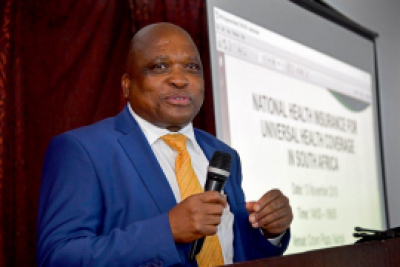
Minister of Health Joe Phaahla says the decision by the UK and several other countries to ban South African travellers is unjustified.
Phaahla was answering media questions on the latest developments around the new Covid-19 variant, B.1.1.529,named ‘Omicron’ by the World Health Organization (WHO) which first detected in South Africa.
While not much is known about the variant, scientists are concerned about the number of mutations and its ability to spread.
Phaahla said South Africa acted in the interest of transparency when it announced the detection of the new variant.
“We feel that banning South Africa is a wrong approach, it is misdirected, and it goes against the norms as advised by the World Health Organisation. We just feel that some of the leaderships of countries are finding scapegoats to deal with what is a worldwide problem.
“We are concerned about rising numbers from low levels to now approaching 3000, but in comparison to some countries that are reacting in this manner, it is countries that have much higher cases,” said Phaahla.
He said they believe current vaccines are effective against the new variant.
“We want to emphasise the fact that the announcement about this new variant, and the risks which the scientists were showing, was not showing any suggestion that severe illness as a result of infection by this new variant will not be prevented by vaccination.
“There is no such evidence, so we want to dispel any notion driven by various commentators. We can assure you that at no stage did the scientists say this particular virus will be resistant to the vaccines which are being utilised.”
On the possibilities of a harder lockdown, Phaahla said the department will submit a recommendation to the National Coronavirus Command Council (NCCC) on possible measures to prevent further spread.
The National Institute for Communicable Diseases (NICD), reports 2,828 new COVID-19 cases that have been identified in South Africa, which brings the total number of laboratory-confirmed cases to 2,955,328. This increase represents a 9.1% positivity rate.
The majority of new cases today are from Gauteng (77%), followed by Western Cape accounting for 5%. KwaZulu-Natal and North West each accounted for 4% respectively; Limpopo and Mpumalanga each accounted for 3% respectively; Free state accounted for 2%; and Eastern Cape and Northern Cape each accounted for 1% respectively of today’s new cases.
NICD said a further 12 COVID-19 related deaths have been reported, bringing total fatalities to 89,783 to date.
Meanwhile the World Health Organization (WHO) on Friday cautioned against imposing travel restrictions due to the B.1.1.529 Covid-19 variant, saying it would take weeks to understand the implications of the newly discovered strain.
As European nations began banning flights from South Africa, the UN health agency said countries should take a risk-based and scientific approach when considering travel curbs in light of the variant — but cautioned against restrictions.
“WHO is closely monitoring the recently reported variant B.1.1.529,”spokesman Christian Lindmeier told a media briefing in Geneva.
“Early analysis shows that this variant has a large number of mutations that require and will undergo further study.
“It will take a few weeks for us to understand what impact this variant has.
“Researchers are working to understand more about the mutations and what they potentially mean for how transmissible or virulent this variant is, and how they may impact on diagnostics, therapeutics and vaccines.”
Germany and Italy on Friday joined UK and other European countries in banning most travel from South Africa as governments scramble to prevent the spread of the new variant.