
By Lehlohonolo Lehana.
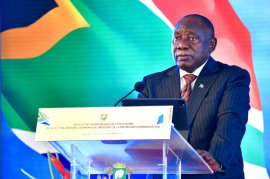
President Cyril Ramaphosa wants to meet with the National Coronavirus Command Council as soon as he lands back in South Africa from a tour of Africa in the coming week, to discuss the rising number of Covid cases in the country.
According to the City Press, the president will return from his four-nation tour of Africa on Wednesday.
The top priority of the meeting will be the Omicron virus which is behind the latest surge in Covid-19 cases in the country, and possible interventions that are needed to combat the spread while also securing livelihoods.
Health minister Joe Phaahla this week confirmed that health experts and government officials will meet in the coming week to discuss the rise in cases.
South Africa recorded over 32,000 new cases of Covid-19 in the last two days, an alarming surge that has pushed the total number of reported cases to over 3 million. Deaths, however, remain relatively low, with only 46 deaths over the same period. 89,965 people have succumbed to the virus so far. There are currently 75,000 active cases in the country.
The majority of new cases today are from Gauteng (71%). Western Cape and KwaZulu-Natal each accounted for 6%.
The proportion of positive new cases/total new tested is 23.8%, while the 7-day average is 16.8%, according to the National Institute for Communicable Diseases.
It pointed to an increase of 110 hospital admissions in the past 24 hours, taking the total to 3,255 cases.
Phaahla said that the government is following its risk-adjusted approach in dealing with restrictions and that it will follow the same key metrics as in previous waves when discussing interventions.
He said that the government needed an additional week to monitor the statistics of the country’s fourth Covid-19 wave and the impact of the Omicron variant. While he was hesitant to pre-empt the meeting, the minister said that the rapid increase in cases and the level of hospitalisations would decide what measures could be introduced.
He added that this was not solely a government decision and that South Africans have a part to play in following non-pharmaceutical interventions to reduce the spread and infections.
Health experts have flagged vaccinations as the best measure to combat the virus, with suggestions that the government opts for vaccine mandates over the reintroduction of harder lockdown conditions.
Worker union, Cosatu, has suggested that lockdown restrictions – should any be reintroduced – only apply to the unvaccinated population.
Phaahla said that indications are that the Omicron variant is highly transmissible, and is reinfecting those who have previously been infected as well as those who have been vaccinated. However, infections are causing mostly mild illness in the latter.
Most importantly, the health minister noted that hospital admissions are mainly dominated by the unvaccinated, with the most impacted people below the age of 40.
Meanwhile as fears of another global surge of Covid-19 cases send jitters through global markets, spur a new round of travel bans, and cause Americans to rethink their holiday plans, scientists studying the Omicron variant are getting the first hints of what’s in store for the months to come.
The new variant’s mutations suggest that it is likely to evade the protections of vaccines to at least some extent, but that it is unlikely to cause more severe illness than previous versions of the coronavirus.
These early hypotheses appear in line with real-world observations from places like South Africa, where infections have included the vaccinated and previously ill but appear so far largely mild.
That data, however, is thus far extremely limited, so much current evidence has come from computer modeling and comparing Omicron’s physical structure to past variants.
A lot remains a mystery about Omicron, which has more than twice the number of mutations as the delta variant, with the bulk found in the spike, the crown-like protein on the surface of the virus that vaccines train our bodies to attack.