
By Lehlohonolo Lehana.
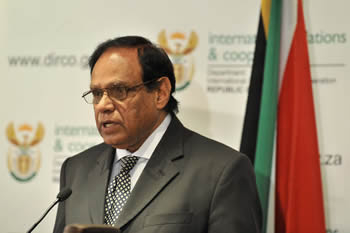
The former deputy minister of International Relations and Cooperation Ebrahim Ismail Ebrahim has passed away at the age of 84.
The African National Congress (ANC) confirmed that Ebrahim had died in a press statement released on Monday.
“The ANC learned with deep sadness of the passing of Ebrahim Ismail Ebrahim, after a long illness at his home in Johannesburg.”
He was a longstanding member of the ANC, a patriot who served his country in different capacities with humility, dedication and distinction,” the party said.
A largely unsung figure in the chronicles of apartheid, Ebrahim joined the struggle against white-minority rule in his early teens, becoming an ANC youth activist in 1952.
He later became a member of the ANC’s armed wing and was arrested in 1963 for sabotage.
He was tried alongside 18 others and sentenced to 15 years on Robben Island, where Nelson Mandela was also imprisoned for 27 years.
Ebrahim was released in 1979 but re-arrested in 1989, tortured, put on trial again and sentenced to 20 years in 1989.
He and two others were convicted for allegedly planting landmines on white-owned farms near Swaziland in 1986.
He was freed in 1991 and joined the government after South Africa’s first democratic election in 1994.
Starting as a lawmaker, he moved on to become a government advisor, helping to mediate conflict between Israel and the Palestinians, Rwanda and the Democratic Republic of Congo, as well as in Burundi, Kosovo, Bolivia, and Nepal.
In 2009, Ebrahim was appointed deputy foreign affairs minister, a position he held for six years.
Ebrahim is survived by his wife Shannon and their two children Sarah and Caden.
Tributes have been pouring in from all over:
The Ahmed Kathrada Foundation is saddened to hear of the passing of former Deputy Minister and struggle activist Ebrahim Ismail Ebrahim. His life, described by Ahmed Kathrada, was one of courage, characterised by the “spirit of sacrifice”.
Freelance writer and activist Suraya Dadoo said: “While Ebrahim Ebrahim’s contribution to South Africa’s liberation struggle is well-known, his true legacy lies in the way he has generously and patiently shared his vast experience and knowledge with younger activists like myself and with people still working for their liberation like the Palestinian and Saharawi people.”
In a statement, the ANC described Ebrahim as “a patriot who served his country in different capacities with humility, dedication and distinction.”