
By Lehlohonolo Lehana.
President Cyril Ramaphosa has called upon South Africa to release FW de Klerk so that he can rest in peace.
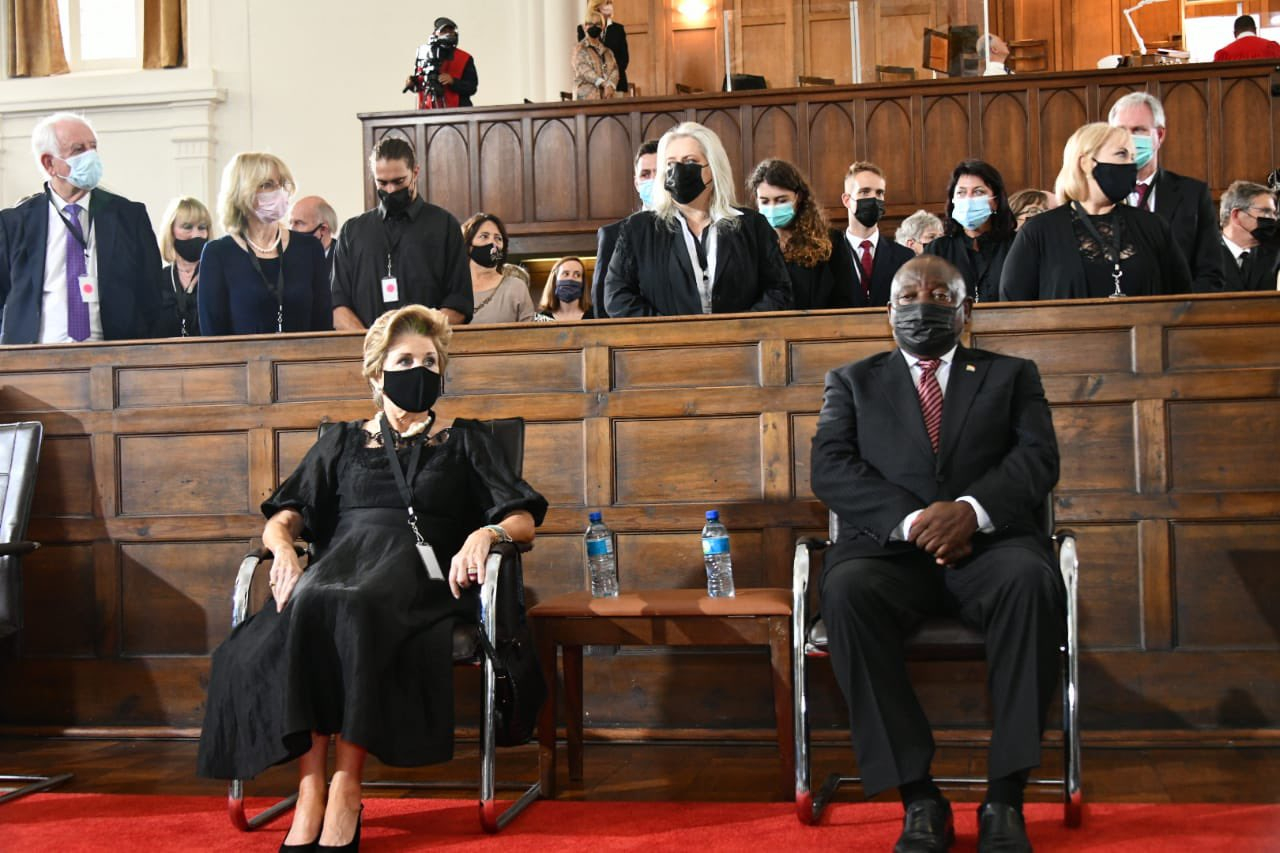
Ramaphosa delivered the eulogy at a state memorial service for De Klerk at the historic Groote Kerk in Cape Town.
“Many wondered why we would want a memorial at a state level for FW de Klerk. And we said we would have it because he is one person who played an important role in the evolution of our democracy. Whether we agreed with him or not, let’s now release him so that he can be at peace,” Ramaphosa told mourners.
De Klerk died at his home in Fresnaye, Cape Town, on 11 November after battling mesothelioma cancer.
He was laid to rest in a private ceremony at an undisclosed location.
Ramaphosa said in remembering De Klerk by according him a state memorial service as a former deputy president – who served under former president Nelson Mandela from 1994 to 1996 – government recognised that the former apartheid leader’s contribution and legacy remained contested and complex.
The fact that it was the struggles of ordinary South Africans that forced De Klerk’s administration to the negotiating table, did not render his contribution to South Africa’s democratic transition any less significant, Ramaphosa said.
Ramaphosa said FW de Klerk’s speech on 2 February 1990, in which he announced the unbanning of liberation movements and the release of Nelson Mandela and other political prisoners, was a brave act.
The president praised De Klerk saying he had gone against elements in his own state security apparatus and party, and against die-hards, who were prepared to take up arms to preserve the status quo in South Africa.
Ramaphosa said he came to know De Klerk over many years during negotiations for the country’s constitutional democracy in the 1990s.
He got to know De Klerk first at the Convention for a Democratic South Africa (CODESA) and the multi-party talks, and later in the Constitutional Assembly.
Recalling his encounters with De Klerk, Ramaphosa said they had moments of friendliness and disagreements, but he was always struck by how the former deputy president held strong to his convictions.
“He could be affable but he could also be stubborn,” Ramaphosa said.
Ramaphosa said South Africans could not ignore nor dismiss the anger, pain and disappointment of those who recall the place De Klerk occupied in the hierarchy of an oppressive state.