
By Lehlohonolo Lehana.
Franklin A. Thomas, who rose from working-class Brooklyn to become, as president of the Ford Foundation, the first Black person to run a major American philanthropic organization, died on Wednesday night at his home in Manhattan. He was 87.
Darren Walker, the foundation’s current president, confirmed the death.
Thomas was already a highly regarded nonprofit and corporate leader in 1979, when the Ford Foundation’s board of trustees chose him from among some 300 candidates to succeed McGeorge Bundy as the organization’s president.
Unlike Bundy, who had come from Massachusetts wealth and academia with a stop at the White House as national security adviser,Thomas grew up in near poverty. But driven by his hard-working immigrant mother, he won a scholarship to Columbia University and then worked for the city and federal governments before taking over a Brooklyn-based nonprofit development corporation in 1967.
He was, in other words, just the sort of fresh air that the rarefied Ford Foundation needed. Years of overspending and the economic slump of the mid-1970s had cut into its endowment — dropping it from $4.1 billion in 1973 to $1.7 billion in 1979 — and rapid inflation was eroding the value of its existing grants. Some blamed Bundy for fostering a complacent, quasi-academic environment in which too many jobs were sinecures and success was measured loosely, if at all.
Thomas led the Ford Foundation between 1979 and 1996, supporting anti-apartheid work and developing an association with Nelson Mandela. The Nelson Mandela Foundation later become a major beneficiary of the Ford Foundation, and more recently Thomas oversaw the US office of the Nelson Mandela Children’s Fund.
Thomas was brought in to stir things up, and he did, despite being warned that the Ford Foundation was almost impossible to change. After spending close to two years studying every aspect of the foundation, he spun into action in 1981.
That May, in what became known as the Mother’s Day Massacre, he ordered the termination of some two dozen of the foundation’s top people, including a seemingly untouchable cadre of program officers and vice presidents known as “Bundy’s barons.” Most went quietly, eased out by generous separation packages, but four filed age-discrimination cases with the Equal Employment Opportunity Commission.
He closed many of the foundation’s foreign offices and restructured its divisions to focus on six thematic areas, including urban poverty, education and public policy. Within three years, he had trimmed a staff of 442 employees to 324.
The cost-cutting depressed morale for a time, but it worked. By the mid-1980s, grants from the foundation were once again on the rise, as was the endowment. When Thomas stepped down in 1996, Ford’s endowment had risen to $7 billion. Today it stands at $16 billion.
“Frank Thomas saved the Ford Foundation,”Walker said. “We were spending ourselves into irrelevance.”
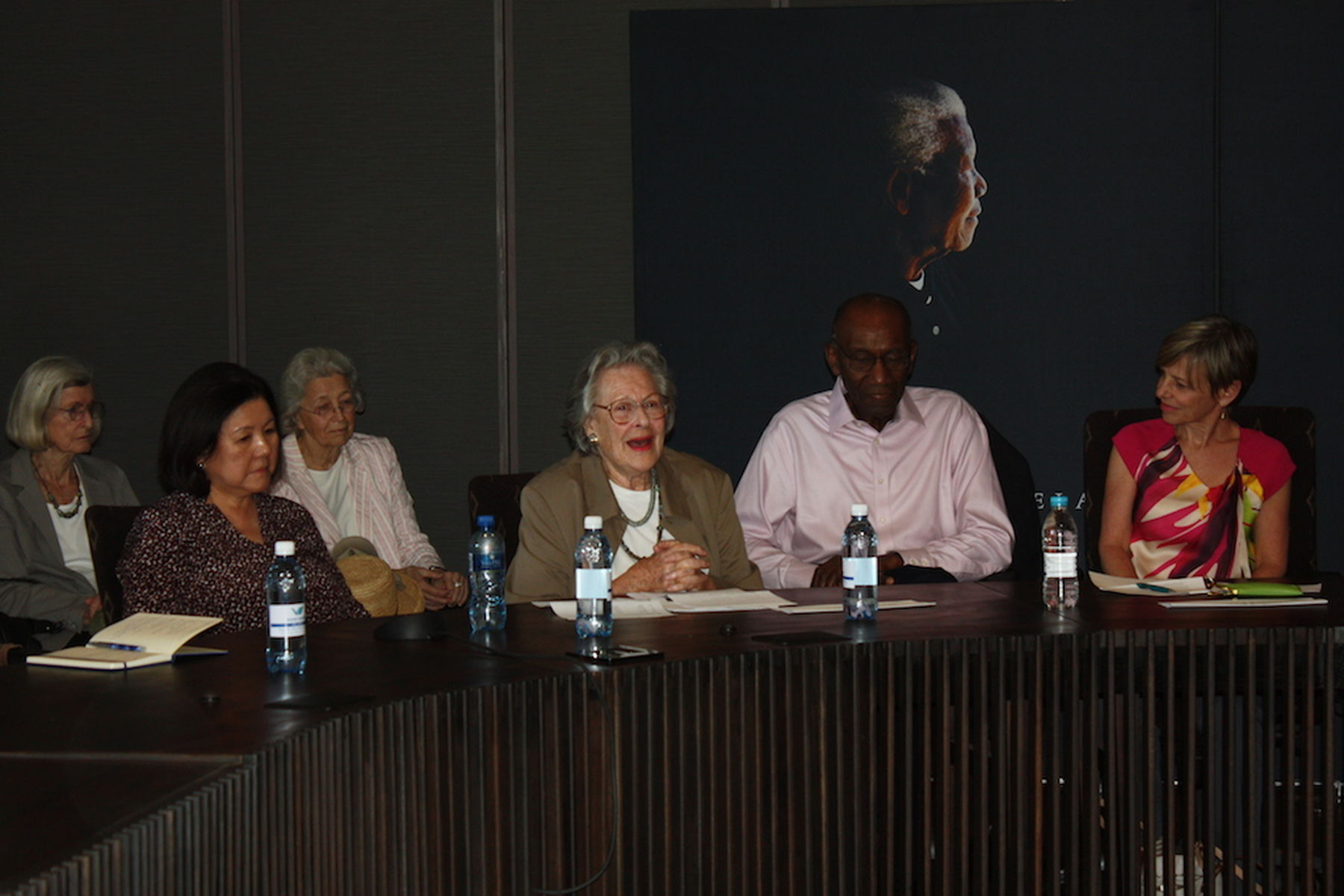
In 2014 Nelson Mandela Foundation were honoured to host Thomas at the Foundation’s newly unveiled Centre of Memory, and to give him a guided tour of Madiba’s private papers as well as the Centre’s exhibitions, reading-room, and dialogue spaces.
Thomas will be missed, especially by the many who have benefitted from his wisdom and commitment. We have lost a friend, said the foundation,