
By Lehlohonolo Lehana.
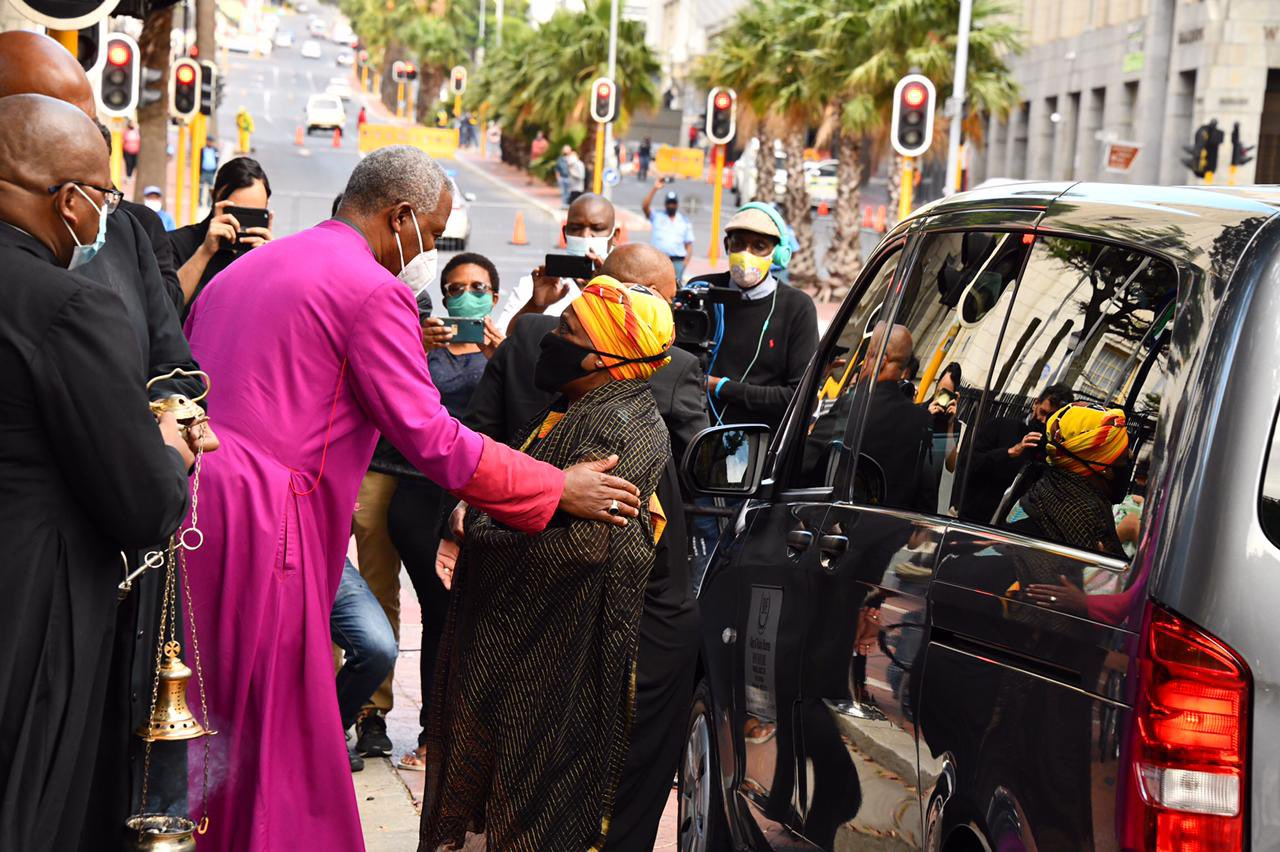
The body of South Africa’s anti-apartheid theologian, Archbishop Desmond Tutu, arrived at Cape Town’s St George’s Cathedral on Thursday morning, where it will lie in state for two days for mourners to pay their final respects.
Tutu, a Nobel Peace prize winner widely revered across racial and cultural divides in South Africa for his moral rectitude and principled fight against white-minority rule, died on Sunday aged 90.
The Tutu family had also arrived. A private service for the family will now be held.
Dressed in black but wearing a bright yellow headdress, Leah wept as she alighted from the vehicle to be greeted by Archbishop Thabo Makgoba.
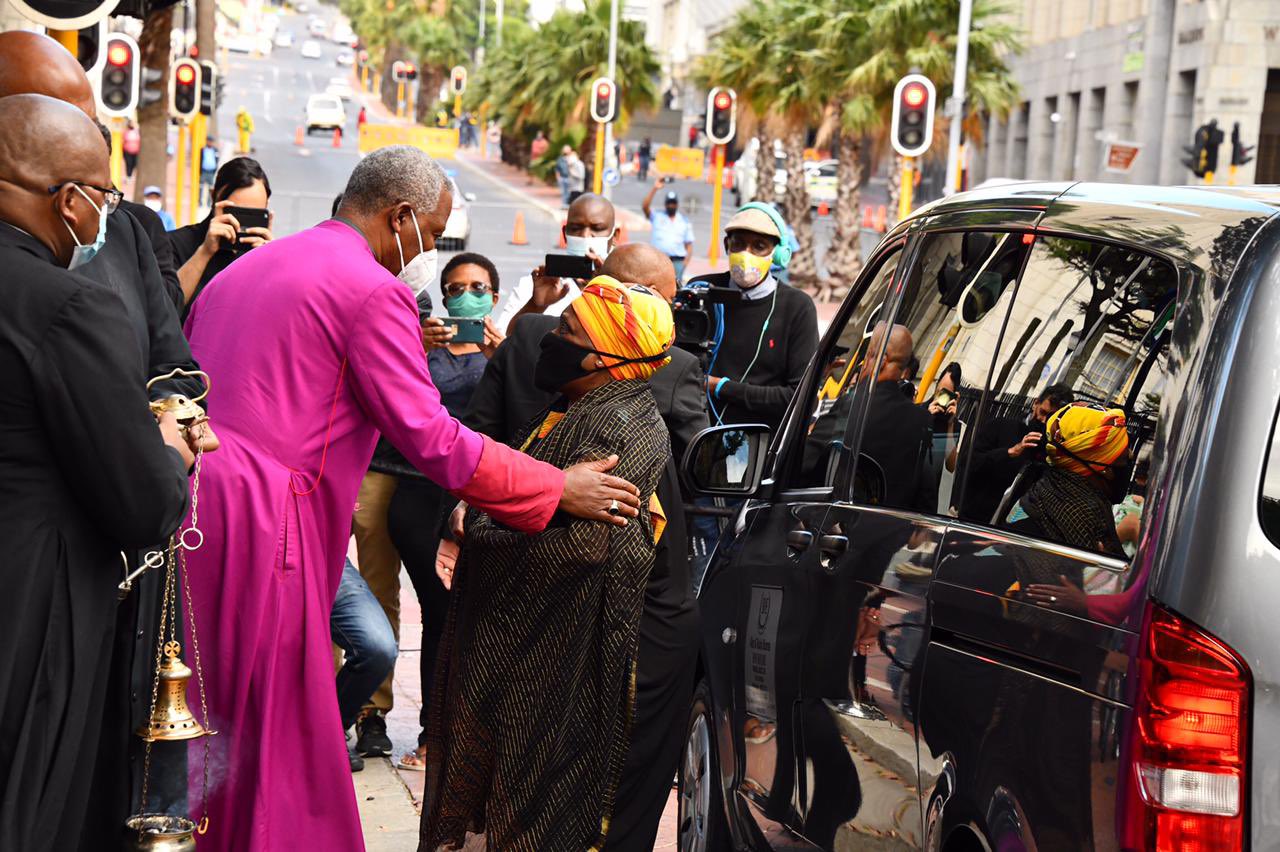
Tutu, who requested the cheapest coffin and did not want any lavish funeral expense, will be cremated and his remains interred behind the St George’s Cathedral pulpit he often used to preach against racial injustice.
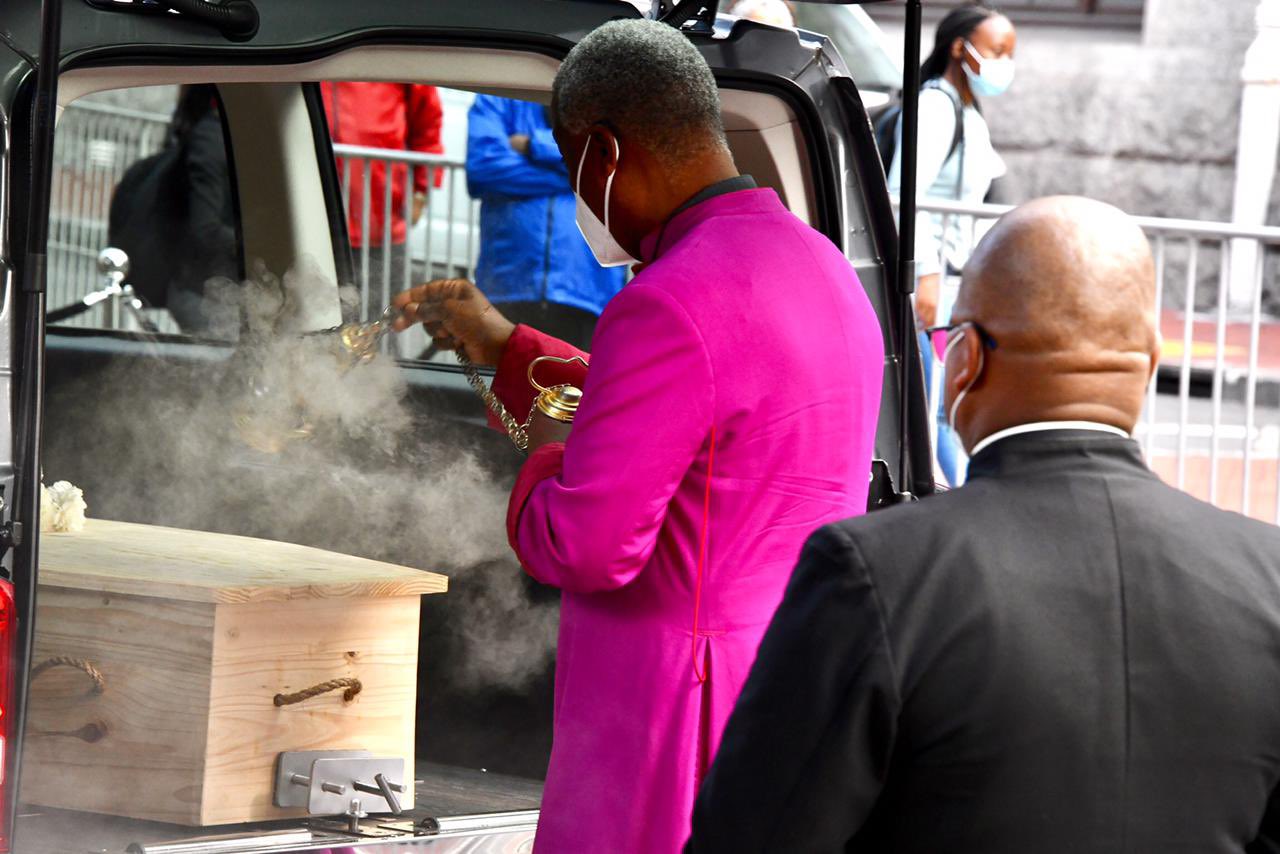
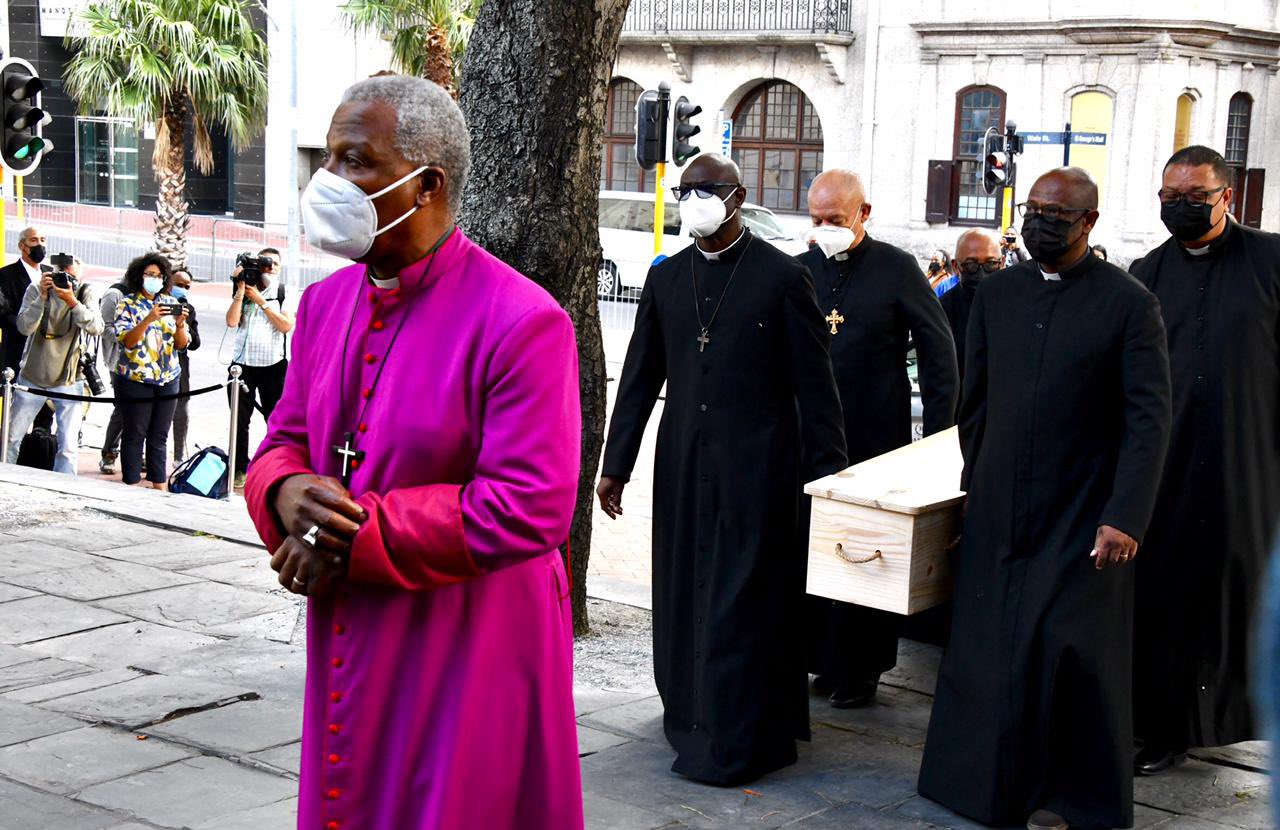
The public will have an opportunity to view Tutu’s body between 9am local time (0700 GMT) and 5pm (1500 GMT) on Thursday and Friday, ahead of a requiem mass funeral service on Saturday where President Cyril Ramaphosa was expected to deliver a eulogy.
Long queues formed outside St George’s Cathedral in Cape Town as members of the public arrived on Thursday to bid farewell to Archbishop Desmond Tutu.
Tutu’s casket will lie in state over the next two days for the public to view ahead of his funeral on Saturday.
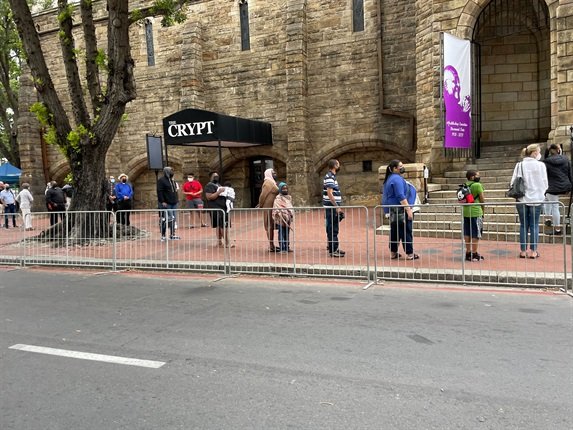
Memorial services were also planned for Tutu in Johannesburg and Pretoria on Thursday.
St’s Mary’s Cathedral Memorial Service.
Tutu won the Nobel Peace Prize in 1984 in recognition of his non-violent opposition to white minority rule. A decade later, he witnessed the end of that regime and chaired a Truth and Reconciliation Commission to unearth the atrocities committed under it.
Tributes continue to pour for the Archbishop Desmond Tutu.
University of the Western Cape mourns Archbishop Tutu
University of the Western Cape buildings lit in purple to honour Archbishop Emeritus Desmond Tutu
In honour of Archbishop Emeritus Desmond Tutu and his legacy at the University of the Western Cape, the Main Hall has been lit in purple every evening this week.
So too has the Life Sciences Building on campus.
Initially known as the University College of the Western Cape, the university was started in 1960 with just 166 students. The institution was an apartheid construct to provide limited training for “Coloureds” only.
They were destined for lower to mid-level positions at schools, the civil service and other institutions.
During his tenure as Chancellor of the University of the Western Cape (UWC), the Arch said: “I believe that education is the key to unlocking the door that will eradicate poverty and that young people have the power to make it happen.”
The little “bush college” heeded his call. It grew into a beacon of strength, and opened the doors of learning to the nation.
It fiercely challenged the illegitimate apartheid government and became known as the “Intellectual Home of the Left”.
The institution went on to shape our democratic South Africa.Today its state of the art Life Sciences Building – which is set to become a landmark in Cape Town as the roof now carries the university’s name – houses some of the continent’s top biological research, with world-class work ranging from genomics to zoology.
Like the Main Hall, the Life Sciences Building will turn purple – a tribute to the Arch who, like fellow university leaders including former Rector and Vice-Chancellor Professor Brian O’ Connell, was determined to expand the academic programme beyond the apartheid government’s restrictions.
In 2011, the Arch officiated his last graduation ceremony as Chancellor at UWC. At the time, approximately 3 000 students walked across the stage of the Main Hall to accept their hard-earned diplomas.
Many of these students were the first in their families to graduate with a university degree.
The Arch was inaugurated in 1987, and during his term, he had capped hundreds of students – several of whom took to social media this week to share treasured images and memories of the moment.
In most instances, he shared a joke followed by his trademark – and exceptionally infectious – cackle. Sometimes he would smile generously or comment on their research.
Craig Govender, the physiotherapist for the Arch’s beloved South Africa national cricket team, wrote: “Honoured to have been capped by a UWC legend and a Nobel Peace Prize recipient.”
Dr Munkombwe Muchindu wrote: “What an honour to be capped by The Arch, as our Chancellor, during my graduation in 2011. The encounter was brief but he made me laugh when he cracked a joke about how complicated my chemistry PhD thesis title sounded.”
Janis Jordan remembered her graduation on 4 April 2005: “Momentous for many reasons but in particular, being capped with the academic cap by the Chancellor, the late Archbishop Desmond Tutu. May his memory be for blessing!”
Jordan’s sister, Kelly Crowther, said it was a “privilege” to be capped by the Arch: “Thank you for being a vessel of peace and your struggles bringing about great changes.”
The Tutu IP Trust and Desmond and Leah Tutu Legacy Foundation are hosting a gathering of friends.
Video Courtesy of Tutu Trust.
Coalitions have brought us closer to Tutu’s ideal of a rainbow nation, says Joburg mayor
Newly elected City of Johannesburg Mayor Mpho Phalatse says the existence of coalition governments has brought the country closer to late Archbishop Emeritus Desmond Tutu’s ideal of a rainbow nation.