
By Kevin Rademeyer, Sports Journalist live from London.
Photo Credit: AELTC/Simon Bruty.
From The All England Lawn Tennis and Croquet Club: There are bigger sporting events on the calendar. There are louder stadiums, richer tournaments and venues with more technology. Yet after another week at the All England Club, Wimbledon continues to prove why it remains the most revered championship in tennis.
Fullview spent the opening week at SW19, where the sport’s greatest players, thousands of devoted supporters and generations of tradition combined to create something that no other tournament has quite managed to replicate. Wimbledon is not simply a Grand Slam. It is tennis at its most refined, where history is carefully protected while the game continues to evolve.
From the moment players drive through the famous gates, it becomes obvious that Wimbledon operates differently. Champions are not merely participants here; they are celebrated. The biggest names arrive through private entrances, are chauffeured around the grounds, practise on immaculate courts and address the world’s media in spacious interview theatres that resemble those reserved for heads of state.
Every detail reinforces their place in tennis history. Novak Djokovic, Serena Williams and Venus Williams are not just competitors. At Wimbledon they are treated like cultural icons, carrying decades of achievement onto courts where every championship has added another layer to the tournament’s mythology.
Away from Centre Court, however, another tradition continues to flourish.
The famous Wimbledon Queue has become more popular than ever. Long after organisers feared it might disappear following the pandemic, demand has reached unprecedented levels. Supporters now camp for as long as two nights in the hope of securing one of just 500 daily Centre Court tickets released through the Queue. Another 500 are allocated for Court One and Court Two, leaving thousands hoping fortune will smile on them after sleeping in tents on Wimbledon Park.
For many, the Queue has become as much a part of the tournament as the tennis itself. It is a reminder that despite Wimbledon hosting royalty, billionaires and sporting legends, ordinary supporters still have a pathway to the best seats in the house through patience rather than privilege.
The contrast between the show courts and the outside courts is equally remarkable.
Centre Court possesses an unmistakable aura. Every movement feels measured. Every applause carries respect. Players speak about walking through its doors almost as a pilgrimage. Yet only a short stroll away, the outer courts offer an entirely different experience. Spectators queue for hours to squeeze onto intimate stands where they are often no more than a few metres from some of the finest players in the world.
During the opening week alone, fans watched Amanda Anisimova, Naomi Osaka, Jessica Pegula, Belinda Bencic, Daniil Medvedev, Madison Keys, Frances Tiafoe, Jelena Ostapenko, Joao Fonseca and Venus Williams on courts that would feel almost secondary at any other Grand Slam. Wimbledon somehow turns every corner of the grounds into a headline attraction.
What also separates Wimbledon is what is absent.
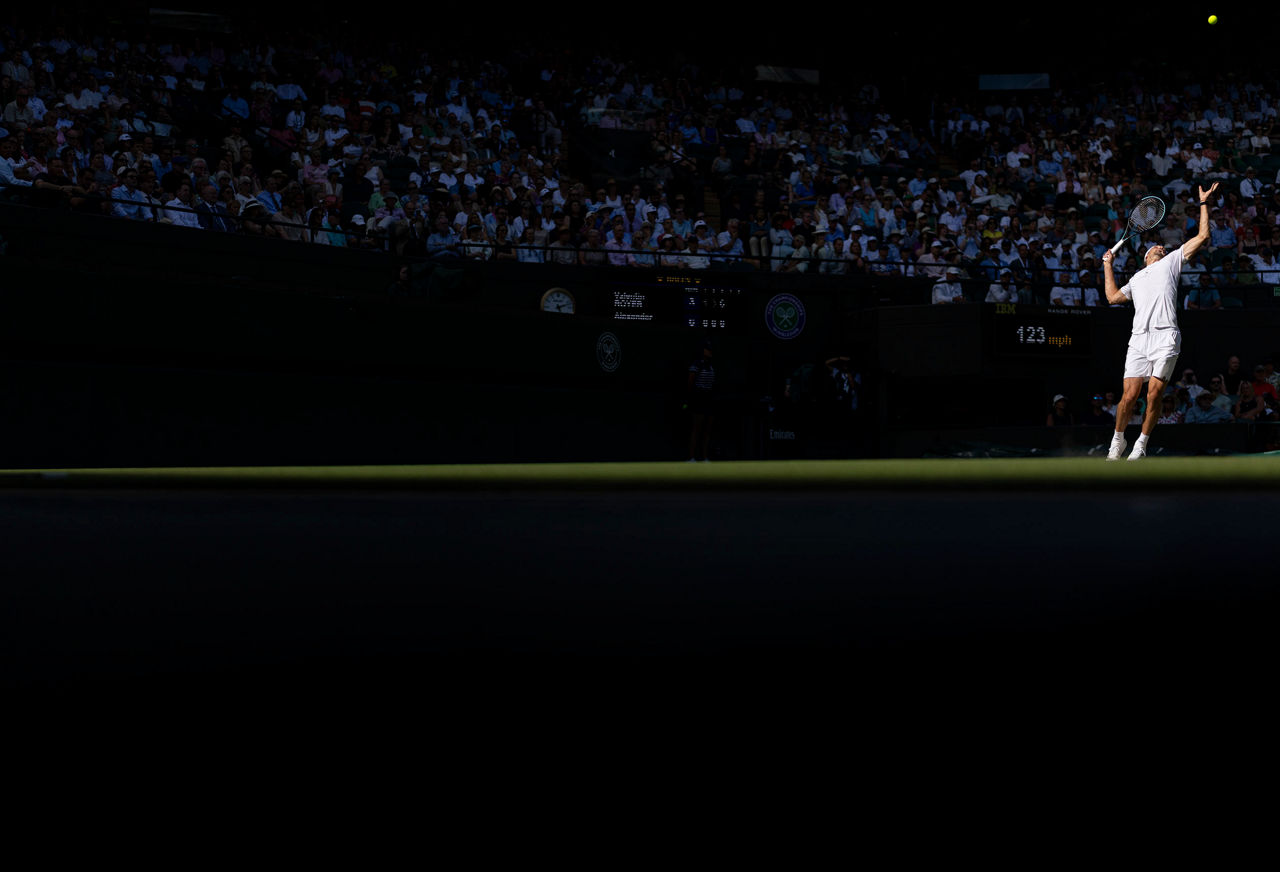
Modern sport is saturated with branding, flashing LED boards and commercial messaging. Wimbledon remains refreshingly restrained. The dark green walls, immaculate flowers and perfectly manicured grass provide an almost timeless backdrop. There are virtually no advertising distractions. Every glance remains fixed on the tennis itself, allowing the players and the competition to remain the centrepiece rather than the sponsors.
The atmosphere extends well beyond the courts. The Royal Box continues to gather an extraordinary collection of guests from across British society. Politicians, Olympic champions, Ryder Cup stars, actors and musicians quietly take their seats without becoming the spectacle themselves. This week, Rory McIlroy attended carrying his Masters Green Jacket, while Catherine, Princess of Wales, surprised spectators by choosing to watch Britain’s Katie Swan from ordinary seats on Court One alongside Andy Murray rather than immediately taking her place inside the Royal Box. Even royalty, it seemed, wanted to experience Wimbledon as tennis supporters first.
The tournament itself also changes as it unfolds.
Opening week belongs to aggressive tennis. The freshly cut grass rewards first strikes, flatter hitting and attacking serving. As thousands of footsteps gradually wear away the surface and moisture softens the courts, rallies lengthen and movement becomes increasingly demanding. It is one of the few major championships where the playing conditions evolve so noticeably over a fortnight, forcing contenders to adapt as much as endure.
Attendance figures reflected the enduring appeal of the Championships. More than 42,500 spectators entered the grounds on each of the opening four days, peaking at 43,320 on Thursday as the tournament settled into full rhythm. The appetite for Wimbledon has rarely appeared stronger.
Then there is the enduring power of greatness.
At 39, Novak Djokovic reminded Centre Court why longevity has become one of modern sport’s defining themes. His victory over Stefanos Tsitsipas was described as vintage Djokovic, yet the Serbian seemed almost amused by the description. “I like the terminology ‘vintage’,” he smiled afterwards. “It brings back the best days.”
He then reflected on fellow sporting icons Lionel Messi, LeBron James, Stephen Curry and Rory McIlroy, believing athletes continue to redefine what is possible late in their careers. Wimbledon remains the perfect stage for those conversations because greatness here always feels larger than the scoreboard.
Perhaps that is why Wimbledon still occupies a category of its own. It is where history walks beside the present. Where tradition never feels outdated. Where camping in a field remains as important as sitting in the Royal Box. And where, for two remarkable weeks every summer, tennis still feels like the most elegant sporting theatre on earth.