
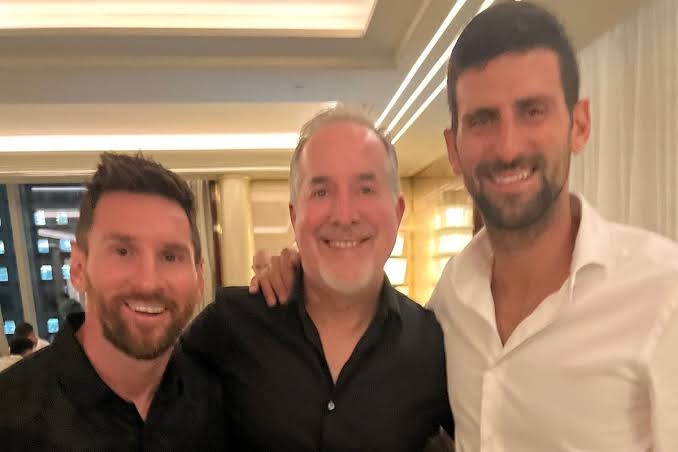
By Kevin Rademeyer, Sports Journalist in London.
Photo Credit: The Mirror.
Live from London- Sport occasionally delivers those rare days when time seems to pause. Tuesday was one of them.
At Wimbledon, Novak Djokovic was locked in the longest quarter-final of his career, stretching every fibre of a 39-year-old body over five punishing hours. Thousands of kilometres away, Lionel Messi was dragging Argentina back from the brink of one of the greatest World Cup upsets in history.
Two different sports. Two different continents. One identical story. Never underestimate greatness.
For a generation raised on instant success and endless highlights, Tuesday served as a reminder that true greatness has never been about talent alone. It is about surviving when everything begins to unravel.
Messi had already missed a penalty. Egypt led Argentina 2-0 with little more than ten minutes remaining. The defending world champions looked finished.
Djokovic was limping through another brutal Wimbledon examination after picking up an injury in the opening set. Every movement looked heavier. Every recovery took longer. Every point demanded another conversation with a body that has spent more than two decades chasing tennis balls across the globe.
Neither man blinked.
Messi inspired one of the greatest World Cup comebacks ever witnessed. First came the assist that reignited Argentina’s belief. Then came the equaliser deep into stoppage time, his 21st World Cup goal extending yet another record before Argentina completed an extraordinary comeback.
On Centre Court, Djokovic somehow found another gear. Again.
After more than five hours of tennis, he emerged victorious in a match that demanded every ounce of his experience, resilience and competitive obsession.
It felt strangely familiar. Because this is what both men have spent nearly twenty years doing. When the game becomes impossible, they somehow simplify it. When panic surrounds them, they slow everything down. When others begin to doubt, they become even more certain.
There is a reason Messi owns eight Ballons d’Or, six European Golden Shoes and has become football’s most decorated player with 46 team trophies. More than 910 career goals and over 1,320 goal contributions tell only part of the story. There is also a reason Djokovic has spent a record 428 weeks as world number one, won 24 Grand Slam titles and completed achievements in tennis no other player has managed.
Statistics explain success. They do not explain greatness. The similarities between the two are almost eerie. Neither dominates through brute force anymore.
Messi no longer sprints relentlessly across ninety minutes. Instead, he walks. He watches. He studies. Every movement is calculated, every burst perfectly timed.
Djokovic has reached the same stage of sporting evolution. He no longer wastes energy chasing impossible balls early in matches. Recovery between points has become as important as the rallies themselves. “The amount of time I spend recovering nowadays is more than I ever have,” Djokovic admitted earlier this week. “It’s part of the process.”
That process includes cryotherapy, hyperbaric chambers, red-light therapy and every recovery technique modern sport can provide.
Messi’s process is different but equally meticulous.
Both have mastered what might be called active rest. They conserve energy because they understand precisely when greatness will be required.
Then there is their vision. Messi sees football two passes ahead. Tiny passing lanes invisible to everyone else suddenly become goals.
Djokovic treats a tennis court like an architect reading blueprints. Angles disappear. Space evaporates. Opponents slowly realise they are playing exactly where he wants them to play.
Neither overwhelms opponents with power. Both dismantle them with precision. Perhaps the greatest quality they share is something impossible to measure.
Pressure. Most athletes carry expectation. Messi and Djokovic carry nations.
Argentina expects Messi to rescue impossible situations because, more often than not, he does. Serbia has watched Djokovic shoulder the hopes of an entire sporting nation for almost two decades.
Neither appears burdened by that responsibility. They embrace it.
Even their evolution mirrors one another. As age robbed Messi of explosive pace, he reinvented himself as football’s greatest playmaker. As Djokovic’s body inevitably slowed, he sharpened every other part of his game. Better serving. Smarter point construction. Shorter exchanges. More efficient movement.
Great champions do not resist time. They negotiate with it.
There was a lovely moment after Djokovic’s epic victory when he was asked about Messi. “Fantastic, unbelievable, like Messi. Thirty-nine years…” came the question. Djokovic smiled. “It would be nice to play 90 minutes like him.” The media laughed.
The comparison felt entirely appropriate.
Later, reflecting on yet another marathon victory, Djokovic quietly summed up what continues to drive him. “At this stage that I’m still able to battle these young guys that have 15 years less than me… I don’t know what tomorrow brings. But this was as good as a final for me. I gave it everything I had.”
Messi has always understood the same truth. “Sometimes you have to accept you can’t win all the time.”
Perhaps that is the final lesson. Neither man built his legacy by avoiding failure. They built it by refusing to let failure become the ending.
On Tuesday, one inspired a nation with a football. The other inspired Centre Court with a tennis racket. Different games. The same greatness. And for those fortunate enough to watch both unfold at the same time, it was a sporting privilege that may never come again.