
By Kevin Rademeyer, Sports Journalist.
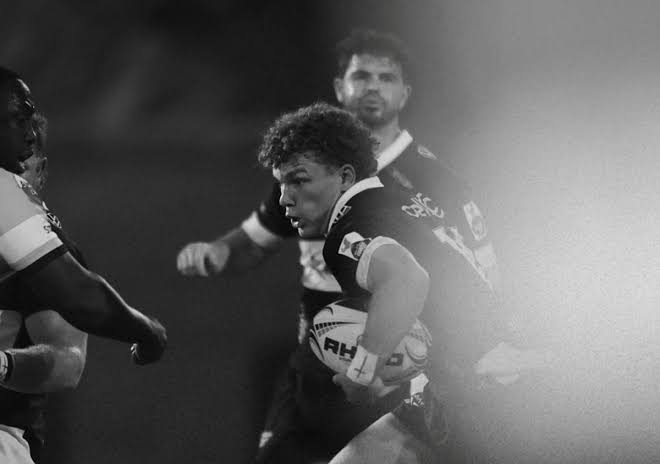
Image via Instagram @sharksrugby.
There was a point early in the second half when the All Blacks stopped playing the Sharks and started playing the game they wanted. That was the moment the contest disappeared.
New Zealand’s 54 0 victory at Kings Park was eventually every bit as emphatic as the score suggests, but the first 40 minutes were far more revealing than the final score. The Sharks had possession, territory and three visits into the All Blacks’ 22 during the opening quarter.
They even had Zekhethelo Siyaya held up over the line. Yet they could not turn pressure into points, while New Zealand needed only two genuine opportunities to establish a 14 0 half time lead. That was the difference between the sides.
The All Blacks did not panic in the wet. They did not attempt to force the game. They absorbed the Sharks’ enthusiasm, trusted their defence and waited for the errors. Once the field position turned, their execution was ruthless.
Jordie Barrett was central to it. His tactical kicking continually challenged the Sharks and created attacking opportunities, while the All Blacks showed a willingness to play the ball when the conditions suggested that safety might have been the better option. Ruben Love was excellent off the tee, landing seven of eight kicks in miserable conditions.
Then came the second half.
Four tries between the 45th and 64th minutes transformed a respectable 14 0 contest into a rout. Caleb Clarke, Fineanganofo, Barrett and Kyle Preston all crossed as the All Blacks began finding space that simply was not there before the interval. By the end they had made 15 line breaks to the Sharks’ one and produced 371 post contact metres.
That is not simply a matter of fitness. It is what happens when one team has spent weeks preparing for international rugby while the other is still assembling itself for the season.
And that is where this tour leaves an uncomfortable question for South African rugby.
The Sharks were always going to struggle. They were in pre season, missing their Springboks and throwing several young players into a game against a team operating at Test intensity. JP Pietersen had warned beforehand that his side was perhaps only at 70 or 80 per cent. The result suggested he was being generous.
The All Blacks were too experienced, too organised and too physically prepared. The Sharks made 105 tackles and missed 21. New Zealand had 60 per cent possession and, once they established control, the home side had very few answers.
The match was therefore useful for New Zealand, but was it the best use of the All Blacks being in South Africa? Perhaps not.
This tour could have been something much broader. The Cheetahs in Bloemfontein, the Pumas in Mbombela, Boland in the Cape and the Griquas in Kimberley could have provided different challenges while taking the All Blacks into rugby communities that do not regularly get to see them.
Those teams would still have been underdogs. But they would have been playing competitive rugby rather than emerging from pre season without their leading Springboks. New Zealand would have been forced to adapt to different styles, different conditions and different crowds.
And South African supporters would have had the chance to see the All Blacks. That matters.
The sight of Ma’a Nonu walking onto the Kings Park field at 44, after responding to the All Blacks’ haka with a solo Kapa o Pango, was one of the genuine moments of theatre. It reminded everyone what international rugby can mean. Yet it came in a match that had become a procession.
The Bulls now provide the next test in Pretoria. Then comes Ellis Park and the reason this tour exists in the first place: the Springboks.
The All Blacks have shown that they can absorb pressure, adapt to difficult conditions and destroy a team once they find their rhythm. The Sharks gave them that rhythm. The Springboks will not.
Scorers
New Zealand – Tries: Fehi Fineanganofo (2), Damian McKenzie, Caleb Clarke, Jordie Barrett, Kyle Preston, Timoci Tavatavanawai, Sam Darry. Conversions: Ruben Love (6).