
By Lehlohonolo Lehana.
The African National Congress (ANC) continued its 2021 Local Government Elections Manifesto (LGE) Review, focusing on Housing, Water and Energy.
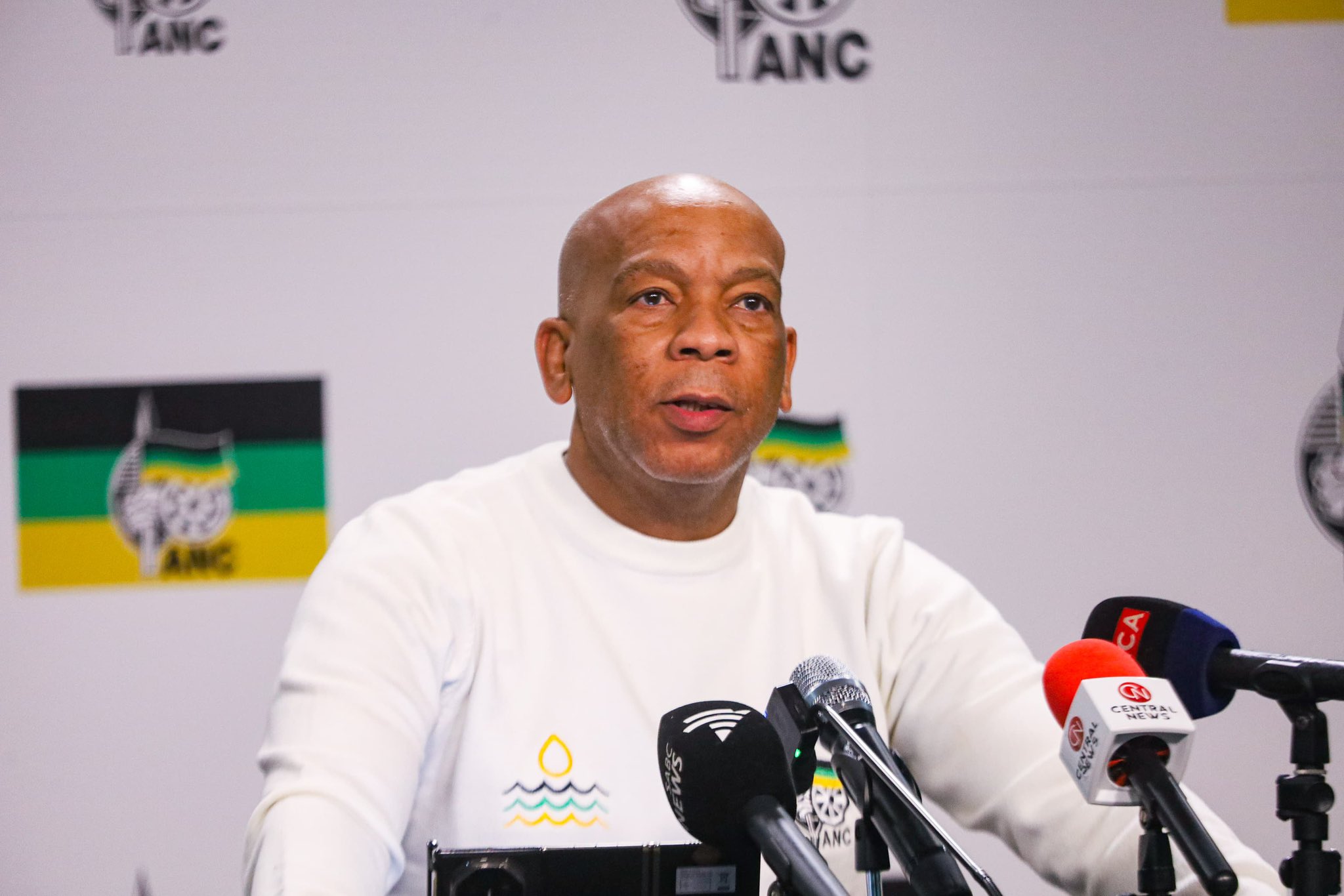
The party’s NEC members Thembi Simelane, David Mahlobo and Kgosientsho Ramokgopa briefed the members of the media at Luthuli House in Johannesburg on Sunday, 16 August 2026.
The briefing outlined the gains made in expanding access to basic services, while confronting the challenges of reliability, infrastructure renewal and building
Human Settlements
Human Settlements Minister Simelane says nearly five million housing units have been built since 1994, providing homes for more than 20 million South Africans as part of efforts to reverse apartheid spatial inequality.
Simelane outlined progress in transforming human settlements and advancing spatial justice.
She said the government had also delivered about 231,000 serviced sites, while more than 300,000 sites had been made available during the period under review.
She said that serviced sites were intended to help people who did not qualify for traditional RDP housing but still needed assistance to access land.
“We give you land where we have built internal roads for you, we have put lights for you, we have put electricity for you, and we have put water connectivity,” Simelane said.
She said government had also disbursed 5,916 subsidies for first-home financing, including in rural municipalities, while more than 24,000 mortgage-related interventions had been recorded during the period under review.
Simelane said the 2021 manifesto had been adopted as South Africa was emerging from the Covid-19 pandemic, with municipalities facing financial pressures, infrastructure backlogs and declining public confidence in local government.
“An honest assessment, therefore, as we’re about to close the term of 2021 local government elections, ending in this November 2026, calls on us to give an honest assessment,” Simelane said.
Government has received about 14,000 hectares from the Department of Public Works, with a further 2,698 hectares released through the Housing Development Agency, she said.
For the 2026/27 financial year, the Human Settlements Development Grant business plan provides for R13.2 billion, with targets including 12,265 serviced sites, 38,019 housing units, 11,195 solar installations and 18,337 title deeds.
She said the ANC wanted to improve its rent-to-buy policy for social housing, particularly for people who had lived in rented units for many years and now regarded them as their homes.
Water and Sanitation
Mahlobo said access to water had increased to 91.3% in 2026, while access to sanitation stood at 85.6%.
He said, however, that these figures had to be considered against the experience of communities that continue to face unreliable water supply.
“But when we give you these figures, there is a qualification. The qualification is around the issues of reliability. The number of days per week, per year in which water will be available in the tap,” Mahlobo said.
He said ageing and deteriorating infrastructure remained a problem and that some households and businesses continued to experience water insecurity.
“Therefore, the task of government is not only to expand access, but to ensure that water and sanitation services in the main are reliable, sustainable, and are capable to meet the demands of our growing population and the demand for our economy.”
Mahlobo said the water crisis had become one of the government’s “apex priorities” because of its effect on livelihoods and the economy.
He said president Cyril Ramaphosa’s National Water Action Plan provided a roadmap for immediate, short, medium and long-term interventions, but the test would be whether government could execute it.
“The only issues we need to be tested on…is on issues of execution,” Mahlobo said.
He said that municipalities struggling to provide water and sanitation would not be left to deal with the problems on their own.
He said the ANC’s Local Government Intervention committee would support municipalities where capacity was inadequate and intervene where municipalities continued to fail.
“Therefore, we say it requires a coordinated action across all spheres of government,” he said.
He said the government had set aside R156 billion over the next three years in grants and subsidies to support water and sanitation at local government level.
Energy
Ramokgopa addressed concerns around privatisation, clarifying that the proposed independent Transmission System Operator will remain state-owned, while outlining the process of transferring transmission assets and continued engagement with organised labour.
He said, government is working towards ending load reduction by March 2027, building on the progress already achieved in seven of the nine provinces.
The programme includes expanding Free Basic Electricity, registering indigent households, installing smart meters, upgrading transformers and feeders, reinforcing networks and tackling illegal connections, vandalism and infrastructure crime.
Through the Energy Action Plan, improved Eskom performance and accelerated new generation, South Africa achieved more than 450 consecutive days without load shedding, with continuous supply since mid-May 2025.
Ramokgopa said the ANC remained committed to a just energy transition, saying that the transition had to improve energy security, reduce emissions, improve air quality and create new industrial opportunities.
He said government was working on expanding the electricity grid by 4,000 kilometres and intended to use the energy transition to build skills, strengthen research and development and expand South Africa’s manufacturing and engineering capabilities.
The minister said the cost of electricity remained another major problem.
“We accept that the cost of electricity is an elephant in the room,” Ramokgopa said.
He said electricity tariffs had increased by more than 907% since 2007, while inflation had increased by about 150% over the same period.
“The electricity is available but not accessible,” he said, saying that households, including middle-class households, were struggling to afford electricity.
Ramokgopa said the government wanted to increase the free basic electricity allocation from the current 50 kilowatt hours and introduce greater transparency in electricity tariffs.