
By Lehlohonolo Lehana.
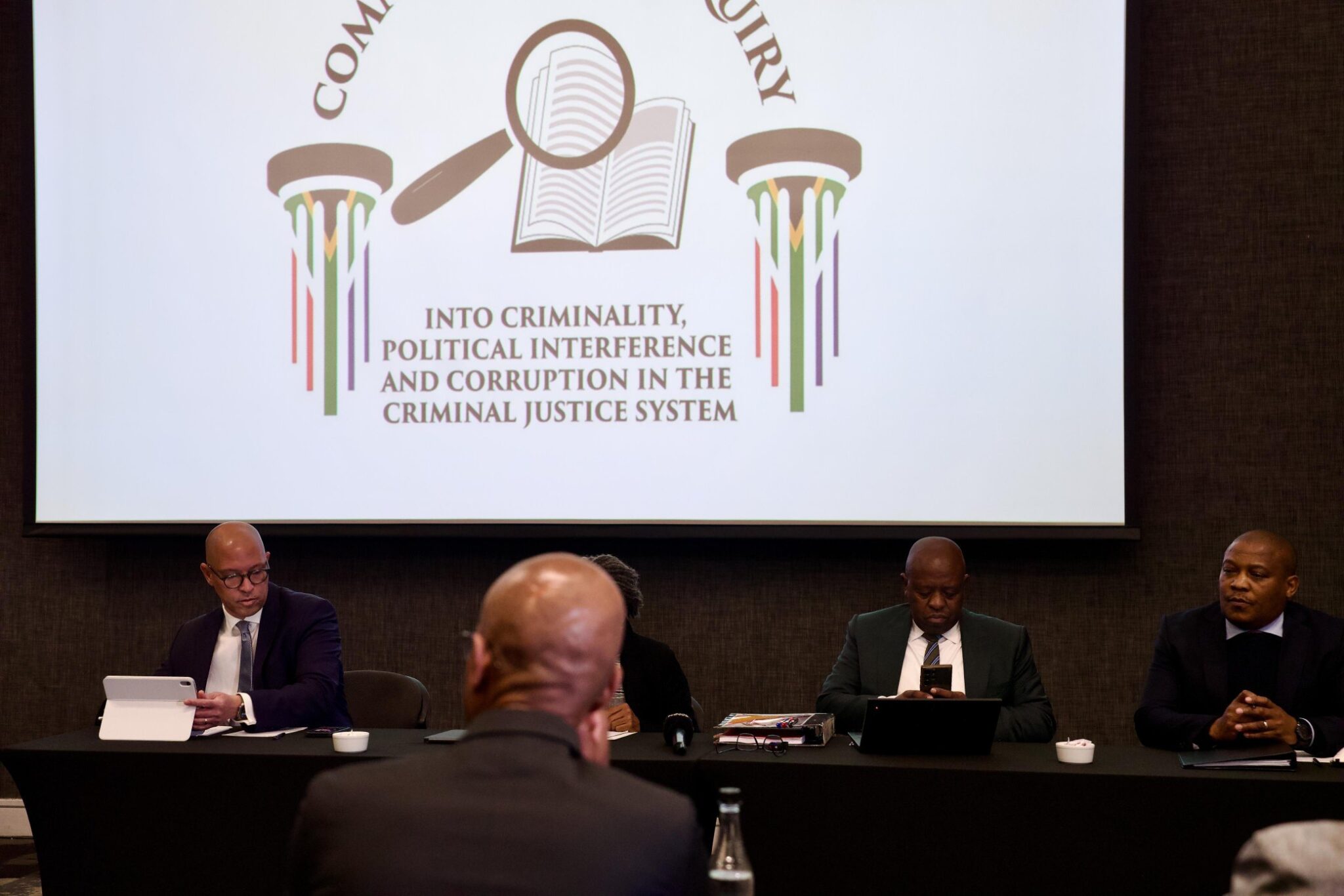
The Madlanga Commission of Inquiry continued to hear the testimony from National Coloured Congress (NCC) Member of Parliament Fadiel Adams on Wednesday, 19 August 2026.
In 2024, Adams, armed with what he said were confidential reports, opened six criminal cases between Cape Town and Soweto against Crime Intelligence head Dumisani Khumalo and his colleagues, accusing them of misconduct.
Earlier, Adams first appeared briefly at the Commission where his testimony could not proceed due to late submission. He argued that he received correspondence late.
Commission Chairperson Judge Mbuyiseli Madlanga presented Adams with a Rule 3 notice sent to him on 3 October 2025. The notice asked Adams to respond to allegations made against him by KwaZulu-Natal police commissioner Nhlanhla Mkhwanazi.
Madlanga questioned Adams about his claim that he had only seen the commission’s Rule 3 notice three months ago.
“If you responded to the commission’s Rule 3 notice only 11 days after it was sent to you, your response being on 14 October, you were not truthful when you said you had not received notice or you only saw the email communication three months ago said Madlanga.
“So for this, I apologise to you and everybody profusely. I will not run from this,” he said.
Adams said confidential Crime Intelligence documents had been secretly slipped under the door of his parliamentary office, exposing alleged high-level corruption, misuse of secret funds and manipulation of police vetting processes in Crime Intelligence.
The report is believed to have been based on top-secret documents that were allegedly delivered anonymously to his parliamentary office.
Questions have since emerged about how Adams came into possession of those documents.
IDAC investigator Mantsha Raphesu, who testified before the commission, said he had also questioned whether the documents could, in fact, have been slipped under the door of Adams’ office.
Adams denied claims that he unlawfully obtained classified police information or that he acts as a hired operative for criminal syndicates.
He said his political party regularly receives information from whistleblowers concerning the South African Police Service (SAPS) and other state institutions.
One of the central issues in Adams’ evidence on Wednesday, 19 August 2026, was what transpired on 6 January 2025, when IDAC officials interviewed him in Cape Town and took supplementary affidavits.
His initial complaint named three people, investigation later expanded to include a substantially wider group of officials and matters, with seven IDAC members, including Khumalo, eventually charged for the wrongful hiring of Brigadier Dineo Mokwele in a scheme IDAC described as an attempt to capture Crime Intelligence.
Those charges have since been provisionally withdrawn, and the commission is trying to get to the bottom of how the investigation expanded beyond Adams’ original complaint.
Four supplementary statements were taken in the presence of IDAC prosecutor advocate Drushantha Ramsamy, according to evidence before the commission. But the statement marked “A1”, later filed in court and before the Commission by IDAC chief investigator Dylan Perumal, was not among those four statements.
The discrepancy raises questions over whether affidavits commissioned in Cape Town were subsequently replaced, amended or supplemented without the knowledge of those involved in the original process.
Adams also responded to allegations previously made by KZN Police Commissioner Mkhwanazi.
He said he was surprised that Mkhwanazi appeared to be more concerned about him than about allegations that police case dockets had been intercepted by Pieter Jacobs.
Adams rejected claims that he acts as a conduit for criminal cartels.
“Lieutenant General Mkhwanazi made allegations that I am a conduit for criminal cartels seeking to weaken the South African Police Service. This allegation is denied and it is false. It has been made without substantiation, in my view, in the same manner that several other statements made my Lieutenant General Mkhwanazi which have not been properly tested,” said Adams.
Adams also told the commission that police opened a case of fraud and obstruction of justice against him, accusing him of drafting Sibusiso Ncengwa’s affidavit.
Ncengwa’s explosive 13-page affidavit details the 2017 assassination of former ANC Youth League secretary-general Sindiso Magaqa. He confessed to the murder, claiming high-level political orchestration over a corrupt multi-million rand tender that Magaqa threatened to expose.
He rejected the allegations, saying Ncengwa can only speak and write isiZulu, while he does not have a command of the language.
Magaqa was ambushed and shot alongside two colleagues while they were travelling in a vehicle on 13 July 2017.
He later died in a Durban hospital while pursuing allegations of corruption within local government.
Adams further told the commission that he sees it as his responsibility to separate allegations that can be immediately verified from those that require investigation by the appropriate authorities. He will continue with his testimony on Thursday, 20 August 2026.